Hello, everyone.
This is Enta.
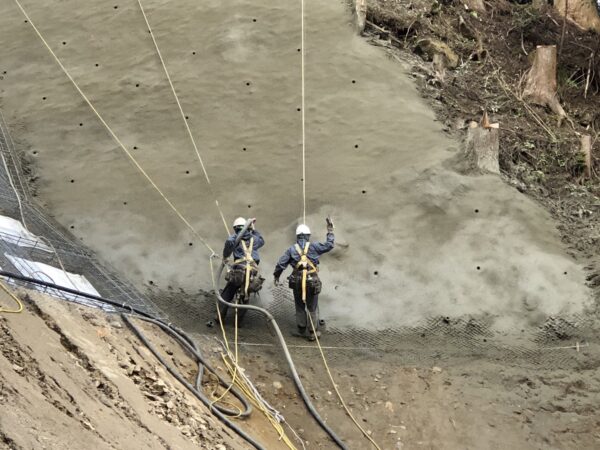
Do you do spray painting? lol
In this post, we’ll discuss sprayed concrete and sprayed mortar.
Concrete or Mortar for Slope Construction? (Part 1)
Concrete or Mortar for Slope Construction? (Part 2)
Concrete Spraying and Mortar Spraying Workers
I’m sure you already know the difference between mortar and concrete, but let’s go over it again.
Sprayed mortar is primarily used for temporary structures, whereas sprayed concrete is used for permanent structures.
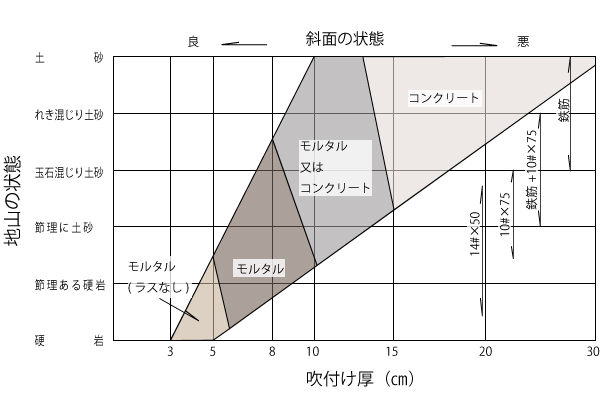
That said, that was a long time ago; I think their positions aren't all that different now.
Looking at this table, it seems like concrete is the choice when the natural ground conditions are poor, right?
As I mentioned in my previous post, concrete is considered to have higher strength.
However, I believe that, in practice, there is virtually no difference.
After all, while concrete is strong under compression, when it’s on a slope, the forces aren’t acting in the direction of compression, are they?
When it collapses, the pressure comes from the inside.
If anything, it gives the impression of being pried open from the inside.
That's why I personally believe there isn't much of a difference in strength between mortar and concrete.
What do you all think about this?
No, no—but concrete is still strong, right!?
I’m sure some of you are thinking that, but how much coarse aggregate do you think is actually used in sprayed concrete?
Amount of Coarse Aggregate
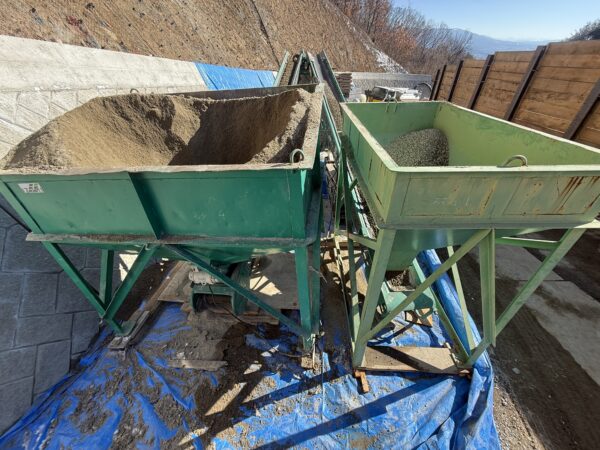
| Mixing Ratios | 1:4Cement: Fine Aggregate | 1:4:1Cement : Fine Aggregate : Coarse Aggregate |
These are the mix ratios for spray application.
The one on the left is mortar; the one on the right is concrete.
For a standard mix (per 1 m³)
Cement: 360 kg
Sand: 1,440 kg
Crushed stone: 360 kg
This is the standard formula.
If you use the full amount of crushed stone when spraying it on, about 70% of the 360 kg of crushed stone will bounce off the bedrock and fly away lol.
To be honest, when you hear this, you’re probably like, “Whaaaaaaaaaaat?”
You might be thinking, “After decades of doing shotcrete, you’re telling me that now?!!?” but it’s the truth.
There's hardly any...
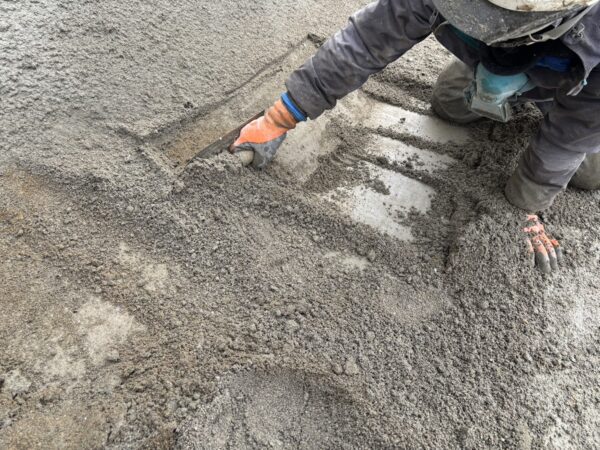
Since it’s being sprayed with air, any hard objects will hit the ground and fly away.
Most of it is blown away and accumulates at the bottom of the slope, where it is discarded as trash.
To be honest, as someone who’s actually doing this, it’s just too much...
Adding crushed stone just to end up as trash... If that's the case, why not just use mortar from the start!
(You could say "spray it on," but it's not a spray product anymore...)
I’d like to bring this up with the design consultants, but,
While comparing costs is important, workability is even more important.
Improved workability helps shorten the construction schedule. Overall, this leads to cost savings!
In particular, the unit price is the same for 10 cm of sprayed mortar and 10 cm of sprayed concrete.
Dealing with crushed stone is really hard work!
I'd really like you to use sprayed mortar as much as possible, lol.
(It's a hassle to change it, too...)
In my next post, I’d like to write about what happens next with the sprayed mortar and concrete.
See you later.