Hello, everyone.
This is Enta.
Concrete or Mortar for Slope Construction? (Part 1)
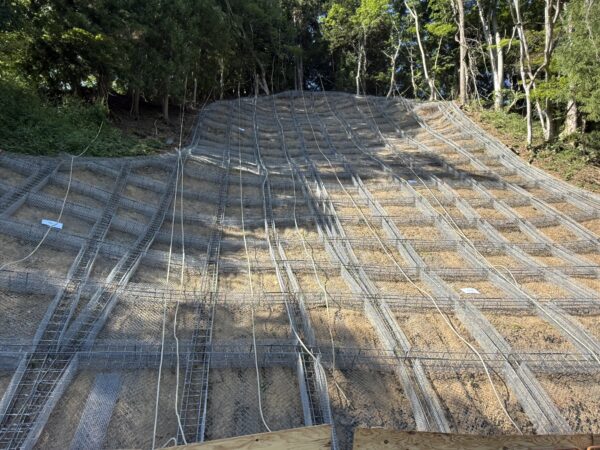
In this article, we’ll explore why concrete isn’t used in formwork construction.
So, let's move on.
Here's a review of the formula.
| Item | Mortar | Concrete |
|---|---|---|
| Main Ingredients | Cement + Fine Aggregate + Water | Cement + Fine Aggregate +Coarse aggregate+ Water |
| Coarse aggregate (gravel) | ❌ None | ⭕ Yes |
| Mixing Ratios | 1:4Cement: Fine Aggregate | 1:4:1Cement : Fine Aggregate : Coarse Aggregate |
| Water-to-cement ratio | 45%–55% | 45%–55% |
| Strength | Lower than concrete | More expensive than mortar |
Concrete contains coarse aggregate.
What happens when you spray concrete into a formwork frame!?
When shotcrete is applied
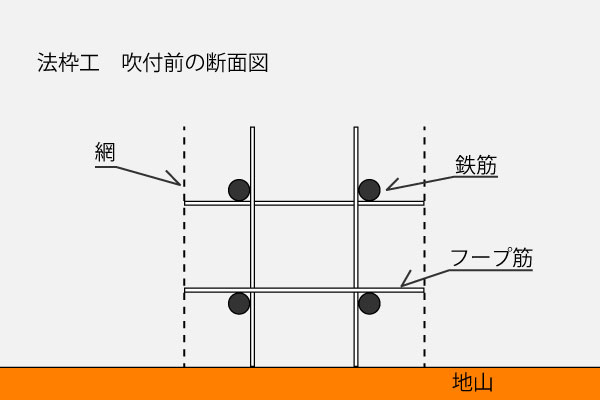
This is a cross-sectional view of the general legal framework prior to application.
Let's say we're going to spray concrete here.
So what happens then?
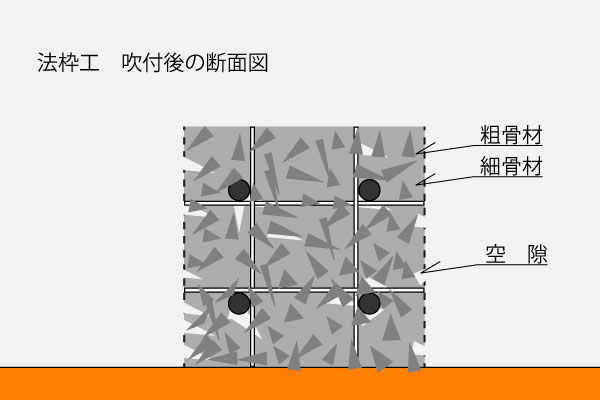
Please think of the small triangles that appear to be filled with coarse aggregate as fine aggregate.
Furthermore, the inclusion of coarse aggregate creates voids.
With spray application, the material is blown onto the surface while being forcefully pounded by air pressure, but voids inevitably form.
This is exactly the same phenomenon that occurs when you pour concrete into a formwork—voids will form.
Basically, it’s a phenomenon where air gets trapped because it’s being drawn in along with the liquid.
When pouring concrete using standard formwork, a vibrator is used.
However, in the case of a legal framework, it is not possible to apply a vibrator.
As a result, it will harden with air still trapped inside.
When spray-applied mortar is used
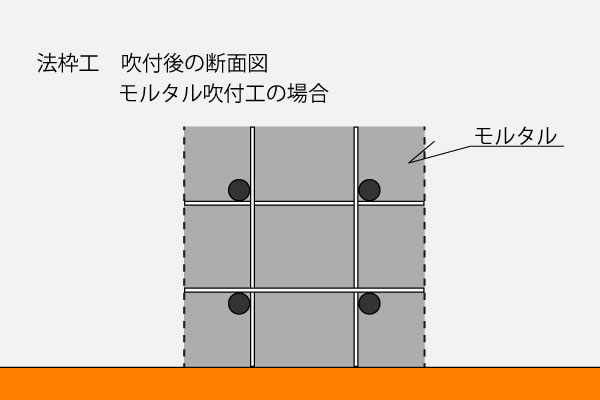
Even if you blow it the same way, it will still pack down fairly tightly.
Of course, since we’re using compressed air to blow the material in, the pores aren’t completely eliminated, but when you remove the core, the material is generally well-packed.
* "Su" refers to gaps or pockets of air.
There was a time in the past when we used to spray concrete onto formwork.
However, a few years later, it became clear that this wasn't the right approach, and now mortar has become the standard.
I believe this information was also included in a publication by the Slope Protection Association.
Please check it out.
Next time, I'll write about concrete and mortar applied using the "bata-buki" method.
See you later.