



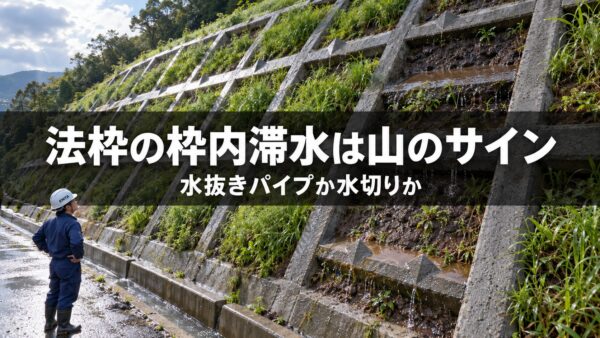
Water Pooling Inside the Legal Framework Is a Sign from the Mountains | Why We Recommend Drainage Channels Over Drain Pipes, and How to Manage Spring Water
Hello, everyone. This is Enta. The other day, we launched “CAI,” a platform that offers free civil engineering site software. Next up is software that provides end-to-end management of ground anchor tension control—from planning to the creation of control charts. Actually, the control chart feature is already complete, so once the testing is finished…
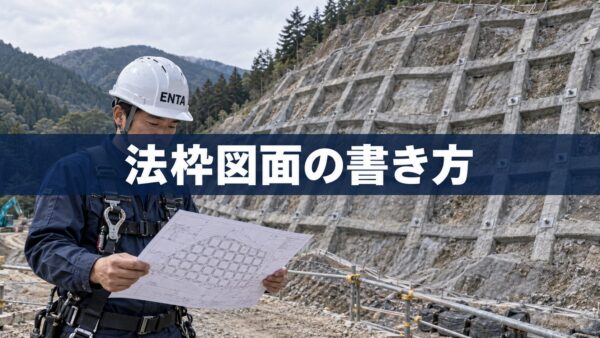
How to Draw Legal Boundary Plans in CAD | The Complete Guide: From Survey Point Management to Drawing Steeply Undulating Mountains
Hello, everyone. This is Enta. The other day, while teaching some of the younger staff about legal frame drawings, I remembered, “I think I wrote about this on my blog a while back,” so I dug up the old post. But it turned out I’d written it in three separate parts, and when I reread it now, there were a few spots where I hadn’t explained things clearly enough, lol. I thought I’d combine this into a single post…

Determine the Pitch for Rebar Placement Using "Projection" | How to Determine Placement Locations Without Hesitation, Even on Steep Slopes
Hello, everyone. This is Enta. Maybe it’s because of the typhoon, but lately it’s been raining on and off, and it’s sooo humid… I’m breaking out in weird sweats lol. Is it because I’m an old guy!? Anyway, I thought I’d write about something I’m often asked regarding the spacing for rebar insertion. It’s about spacing. Well…
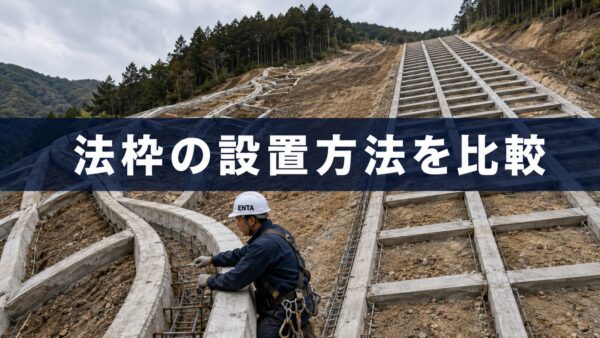
A Comprehensive Comparison of Formwork Installation Methods | Contour-Fitting vs. Straight-Line Layout: Pros, Cons, and Cost Differences
Hello, everyone. This is Enta. The other day, while I was organizing old photos from a past project for the first time in a while, I came across a few articles I’d written about seven years ago. When I reread them, I realized that while the content is still accurate, the stories are fragmented and split across three separate articles, so honestly, reading them now…
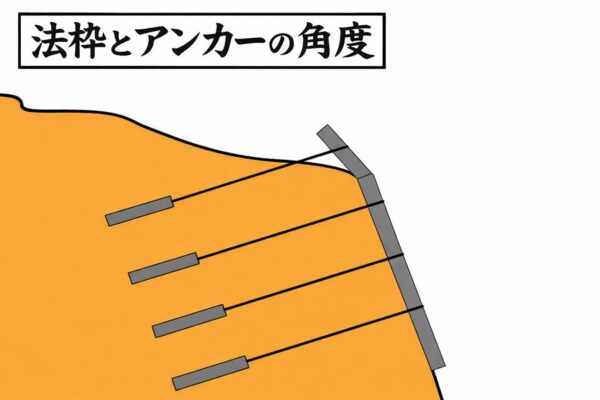
Installation of a Retaining Wall with Ground Anchors (Part 2)
Hello, everyone. This is Enta. Installing Formwork with Ground Anchors (Part 1) This is a continuation of the previous post. I think I mentioned in the last post to pay close attention to the angles of the anchors and the formwork! The next issue that arises with those angles is the rebar. The white lines on the formwork…
Installation of a Retaining Wall with Ground Anchors (Part 1)
Hello, everyone. This is Enta. Today, I’d like to talk about installing retaining walls. Let’s say we have a slope like this (in a design cross-section). There’s a design drawing showing the installation of a retaining wall. Let’s assume the design looks something like this (for illustrative purposes). Ground anchors have also been installed. …
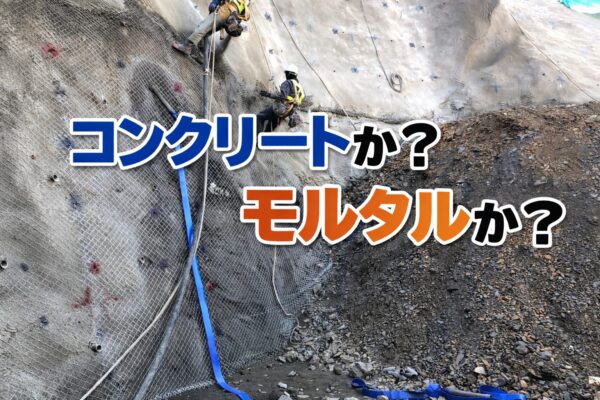
Sprayed Concrete or Sprayed Mortar? (Part 4)
Hello, everyone. This is Enta. Concrete or Mortar for Slope Stabilization? (Part 1) Concrete or Mortar for Slope Stabilization? (Part 2) Concrete or Mortar for Slope Stabilization? (Part 3) Continuing from last time, this time we’ll look at mortar…
Sprayed Concrete or Sprayed Mortar? (Part 3)
Hello, everyone. This is Enta. Do you do spray work? lol This time, I’ll be talking about concrete and mortar sprayers. Concrete or Mortar for Slope Construction? (Part 1) Concrete or Mortar for Slope Construction? (Part 2) Concrete Spray and Mort…

A Comparison of Theoretical and Actual Values for Frost Damage Prevention in Sprayed Concrete
Hello, everyone. This is Enta. How to maintain a constant ambient temperature during winter curing; the criteria for mixing cement slurry with hot water based on the final mix temperature; when it comes to winter construction, mixing with hot water is the best option, right!? The other day, I wrote about the final mix temperature of mortar as a measure against freeze damage…