Hello, everyone.
This is Enta.
It's the height of Obon season, but I'm in the thick of 3D CAD work lol
There's always work to do, isn't there? lol...
Ground Anchor Construction: Mastering Tension Control (Part 1)
Continuing from the other day, here’s a look at tension management in ground anchor construction.
Purpose of Anchor Installation
Ground anchors were installed as a landslide prevention measure, and
The purpose is to increase landslide resistance through the tensile force of the anchors and thereby ensure the stability of the slope.
(Well, the specific measures will vary depending on the type of construction work, but this is generally how it works.)
Purpose of the Exam
| Exam | Purpose | Key Points to Check |
| Aptitude Test | ・The anchor was properly designed and installed Check whether that was the case. 51 TP3T and 3 or more units |
・Estimate the free length of the tendon and the amount of friction loss based on the load-displacement characteristics, and verify that the design anchor force is within safe limits. |
| Confirmation Test | ・With respect to the design anchor force Make sure it is safe. All anchors other than the aptitude test |
・Verify that the anchor force meets the design requirements and that the load-displacement characteristics do not differ significantly from the results of the suitability test. |
The two types of tests listed above are the standard test items for ground anchor construction.
It’s a different story when it comes to taking the basic exam.
For example, let's say there are 100 anchors.
We will conduct a qualification test on either 5% of them or at least three units, whichever is greater, and perform a verification test on all the rest.
So, that means we’ll be conducting at least three aptitude tests.
However, if the anchor length or the anchor body length differs, the procedure may be performed separately for each type (depending on the supervisor).
Since I generally base my calculations on a single job site, the maximum is 5%.
The worst part about aptitude tests is that they take so long.
In reality, if the temporary creep stabilizes, we can shorten the time, but,
Inexperienced construction managers often stick to the originally scheduled timeline.
If the plan specifies holding the maximum test load for one hour, then we hold it for one hour—even if there is no displacement.
If there is no displacement (i.e., the dial gauge reading does not change as the PC wire stretches or contracts), this indicates that the part is not moving.
If there is no displacement after 30 minutes, there won’t be any even after an hour, so those few millimeters aren’t that significant.
We know that temporary creep does not occur within that time frame.
(The first creep phase lasts about one week; the second phase lasts about two months.)
In fact, since it’s easy to fall within the upper and lower limits if you take a long time, the Anchor Association uses vague wording in that regard.
If the ground anchor installer thinks it can be done shorter, lol
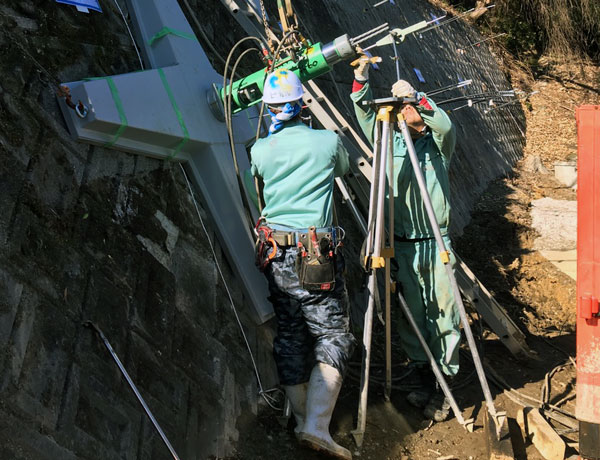
And the most important part is"It is safe with respect to the design anchor force."
That's the point. Which means the most important thing is that the ground anchor hasn't come loose. (That goes without saying, lol.)
The qualification test may apply a load of up to approximately 1.5 times the design anchor force. (Depending on the ground conditions.)
Since it can handle that much of a load, you can rest assured that the design anchor strength is sufficient.
Even if the test results are poor, as long as there are no omissions, it simply means there is a problem with the way the test was administered, and the anchor can be considered sound.
If the results fall outside the upper and lower limits, it means the testing method is flawed. (The cause of results falling outside the range is almost always the testing method.)
Even if the test results are poor during the on-site inspection, as long as the anchor itself hasn't come loose, you can be confident that
"The anchor installation was done properly. However, the test failed. We will retake the test."
That's fine.
I tried it again, and it worked fine, so there's no problem. (A follow-up report is sufficient.)
The important thing is to have government officials witness the maximum load test. (This serves as proof that nothing was omitted.)
There’s also an easier way to take the exam, so I’ll save that for next time.
See you later.