Hello, everyone.
This is Enta.
The Obon holiday ends today, huh? lol
Well, while some people are still on a long break, my Obon vacation is over.
That said, it's half vacation and half work.
But I did get to sleep in this morning!
I lazed around until around 10:00.
It was such a great time lol

But that's beside the point.
Ground Anchor Construction: Mastering Tension Control (Part 1)
Ground Anchor Construction: Mastering Tension Control (Part 2)
The Easiest Way to Take a Test
This approach is a little different from the usual aptitude tests and verification tests.
This method also yields the same data.
However, if you're thinking, "This is a bad idea, isn't it?," you should probably skip it.
Please use this at your own risk.
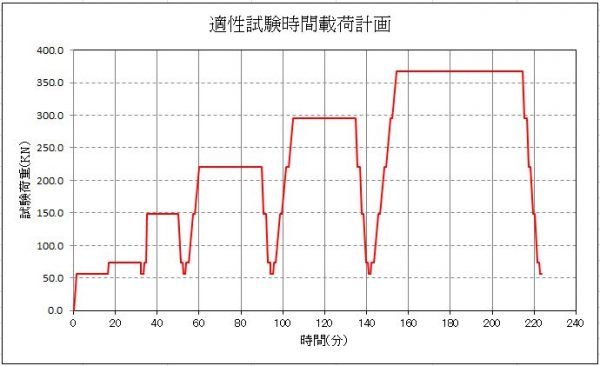
This is a load graph from the qualification test.
First, we’ll start with the initial load. (The test is conducted in either 5 or 10 stages, as desired.) This time, we’re using the 5-stage specification.
The qualification test is always conducted using this cyclic loading.
Stage 1 = Initial Load →Level 1→Initial Load
Stage 2 = Initial load → Stage 1 →2-step→Level 1→Initial Load
Stage 3 = Initial Load → Stage 1 → Stage 2 →3 levels→Stage 2→Stage 1→Initial Load
Stage 4 = Initial load → Stage 1 → Stage 2 → Stage 3 →4 levels→3-stage→2-stage→1-stage→Initial Load
Stage 5 = Initial Load → Stage 1 → Stage 2 → Stage 3 → Stage 4 →5 levels→4 levels→3 levels→2 levels→1 level→Initial Load
The graph above shows the results of tests conducted at up to five levels.
The key point in this graph is that,Elongation at maximum load for each stage, and elongation after returning to the initial loadThat's it.
The actual measured upper and lower limits are ultimately calculated from this difference (the elongation under load, which is the value obtained by subtracting the blue value from the red value).
Furthermore, as long as the load remains within the upper and lower limits at maximum load, there is no problem; so, to sum up,
During the test, the tension is applied in one go from the initial load to the maximum load, and held at that point.
Once the rate of elongation has stabilized, read the value.
Next, lower the load to the initial load and read the value.
Maximum Load – Initial Load = Elongation
So please do the math.
How does this compare to the theoretical value?
(By the way, what is meant here isStability is...For example, let’s say the maximum test load is 380 kN.
This refers to a state in which the elongation value remains unchanged while the jack is holding a load of 380 kN.
(The dial gauge and other instruments are not moving.)
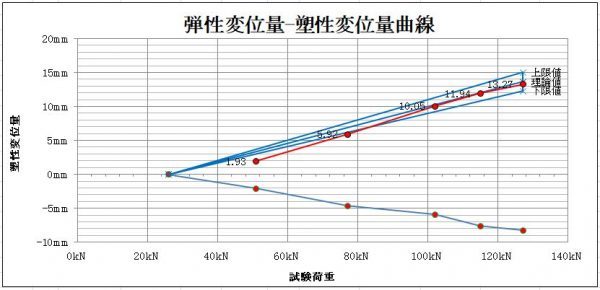
This isElastic-Plastic Displacement CurveHowever,
Within 10 percent of the theoretical valueIf it falls within that range, you’ll pass the exam.
The theoretical value can be calculated using the initial load based on the maximum test load, even without applying cyclic loading.
However, as mentioned above, please keep in mind that you do this entirely at your own risk.
That said, when calculating and testing the elastic modulus (Young's modulus) of PC wire according to JIS standards, the method is the same. (laughs)
See you later.