Hello, everyone.
This is Enta.
This summer feels even hotter than last year, so we have no choice but to keep working on the job site while taking more breaks.
Don't forget to stay hydrated, everyone! lol
But that's beside the point.
In this post, I’ll explore the question: “What do you think of the method of wrapping aramid fiber around retaining walls and stone masonry?”
Since this construction method is commonly used in public works projects, I’ll explain it in a way that’s easy to understand, even for those hearing about it for the first time.
What Are Aramid Fibers? How Are They Used in Masonry and Retaining Walls?
Aramid fiber is an organic fiber developed by DuPont in the United States.
It’s thin and lightweight, yet its tensile strength is equal to or greater than that of steel!
It also offers excellent flexibility and adheres well to the corners and curved surfaces of columns, making it easy to apply.
Furthermore, since it is made of organic fibers, there is no risk of rust, and it does not cause electrical malfunctions.
Because of these characteristics, it is often used to reinforce areas where thickness cannot be added, such as concrete surfaces.
I've heard that it is sometimes used for partial reinforcement of wood.
If you wrap aramid fiber around a structure and cure it with urethane or epoxy resin, it will have strength equal to or greater than that of steel plate.
The important thing here is that,"Any part that can be wrapped around the object can be reinforced."That is the point.
Since wrapping it prevents further displacement, it can be considered a reinforcement.
Conversely, areas that cannot be wrapped around are treated as repairs rather than reinforcements.
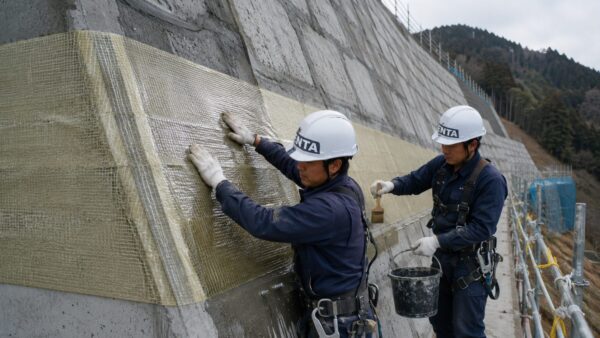
When applied to stone masonry or retaining walls, it is closer to “repair” than “reinforcement.”
Let's apply this concept to stone masonry.
Applying aramid fiber to the surface of stone masonry or retaining walls is technically feasible, and such construction is, in fact, being carried out.
However, this is merely a measure intended to increase the continuity between the stones.
To put it simply, it’s like attaching a thin sheet of metal to the surface of the stone wall.
This approach is very similar to the Moldam method.
The difference between the Moldam method and the Aramid method is that the Moldam method involves bonding the stones directly to each other, whereas the Aramid method involves bonding to the surface of the stones.
Although the methods differ, both share the same goal of maintaining the continuity of the stonework.
So, if anything, I think this project is more about repairs.
If you look at each stone individually, you could call it reinforcement, but when you look at the retaining wall as a whole, it’s more of a repair aimed at restoring its degraded structural integrity (though that’s a bit hard to understand, lol).
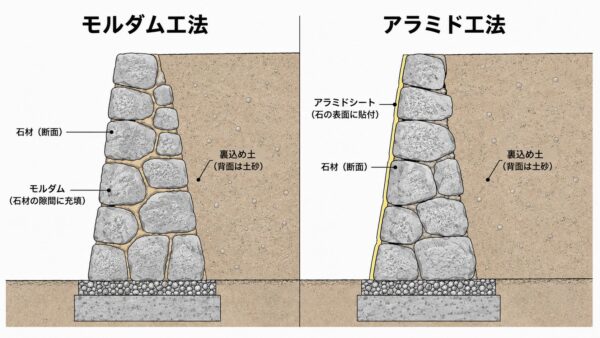
Surface reinforcement alone isn't enough to withstand earth pressure, so reinforcing from within the ground is the key.
However, that doesn't mean we can rest easy just because of this.
This is because both the aramid method and the Moldam method merely reinforce and repair the surface of the masonry; they are entirely separate from the issue of earth pressure.
There are an increasing number of cases where even stone walls that were originally built to withstand soil pressure are no longer able to do so due to deterioration over time.
The structural deterioration is severe, and the reality of this type of construction work involves repairing and reinforcing such stone masonry with mortar or aramid.
Since the soil pressure is distributed over a surface rather than concentrated at a single point, the structure is stronger overall.
However, based on my experience in the field, I believe that with the recent earthquakes and heavy rains, there is a high probability that simply reinforcing the surface won’t be enough to withstand them.
This is where the concept of reinforcing the natural ground itself comes into play.
I believe the most important thing is how well the stonework or retaining wall can withstand soil pressure.
Both aramid and moldam are, after all, just surface treatments.
Please be sure to understand that this is not internal reinforcement.
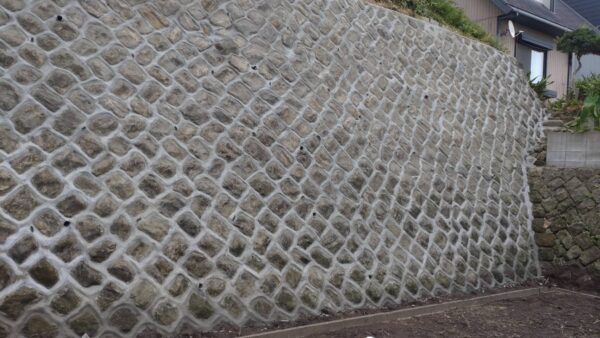
And, as I’ve said many times before, please avoid construction methods that simply cover the surface of the stonework with mortar lol
It may look nice, but it doesn't add any strength.
I think it’s actually more dangerous when you can’t see that a situation is dangerous.
It’s very unfortunate that some YouTubers are recommending the use of mortar, and that some people are taking their advice at face value and applying it.
Also, for porous stone materials such as Otani stone, we recommend spraying (or applying) a penetrating resin rather than covering the surface with mortar to hide it.
This is because the resin penetrates deep into the porous interior, slowing the progression of deterioration while still making it easy to see the extent of the damage.
It's better to be able to see the danger.
The reason is that it's easier to take countermeasures.
It's better than having it all come crashing down all of a sudden, right!?
While surface repairs and reinforcement are important construction tasks, we must not be satisfied with just that; we must not lose sight of the need to address the earth pressure itself.
See you later.
Precautions When Using Aramid Fiber in Grout | Preventing Clogging