Will National Resilience Measures Lead to an Increase in Local Public Works Projects?
The civil engineering industry is expected to maintain a stable market in fiscal year 2022, continuing the trend from fiscal year 2021. This is because regional public works projects are also expected to increase as the “Five-Year Acceleration Measures for Disaster Prevention, Mitigation, and National Resilience” enter its second year.
On December 24, the government approved the fiscal year 2022 budget proposal at a cabinet meeting. The total General Account budget amounted to 107.0964 trillion yen, of which 6.0575 trillion yen was allocated to public works-related expenditures.
According to the “FY Reiwa 4 Budget Proposal for National Resilience” compiled by the Cabinet Secretariat from relevant ministries and agencies, the total budget amounted to 4.5577 trillion yen (up 3.0% from the previous year), of which public works expenditures totaled 3.8736 trillion yen (up 3.0% from the previous year).
Meanwhile, the FY2021 supplementary budget was recently passed and enacted by the House of Councillors in a plenary session. Total expenditures under the supplementary budget amount to 35.9895 trillion yen—the largest ever for a supplementary budget. Of this amount, 2.019 trillion yen is allocated for public works, with a particular focus on disaster prevention and mitigation, as well as national resilience, totaling 1.2539 trillion yen. It will be implemented as a “16-month budget” that combines the FY2021 supplementary budget and the FY2022 budget proposal.
Following the Cabinet’s approval of the fiscal year 2022 budget proposal, there has been a strong outpouring of support from the construction industry. Based on these “Five-Year Acceleration Measures for Disaster Prevention, Mitigation, and National Resilience” and the massive “16-Month Budget,” this report examines public works projects for fiscal year 2022.
Background for Implementing National Resilience Measures
What exactly is national resilience?
This refers to the process of building, even in peacetime, a national infrastructure and socio-economic system that possesses the “strength and resilience” necessary to protect human lives during large-scale disasters, prevent catastrophic damage to the economy and society, and ensure a swift recovery. In particular, Japan has experienced various large-scale natural disasters, suffering extensive damage each time and being forced to implement “post-disaster measures” involving long-term recovery and reconstruction.
Consequently, in December 2013, the “Basic Act on National Resilience” was enacted as a member-sponsored bill. The “Basic Plan for National Resilience” was approved by the Cabinet in June 2014 and revised in December 2018. Furthermore, the “Three-Year Emergency Measures for Disaster Prevention, Mitigation, and National Resilience” (FY2018–2020) was approved by the Cabinet in December 2018, and the “Five-Year Accelerated Measures for Disaster Prevention, Mitigation, and National Resilience” (FY 2021–2025) were each approved by the Cabinet in December 2020.
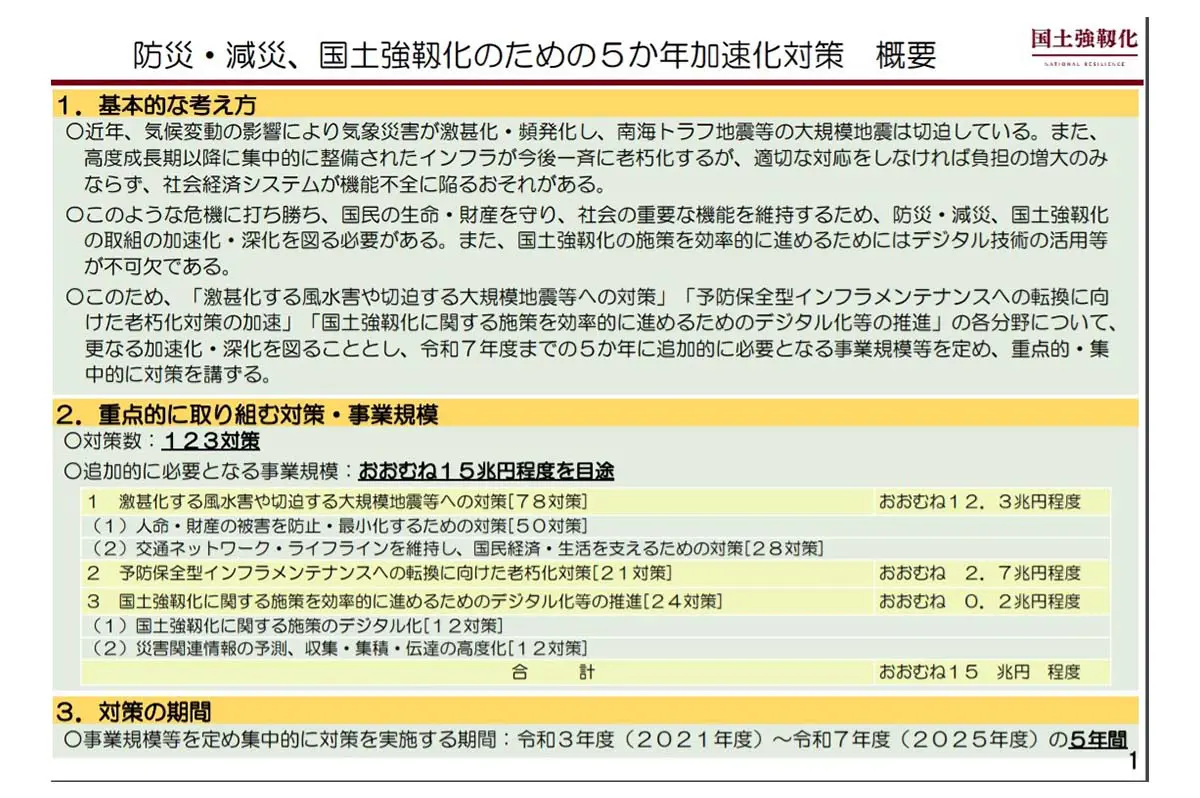
Overview of the “Five-Year Accelerated Measures for Disaster Prevention, Mitigation, and National Resilience” / Source: Cabinet Secretariat
Among these, the objectives of the five-year acceleration measures currently being implemented are to build a resilient national territory that can withstand disasters and to promote the utilization of digital technologies, which have seen remarkable development in recent years. These measures focus on “countermeasures against increasingly severe wind and flood disasters and the imminent threat of large-scale earthquakes,” “accelerating measures to address aging infrastructure in preparation for a shift to preventive and maintenance-oriented infrastructure management,” and “promoting digitization and other initiatives to efficiently advance measures for national resilience.” The government is currently working to further accelerate and deepen efforts in these areas, implementing targeted and concentrated measures.
What is the scale of the project? How many measures are involved?
The Five-Year Acceleration Plan consists of 123 measures, and the estimated additional project funding required is roughly 15 trillion yen.
Under “Measures to Address Increasingly Severe Wind and Flood Damage and the Imminent Threat of Large-Scale Earthquakes,” there are 78 measures totaling approximately 12.3 trillion yen. Of these, 50 measures are aimed at “preventing and minimizing damage to human life and property,” while 28 are designed to “maintain transportation networks and lifelines to support the national economy and people’s livelihoods.”
Next, “Measures to Address Aging Infrastructure in Preparation for a Shift to Preventive Maintenance-Based Infrastructure Maintenance” consists of 21 measures totaling approximately 2.7 trillion yen, "Promoting Digitalization and Other Measures to Efficiently Advance National Resilience Initiatives" comprises 24 measures costing approximately 0.2 trillion yen; of these, 12 measures focus on the digitalization of national resilience initiatives, while 12 measures are dedicated to "Advancing the Prediction, Collection, Aggregation, and Transmission of Disaster-Related Information."
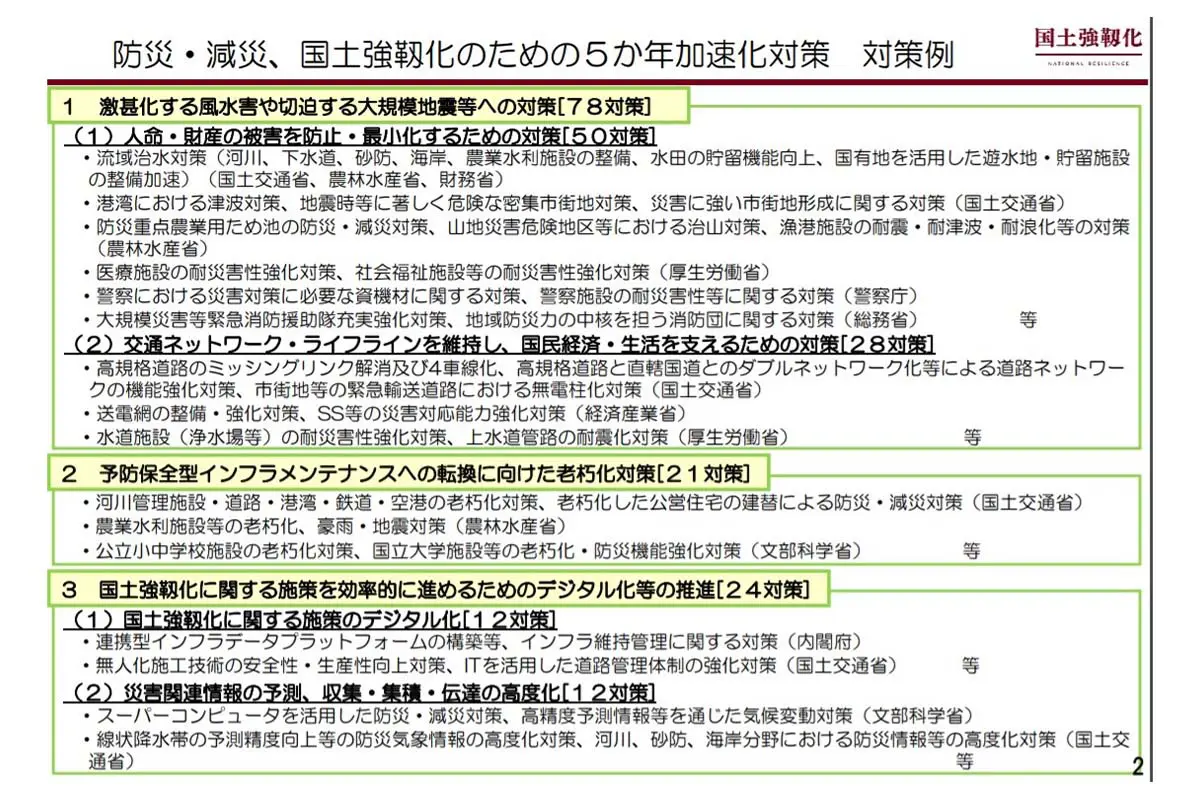
Examples of Measures from the “Five-Year Accelerated Action Plan for Disaster Prevention, Mitigation, and National Resilience” / Source: Cabinet Secretariat
These measures can truly be described as part of the nation’s long-term plan for the next century.
Key Points of the FY2022 Budget Proposal for National Resilience: Based on the “Basic Policy on Economic and Fiscal Management and Reform 2021,” the proposal promotes integrated hardware and software initiatives to overcome national crises—such as the growing threat of large-scale earthquake disasters, a succession of weather-related disasters, volcanic disasters, and aging infrastructure, and to protect the lives and livelihoods of the public and maintain critical societal functions.
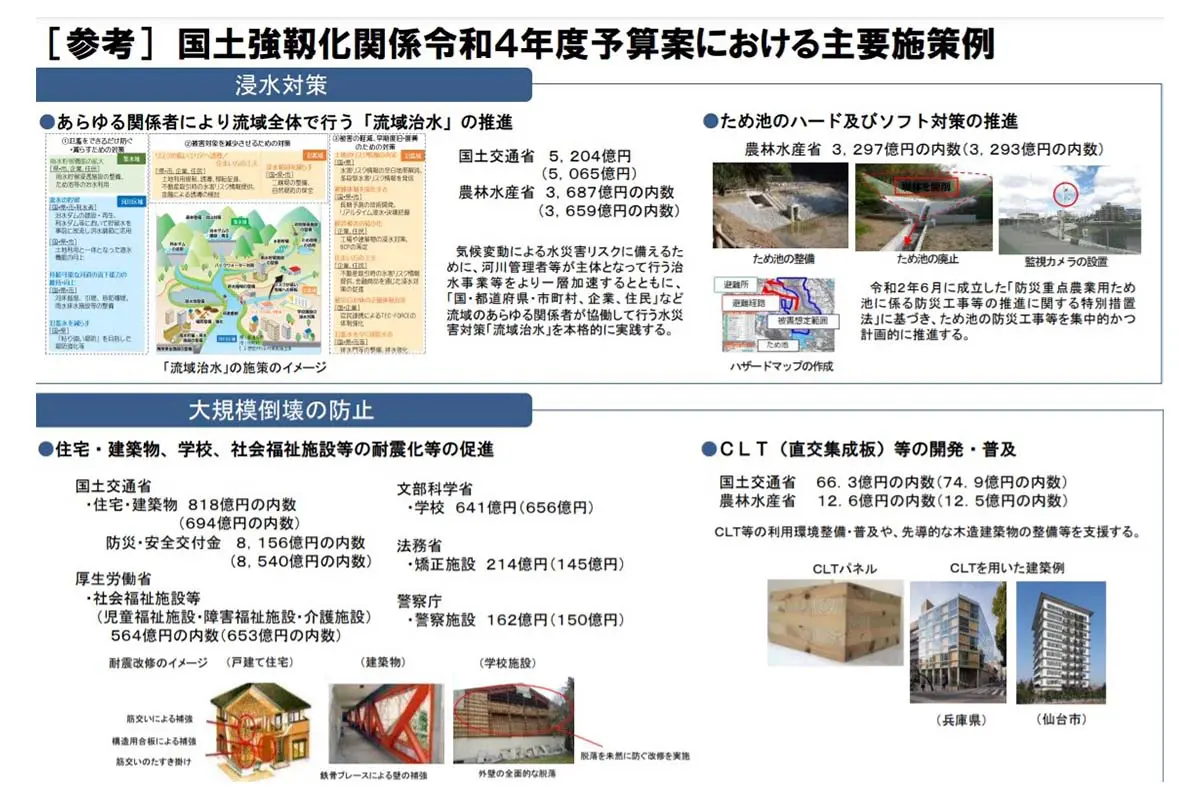
Selected Key Measures from the Draft Budget for Fiscal Year Reiwa 4 Related to National Resilience / Source: Cabinet Secretariat
"River Basin Flood Control Measures" Gain Momentum
So, what specific measures are in place? First and foremost is “river basin flood control”—an initiative in which all stakeholders involved in a river basin collaborate to mitigate flood damage across the entire basin (Ministry of Land, Infrastructure, Transport and Tourism: 520.4 billion yen; Ministry of Agriculture, Forestry and Fisheries: 368.7 billion yen).
The construction work will include dredging river channels, maintaining and reinforcing levees, implementing seismic retrofitting measures, promoting preemptive dam releases, and developing dams and flood detention basins.
As of fiscal year 2019, the rate of river improvement capable of withstanding the largest postwar floods and other events on Class 1 rivers stood at approximately 65 percent; however, the medium- to long-term target is to raise this to 100 percent, and the target year for achievement has been moved up from around fiscal year 2050 to around fiscal year 2045. Next, the rate of river improvements designed to withstand floods and other disasters that have occurred in recent years on Class 2 rivers stood at approximately 62% as of fiscal year 2019. The medium- to long-term target is similarly set at 100%, and the policy is to bring forward the target year to fiscal year 2045 as well.
In fiscal year 2025—a little way into the future—the target completion rate for Class 1 rivers is set at approximately 73 percent, while the target completion rate for Class 2 rivers is set at approximately 71 percent.
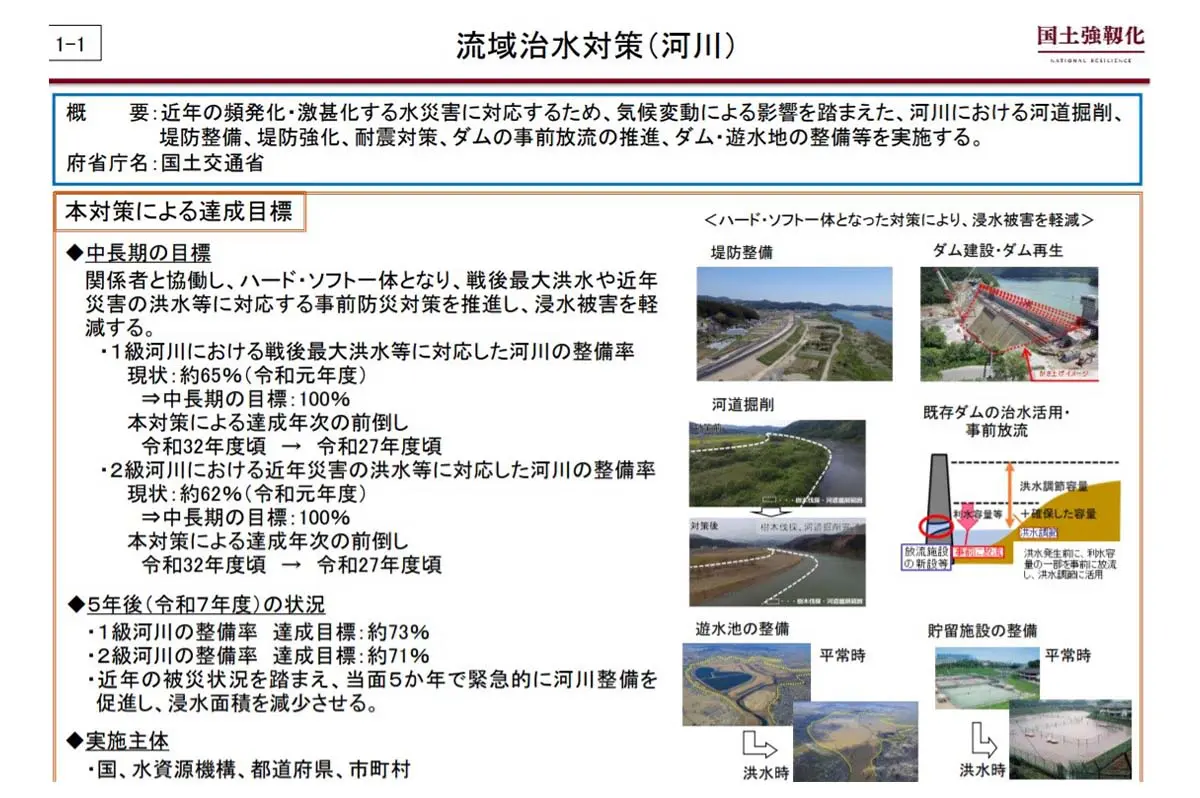
Watershed Flood Control Measures (Rivers) / Source: Cabinet Secretariat
The Construction Division also works to promote seismic retrofitting of residential and other buildings, schools, social welfare facilities, and other structures to prevent large-scale collapse (Ministry of Land, Infrastructure, Transport and Tourism; Ministry of Health, Labor and Welfare; Ministry of Education, Culture, Sports, Science and Technology; Ministry of Justice; National Police Agency).
Expanding a Temporary Two-Lane Highway to Four Lanes
Another major focus is the promotion of measures to enhance the road network (such as eliminating missing links in high-standard roads) (Ministry of Land, Infrastructure, Transport and Tourism: 1.47 trillion yen).
While this served as a major lesson learned from the Great East Japan Earthquake, in order to ensure the functionality of a disaster-resilient national trunk road network, we will work to eliminate missing links in high-standard roads, expand temporary two-lane sections to four lanes, and strengthen the dual network consisting of high-standard roads and directly administered national highways that serve as alternatives.
While the goal is to achieve a 100% improvement rate for missing links (approximately 200 sections) on high-standard roads over the medium to long term, the policy is to bring forward the target year from fiscal year 2043 to fiscal year 2041. For fiscal year 2025, the target completion rate for high-standard road missing links is 30 percent. Of the approximately 20,000 km of high-standard roads, about 30 percent of the missing links (approximately 200 sections) will be opened to traffic, either in full or in part.
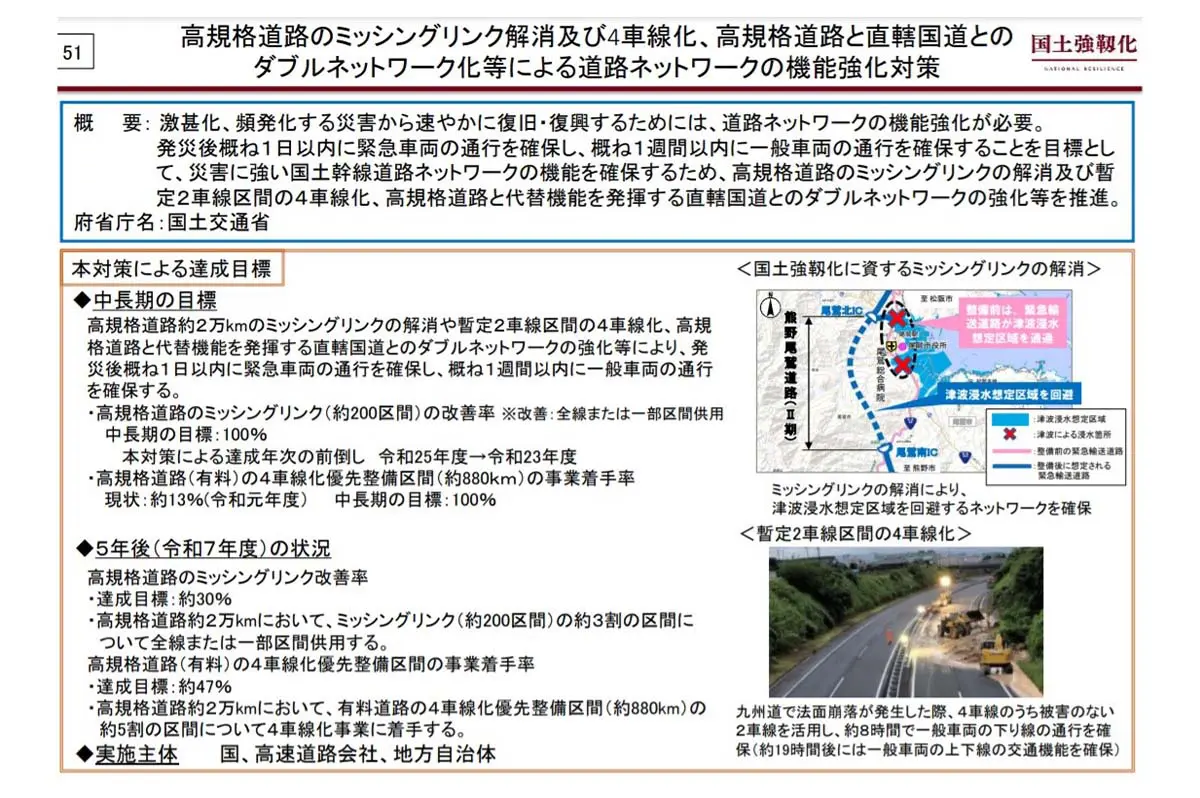
Measures to Strengthen the Road Network by Eliminating Missing Links on High-Standard Roads, Expanding Them to Four Lanes, and Creating a Dual Network of High-Standard Roads and National Highways Administered Directly by the Government / Source: Cabinet Secretariat
In addition, there are numerous other initiatives too numerous to list here, such as the promotion of strategic maintenance and renewal to address aging infrastructure (Ministry of Land, Infrastructure, Transport and Tourism). While each initiative deserves a detailed description, this report will focus on summarizing the key points. Broadly speaking, it can be said that the budget has been prioritized for measures to address aging infrastructure—such as drone inspections—as well as disaster prevention and mitigation, including flood control, earthquake, and tsunami countermeasures, and efforts to strengthen the nation’s resilience.
In order to smoothly implement this national resilience-building initiative, it is crucial for each region to adapt the five-year action plan to its specific context and determine how to enhance its own resilience.
Therefore, it is crucial for each local government to formulate a Regional Plan for National Resilience. A Regional National Resilience Plan is a blueprint for creating “resilient communities” that remain functional and vibrant indefinitely, regardless of the scale of natural disasters or other emergencies. It also serves as a fundamental guideline for matters related to resilience within existing comprehensive plans—including regional disaster prevention plans—that cover all aspects of public administration.
There are some differences in the level of commitment among municipalities
However, it is evident that some local governments in Tokyo, Saitama, Gunma, Nagano, Okayama, and Fukuoka Prefectures are behind schedule in formulating their plans.
In particular, among the major earthquakes expected to occur, an earthquake directly beneath the capital is a major concern; with estimates suggesting that it could damage up to approximately 610,000 buildings, claim up to approximately 23,000 lives, and cause economic losses of 95 trillion yen, the delay in formulating disaster response plans in the Tokyo metropolitan area is a cause for concern.
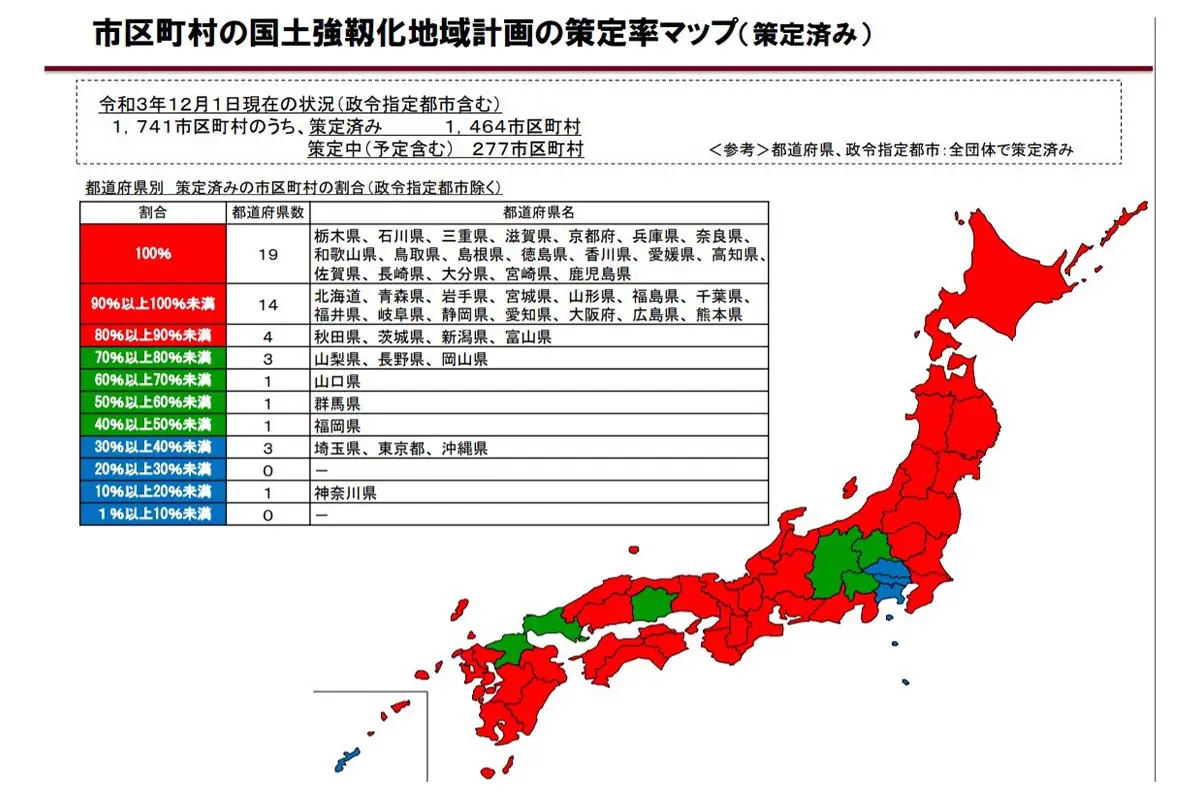
Map of the Formulation Rates of Municipal National Resilience Plans / Source: Cabinet Secretariat
Furthermore, national resilience efforts are being advanced not only by the national government and local governments, but through collaboration between the public and private sectors, with each playing its respective role, as a nationwide effort.
The Office for the Promotion of National Resilience within the Cabinet Secretariat has announced that, “National Resilience: A Collection of Private-Sector Initiatives—Leading Cases for Building a Strong and Resilient Japan"This report summarizes these efforts and introduces pioneering initiatives. In addition to the national and local governments, the private sector is also taking action, and we can expect to see an increase in cases where the public and private sectors collaborate to enhance national resilience."
Positive Reactions from the Construction Industry
Finally, following the Cabinet’s approval of the fiscal year 2022 government budget, the presidents of the three construction industry associations have each issued statements of gratitude, which we present below.
Yoichi Miyamoto, Chairman, Japan Construction Industry Federation (General Incorporated Association)
The Reiwa 4 fiscal year government budget (draft) secures a public works budget that is roughly the same as the previous fiscal year. In particular, regarding the “Five-Year Accelerated Measures for Disaster Prevention, Mitigation, and National Resilience,” progress continued to be advanced when the Reiwa 3 supplementary budget—which was compiled as a single 16-month budget for the first year—is included.
Furthermore, the “Government Bonds for Business Acceleration and Facilitation,” which were approved for the first time this year, are a most welcome system that addresses the drawbacks of the single-fiscal-year budgeting principle—an issue that the Japan Construction Industry Federation had been advocating to be corrected. I would like to express my gratitude to the Ministry of Land, Infrastructure, Transport and Tourism, as well as all relevant officials in the government and the ruling party, for their dedicated efforts in securing the necessary budget and establishing this new system.
We expect that the steady implementation of the measures outlined in the “Economic Measures to Overcome COVID-19 and Pave the Way for a New Era” will lead to a recovery of the economy, which has been weakened by the COVID-19 pandemic, and will vigorously advance socioeconomic activities. Furthermore, alongside efforts to promote disaster prevention, disaster mitigation, and national resilience, we hope that the government will appropriately address new challenges—such as digital transformation (DX) and achieving carbon neutrality by 2050—in the context of living with COVID-19.
The Japan Construction Contractors Association has ample capacity to undertake construction projects, and we intend to continue working together as one to ensure the smooth execution of public works projects. (Japan Construction Industry Federation Website(Quoted from...)
Takanori Okumura, Chairman of the Japan Construction Industry Association (General Incorporated Association)
Following the passage of the Reiwa 3 supplementary budget on the 20th—which allocated approximately 2 trillion yen for public works, including over 1.25 trillion yen for the second year of the “Five-Year Accelerated Measures for Disaster Prevention, Mitigation, and National Resilience”— we are very pleased that the FY22 budget proposal includes a public works budget of over 6.05 trillion yen—the same level as the previous fiscal year—as this largely fulfills the requests we have been making.
I would like to express my sincere gratitude to the Ministry of Land, Infrastructure, Transport and Tourism, as well as to all relevant officials in the government and the ruling party, for their dedicated efforts in finalizing the budget proposal.
Going forward, we once again ask that budget execution proceed seamlessly from this fiscal year’s supplementary budget through next fiscal year’s initial budget, that consideration be given to smoothing out the pace of construction, and that budget allocations be prioritized in a manner that takes local circumstances into account.
The Japan Construction Association and the construction industry associations of all 47 prefectures will continue to make every effort to develop and maintain social infrastructure that safeguards people’s livelihoods and supports various economic activities, while leveraging the construction capabilities of our member companies to contribute to the smooth implementation of projects. (Zenken Website(Quoted from...)
Ryōji Toshida, President, National Association of Small and Medium-Sized Construction Companies (General Incorporated Association)
The FY22 budget proposal, when combined with the FY21 supplementary budget, secures a public works budget that exceeds that of the previous fiscal year. Furthermore, we appreciate that, through systematic execution—including the FY22 supplementary budget—efforts are being made to achieve the early realization of policy outcomes through seamless budget execution. This will help level out the timing of construction orders and project deliveries for contractors.
With regard to budget allocation, we request that priority be given to allocations that take local circumstances into account; furthermore, regarding procurement procedures, we ask for further guidance to ensure that the intent of national policies and other initiatives is fully communicated to the relevant officials in local governments.
As the All-Japan Construction Association, we will strive to ensure the smooth execution of our projects by fully leveraging the construction capabilities of our member companies.