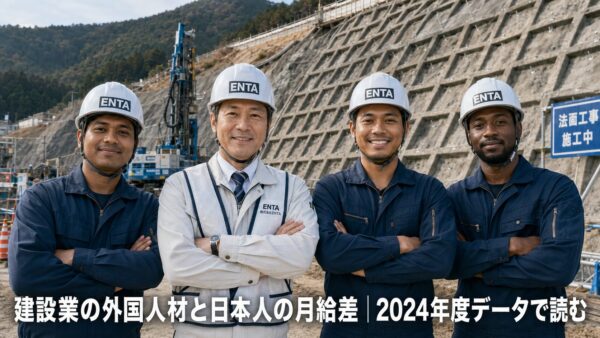
Hello, everyone.
This is Enta.
It's already the sixth day of introducing our technical interns from Vietnam!
But I'm already back home lol
So the number of days is kind of like "Part 1," "Part 2," and so on, lol.
I definitely can't go that many days in a row. I'd be getting a ton of calls, and my phone bill would get out of hand, lol.
In this post, we’ll share the candid thoughts of Vietnamese technical interns.
This is the part about what actual Vietnamese technical interns find most difficult when they come to Japan.
1. The Speed of Japanese
2. Technical Terms
3. Dialects
4. Shortening
It all comes down to words.
They study at a Japanese language school. However, the Japanese they learn there is quite slow-paced.
First, I’ll study Japanese to get used to the language.
When a Japanese person says, “This is a pen”
It's the same as memorizing that.
You'll learn Japanese at that level for six months.
And on top of that, they only use polite language.
And then I'll come to Japan.
That's where the hard part begins, but apparently, the Japanese is spoken so fast that they can't understand it.
So, if your company has technical interns, please try to speak as slowly as possible to them.
If you do that, your message is sure to get across!
Next, let's look at the technical terms.
For example, nozzles, spray guns, and packers.
As for anchors, there are a crazy number of them! lol
This is an anchor, that's an anchor, and this one over here is an anchor, too.
There are times when even Japanese people think, “Really?!”
This part needs to be explained carefully and consistently.

Dialects are tough, aren't they?
It's the same for us. Dialects are hard.
He’s an interpreter who finished his technical internship in Toyama Prefecture a few years ago and returned to Vietnam—and he spoke the Toyama dialect, lol.
I thought, "A Vietnamese person speaking the Toyama dialect? lol," but since I love dialects, I actually felt a bit of a connection.
At Japanese language schools, students learn Standard Japanese.
However, since the text is translated into the local language once it’s adopted in that region, it naturally gets converted into Japanese with a strong dialect if the region has a strong dialect.
For example, the standard Japanese phrase “It’s okay.” becomes “Yoka desu yo. Yoka yo. Yoka.” in the Kagoshima dialect.
In standard Japanese, “Are you okay?” is rendered as “Yoka desu ka? Yokake? Daijokke?” in the Kagoshima dialect.
Even ordinary Japanese people wouldn't understand that, right? lol
We Japanese use this final contraction quite casually, but foreigners probably don't understand it.
It's shortened in that dialect too, isn't it?
There are three of them just for "It's okay," you know. (Kagoshima dialect)
They learn to say, “Thank you very much.”
However, Japanese people say “arigatou.” Some people even say “arigatou-san.”
"You must not do that" is expressed as "Akan, no."
On top of that, since dialectal expressions are also mixed in with this colloquial language, I think it’s really difficult.
Most Japanese people speak using a combination of kanji, hiragana, katakana, and dialects.
I use it all the time, but it's pretty outrageous, isn't it?
Depending on how you say it, it can mean the same thing or something different.
That's probably why there are so many vague terms, lol.
Companies and employees need to be aware of the above.
If you know how to speak to them and how to teach them, there’s no doubt their growth will skyrocket!
It’s certainly not that they haven’t studied enough, and
This means that we Japanese also need to do our part!
Being in a teaching role does not mean you are superior in any way.
If we can learn from each other and grow together, that will solve everything.
Don't you think Japanese people's Japanese skills would improve dramatically just by changing the way they teach or speak?
Unfortunately, there are some people who look down on Vietnamese people.
I’d recommend that people who say things like that try going to Vietnam on their own.
I have absolutely no idea what you're talking about. You should be able to understand how they feel.
See you later.
P.S. I wrote an article a while back about the Mehrabian Principle.
I think Vietnamese people are able to do their jobs in Japan because they're putting the Mehrabian Principle into practice lol