Why Do Even Experienced Professionals Make Basic Mistakes?
Have you ever encountered a problem on the job that left you wondering, “How could such a veteran make such a basic mistake?”
When an accident happens, we tend to say things like, “It’s complacency from getting used to it,” or “You should be more careful when working,”We tend to brush it off as just a matter of mindsetThat's it.
However, due to the way the human brain works,"Gaining experience and getting used to the work" itself can be a cause of serious errors.You could also say that.
In this article, we’ll use the “SRK Model”—which explains the mechanisms behind human behavior—to examine “assumptions” and “misunderstandings” that occur on the job, and consider how we might prevent them.
SRK Model
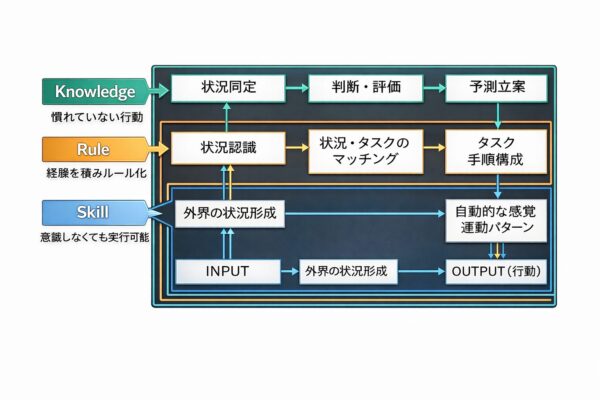
According to the "SRK Model," which is well-known in the field of ergonomics, the process by which a person processes information and takes action is,
We categorize these into the following three levels (loops) based on the degree of cognitive load.
-
Knowledge Base (Knowledge): This involves taking action in situations you’re facing for the first time—situations for which there is no manual. In order to interpret the situation, reason through it in your head, and plan a course of action,It requires the most advanced information processing and places a heavy burden on the brain.That's the situation.
-
Rule-Based (Rule): Recognize the situation and decide, “In this case, I’ll do this,”Rules, manuals, and past regulationsIt is an action taken in response to that.
-
Skill-Based (Skill): These are actions (habitual behaviors) performed unconsciously, relying solely on automatic sensations and movements.It places the least strain on the brain and allows for quick processing.
Why Do Experienced Workers Work So Fast?
People unconsciously find ways to reduce the strain on their brains when performing tasks they do frequently in their daily lives.
When you're new on the job, you work by referring to the manual—thinking, "According to this manual, this is how it's done..." (knowledge-based). But as you gain experience, you work by recalling the manual—thinking, "This is how it's done according to this procedure..." (rule-based).
And as you gain experience, you’ll eliminate the need to constantly assess the situation and check the rules, replacing those steps with an automatic “skill-based” loop.
The reason experienced workers are fast and smooth isn't because they're cutting corners, but because their brains process tasks efficiently based on their skills.It can be said that...
"Misconceptions" That Experienced People Fall Into
However, there are pitfalls (sources of errors) lurking in skill-based processing.
When a situation arises that is slightly different from usual—such as when there are signs of an anomaly or on a day when special instructions differ from the norm—you should normally pause to assess the situation and reconsider your approach based on “rules” or “knowledge.”
However,People with limited experience or seasoned veteransSince I'm completely used to the work,We unconsciously end up forcing our way through irregular situations—which should actually be handled using a “rule-based” approach—using our usual “skill-based” approach.。
Because of things like this, people say things like, “I thought it was business as usual,” or “I misunderstood,”Serious errors (mistakes) caused by mix-ups or misconceptions...becomes more likely to occur.
From Mental Approach to Understanding the Mechanism
How can we apply the principles of this SRK model to safety training?
Why not stop focusing on abstract theories and try adopting an approach like the one described below?
-
Teaching the "Mechanism of Habituation": He told the workers, “Once people get used to something, they’re creatures who unconsciously skip checking the rules.”FactWe provide training on .
Being aware that “your brain is operating on autopilot (skill-based)” helps prevent errors. -
Sharing the "Mindset Switch" of a Veteran: Truly skilled veterans don’t just go about their work unconsciously. The moment they sense something amiss—such as “a sound that’s different from usual,” “a different feel,” or “something’s off”—they have the ability to instantly switch their mindset to the “manual (rule-based) approach.”
Through on-the-job training (OJT) and other methods, it is important to articulate this unspoken rule—namely, “where to pause and check”—and pass it on to younger employees.
In Closing
I believe that by basing our approach on the fundamental premise that “people make mistakes” and conducting training with an understanding of how the brain works, we can make safety management on the job more convincing.
Please consider discussing the “SRK Model” as a topic for your safety meeting.