



Hello, everyone.
This is Enta.
Here's the 2.2 kW motor that I forgot to take a picture of the other day.
I removed the rust from the rotor and cleaned the electromagnet as well.
The bearing has been replaced with a new one.
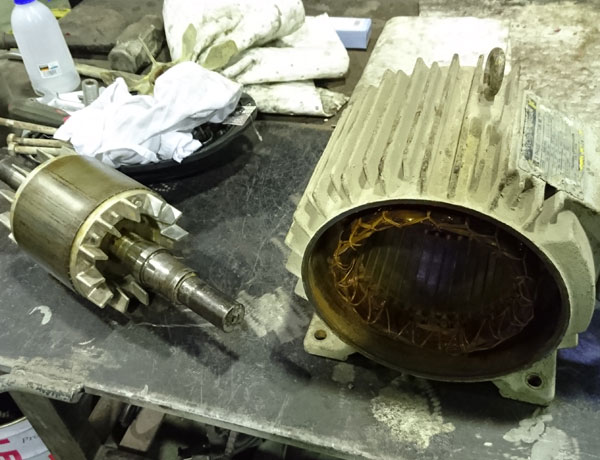
While I was at it, I took the Thunder apart and cleaned it.
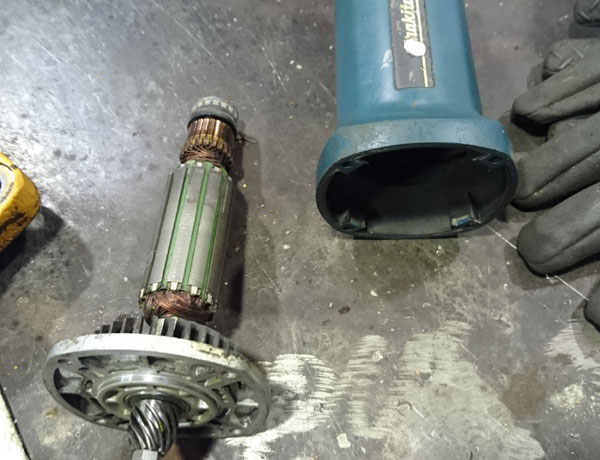
If used in anchor work, it may become covered in grease, which can cause heat to build up inside.
That's why giving it a moderate overhaul will significantly improve its performance and extend its lifespan.
But that's beside the point.
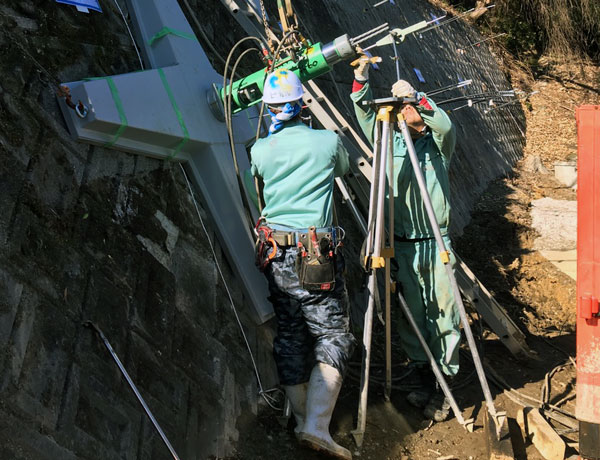
It just slips out, doesn't it?
Anchor, lol
It slips out every once in a while.
Last fiscal year, only one item went missing from our company.
(Of course, we redid the work.)
Causes, Factors, and Predictions of Hair Loss
- There was a significant difference from the expected soil conditions for anchoring (as determined by N-values and other factors, as well as based on the drilling speed and other observations).
- Even at the same job site, there were some boreholes where the grout had strayed significantly from the target path.
- There is virtually no return of drilling fluid. (No cuttings are discharged.)
- There is no air return. (No soil discharge.)
- Insufficient cleaning of the borehole inside the casing may have caused mud or other debris to adhere to the anchor’s anchorage area during insertion (especially clay).
- I applied too much pressure, and the grout leaked out. (Did the natural ground collapse?)
- Grease has adhered to the anchor mounting area.
- The water pressure is high. (The grout is being pushed by the water pressure.)
- The anchorage section is in sandy soil, and backflow is severe.
There are a few other things, but that's the general idea.
There are other factors besides those mentioned above.
We must make every effort to ensure that quality does not decline.
Still, when it slips out, it slips out, so let's just give up lol
Since the incident itself can’t be helped, it’s important to decide on the next steps.
Generally speaking, the proper course of action is to report the issue to the local government and have the work redone.
It’s perfectly fine to handle everything within the company or within the prime contractor’s organization, butIt's somehow easier just to say it.
For rework, we will, for the time being, remove the loose anchor bodies to the extent possible.
You can just use a jack to lift it out little by little, right?
It slides right out under a load of about 1 metric ton, so just pull it out lol.
Next, regarding the anchor angle, it’s best to set it about 1 to 2 degrees downward if possible. (Within the design specifications.)
As for reordering materials, it would be safer to place an order with the fixed length extended by about 1 to 2 meters, if possible.
The cost of the materials is negligible.
In some cases, areas where plants have been removed may have disturbed the surrounding soil.
If the angle is different, the free end will be drilled while partially overlapping, but for the anchoring section, I want to drill as far away from the first hole as possible.
If the concrete cannot be poured at the same location, separate consideration will be required.
See you later.


Take KTB's SC anchors, for example—I haven't installed them recently, but even the load-distributing type tends to come loose easily.
Then there’s the fact that… the designer is an idiot who determines circumferential friction based solely on soil classification.
Other than that… I messed up the test load or something (>_<)
Thank you as always.
Every company has its own unique characteristics, so it's hard to generalize, but if the administrator has a solid grasp of the anchors being used, they're less likely to come loose, lol.
There are quite a few issues with designers, too. In particular, I often hear that designers these days lack experience.
There's a high chance of getting the design load wrong during conversion, lol.
I once accidentally applied a load equal to 0.9 times the yield strength of steel wire, too, lol.
I have a quick question: If a KTB SC anchor comes loose, could you tell me what methods are available for removing it?
It's on a slope, but...
Thank you as always.
Thanks for the great material lol
I had the opportunity to write this as an article.
Thank you in advance.
Troubleshooting Series (Part 4): The Anchor Came Loose—Let's Remove It!
Thank you very much for writing such a detailed response.
The slope is about 10 meters high, but since it’s located within the facility, the space is narrow, so I think it will be difficult to operate heavy machinery there.
In that case, I guess I'll just have to use a jack to pull it out, won't I?
That was really helpful! I'll be posting another comment soon, so I look forward to your response then.
Thank you for your comment.
If the space inside the facility is limited, wouldn't the anchor length be relatively short as well?
In fact, pulling out a jack is hard work, so please be careful when doing so.
We look forward to your continued support.
The anchor is about 9 meters long!
Thank you very much. I'll do my best!
Please take every precaution while performing this work.
It’s not uncommon to cut your hands with a utility knife or similar tool, so please be careful.
Also, please do not stand behind the jack.
Stay safe!