Hello, everyone.
This is Enta.
The other day, I did some practice for the exam for the first time in a while lol
Even though the current format has been established for over 30 years now, what's the point of practice exams?
That's what I end up thinking.
When it comes to sprayed mortar, you mix a 1:4 mortar ratio, and based on experience, it achieves the required strength nearly 99% of the time, right?
When I write that, I’m sure some of you will say, “Oh yeah, that’s happened to me too—I just couldn’t bring myself to do it!”
I've had times when I couldn't get the strength either, lol.
I tried to figure out why I didn't show up back then.
1. Amount of Water
2. Incorrect formulation
3. Mixing Time
4. How to Remove the Core
5. Types of Sand
6. Temperature
7. Preparation of Test Specimens
I guess those are the main causes, more or less.
1. Well, there’s always at least some chance of getting the amount of water wrong, isn’t there?
Sometimes craftsmen change the amount on their own to make it easier to blow. (Be careful when making test batches.)
However, even if the W/C (water-to-cement ratio) changes slightly here, the concrete will still achieve the required strength.
2. There are no mistakes in the formula, lol. I think it's practically nonexistent.
Making a mistake here can be disastrous, so please study the basics from the beginning.
3. You don't need to worry too much about how long you mix it.
It's hard to imagine that the lack of strength is due to this part being too short.
It's true that if it's quite short, mixing may not work properly, which can lead to inconsistencies.
However, since this is just a practice test, that seems unlikely.
4. How you remove the core is very important!
Actually, I think this might be the most important part.
A common mistake is removing the core even though it isn't strong enough.
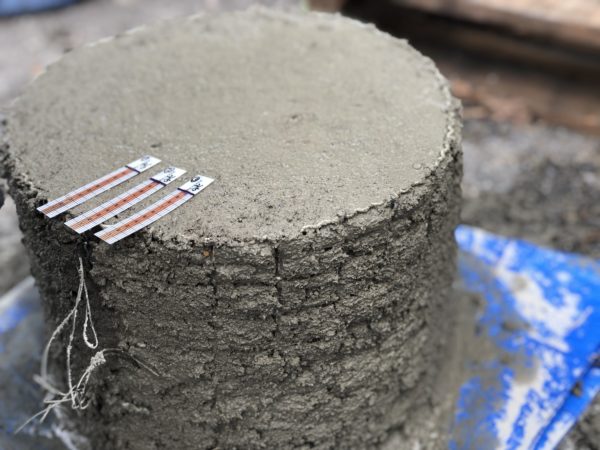
For example, with ordinary cement, if you take a core sample on about the second day—before the concrete has reached its one-week strength—the cross-section (surface) will appear crumbly.
This is clearly a state in which no strength is being exerted.
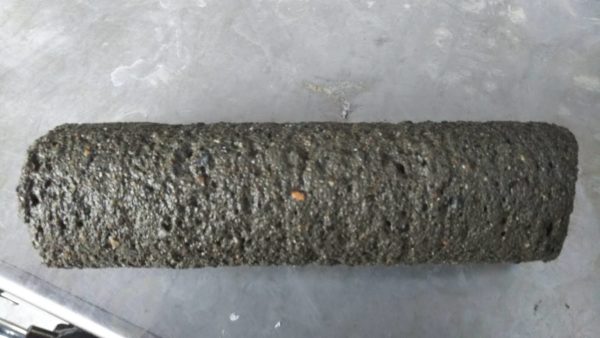
This is not acceptable as a test specimen.
Since the φ50 portion of the φ50 × 100 mm section cannot be maintained and becomes narrower, the strength is reduced.
For regular cement, we recommend coring the day before or on the day of the job. (It’s hard, though.)
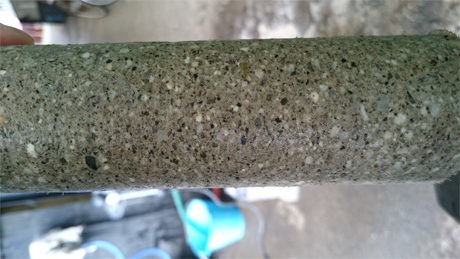
It's reassuring when the surface is this smooth ↑↑.
5. As for the type of sand, there are some types that don't develop much strength.
Slope contractors definitely know this. (Local contractors)
"They say sand from anywhere doesn't hold up, lol"
In particular, sand that contains a lot of silt—especially when it hasn’t been washed thoroughly—tends to have lower strength.
And it’s better if the grain size is consistent—neither too fine nor too coarse. (Some suppliers will blend it for you.)
6. Temperature is important.
Please be especially careful when pouring concrete in cold weather.
Under no circumstances should you add antifreeze at this time.
Since antifreeze inhibits the hydration reaction, it further slows down the hardening process.
Be careful—there are a lot of false claims about antifreeze.
(As far as I know, the claim that there are two types of antifreeze was either a lie or a misunderstanding.)
(I've already tested this at an official testing facility, but since I can't make the results public, I'll show it to you privately lol)
I'd actually like to try a few different experiments.
7. Since the test specimens were spray-applied, I don’t think there will be any particular issues.
However, please be careful, as there are rare instances when you end up chewing nothing butロス, resulting in a mille-feuille ofロス and mortar.
After I made it, I just left it there to make sure the conditions matched those on site, lol.
That's the general idea.
I'm sure there are plenty of others as well.
External factors, such as capping at the strength testing facility, may also have an impact.
I think the person who did it knows best where they went wrong.
If I'm going to do it anyway, I might as well prepare for the exam perfectly, lol.
See you later.