Hello, everyone.
This is Enta.
Removal of Temporary AnchorsI'll write about that.
This is a step that always follows the completion of the main construction work; while it may seem unremarkable, it’s a task that often falls on the critical path of the project.
Let me say this up front: once you get used to this entire process—from unloading to cutting and pulling—Work that can be performed even under the prime contractor's direct managementThat's it.
Since calling in professionals like us comes with a corresponding cost, I think you might want to consider handling it on your own.
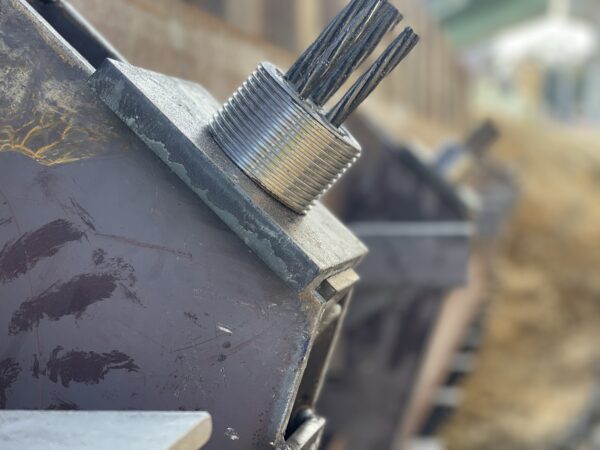
Reasons for Cutting the Back with a Thunder
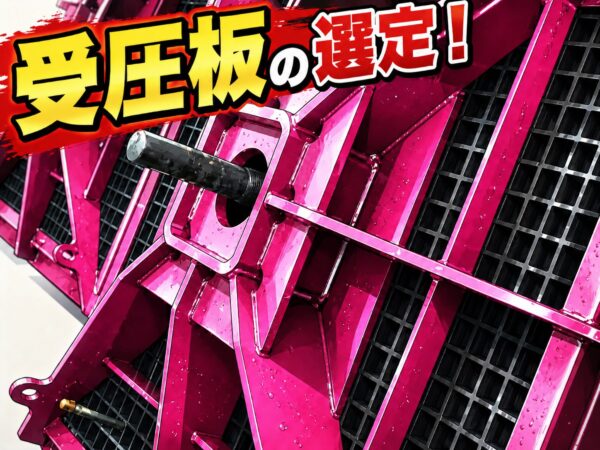
Unloading isThe back of the steel pressure plate using a grinder (disc grinder), which means you cut the underside of the anchor head.
Since PC steel strands are basically arranged in a U-turn pattern, they always come in an even number of strands, so in theory, the unloading process is complete once half of them have been cut.
However, considering the setup for the next process, I will remove the steel pressure plate after cutting all the pieces.
If there are enough people, we can also remove them from the back!
The main reason for choosing an angle grinder over gas cutting is,The cut surface is cleanThat's why.
With PC steel strands, when the angle grinder blade cuts into the strand halfway through a single strand, you can feel the remaining portion snap off on its own due to the tensile force.
If the cut surface is clean, then the next step is...Wedge-type and clamp-type drawing dies engage smoothly during the drawing process.That is the advantage.
If you cut with a gas torch, the cross-section melts and forms a lump, so you often end up having to recut that area with an angle grinder, which creates extra work.
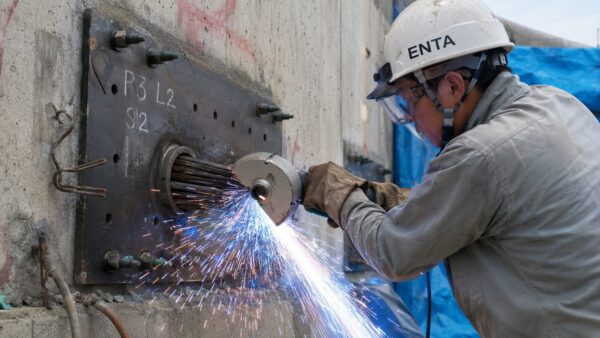
Comparison with Gas Cutting and Fire Risk
Some people say, “It’s dangerous unless you use gas.” However, I believe that, depending on the situation, an angle grinder is actually the safer option.
In some cases, grease, drilling fluid, and rust-preventive oil from inside the sheath may remain around the head of the temporary anchor, and
The temperature of an oxy-acetylene flame is approximatelyAround 3,000°CSince it reaches that temperature, the oil may suddenly catch fire.
Even with a thunderbolt, there is still a possibility—albeit a small one—that a spark could ignite the oil if it comes into contact with it.
However, the energy it provides as an ignition source is less than that of a gas flame, and the direction in which sparks fly can be controlled to some extent.
In practice, the choice of cutting method should be based on the amount of oil remaining around the head and the condition of the surrounding protective covering.
In fact, when cutting with acetylene gas, there is a more than 90% chance of ignition.
Water and fire-fighting equipment are required.
And it releases toxic gas for no good reason.
Stories about flying debris and PC steel strands snapping
People often say, “PC steel strands are dangerous because they can snap when cut with an angle grinder, sending fragments flying.” In my own 30 years of experience, so far...The wire has never snapped and flown off as fragments.。
However, because PC strands are under tension, they make a loud “bang” the moment they snap.
This is the sound of the tension being released all at once, causing the wire to snap back—it might startle people who aren’t used to it lol (The sound when cutting with a gas torch is similar at the moment the cut is made.)
In my experience, I have never seen a case where the bare wire itself shattered into fragments—it was just a loud noise.
However, on top of that,Safety Goggles, Safety Helmets, Leather GlovesI make sure to keep these three points in mind.
Just in case something happens, this is an absolute must!
Furthermore, Article 117 of the Occupational Safety and Health Regulations addresses grinding wheel covers, and Article 118 of the same regulations addressesTest run for at least 1 minute before starting work(At least 3 minutes when replacing), so
Since we use a lot of cutting wheels, this isn't something we can decide on the spot—it's governed by law, lol.
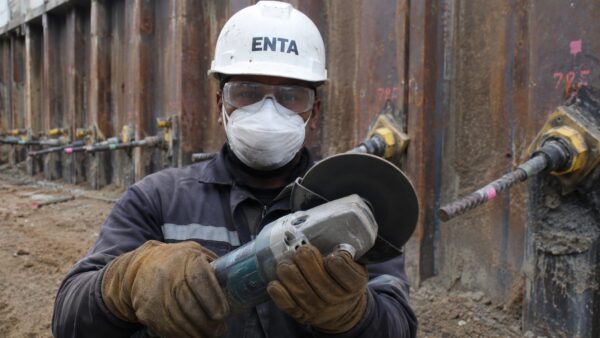
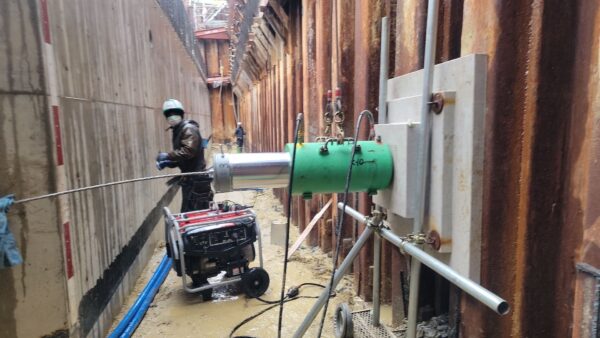
The Pull-Out Process After Cutting and Avoiding Duplicate Work
Once the cutting and unloading are complete, all that's left is to pull it out.
Grip the head of each PC steel strand individually using a wedge-type or clamp-type pulling jig, and pull it upward using a crane or backhoe.
The cleaner the cut surface is here, the faster the part can be mounted in the jig, which clearly reduces the work time.
The real benefit of choosing Thunder isn't just about the cut itself, but rather,Reducing the total processing time, including this drawing processis located there.
If the PC steel strand cannot be pulled out partway through the process, it is possible that cement slurry has adhered to it due to a tear in the sheath.
Based on experience, the maximum isTensile force of approximately 7 metric tons (about 68.6 kN)It’s often possible to get through at this point, but if you go beyond it, there’s a risk of tipping due to recoil when using a crane or backhoe.
In that case, it’s safer not to force it and to consider using a different extraction tool or method. (If you only have a jack, you could try a rough-and-tumble method with a BH...)
Work for which the general contractor might consider bringing in-house
As I mentioned at the beginning, the removal process itself is straightforward.
Use an angle grinder on the back of the steel pressure plate and cut it in half to complete the unloading.
Then, use the pulling jig to remove them one by one.。
Since this is more a matter of planning and safety management than specialized technical expertise, I believe it’s something that can be handled adequately even by the general contractor’s in-house staff.
Since this is clearly less expensive than calling in a specialized anchor contractor, I think general contractors looking to cut costs should consider exploring this option internally.
See you later.
How to Remove Prestressed Steel Cables from Temporary Anchors That Won't Come Out