



Hello, everyone.
This is Enta.
One of the most common inquiries we’ve been receiving lately is about work to prevent the collapse of residential retaining walls.
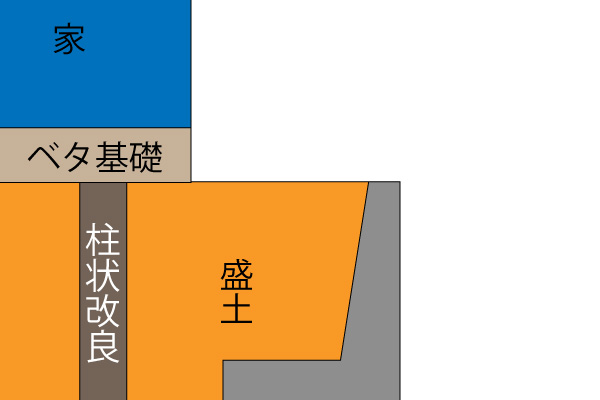
Here's a rough cross-section.
In homes built on embankments using L-shaped retaining walls, older structures often feature stone masonry or concrete blocks.
Whether the structure consists of an embankment like the one described above or a stone wall, various problems can arise as it ages, during heavy rain, or following an earthquake—such as bulging, cracking, or, in the worst-case scenario, the structure collapsing.
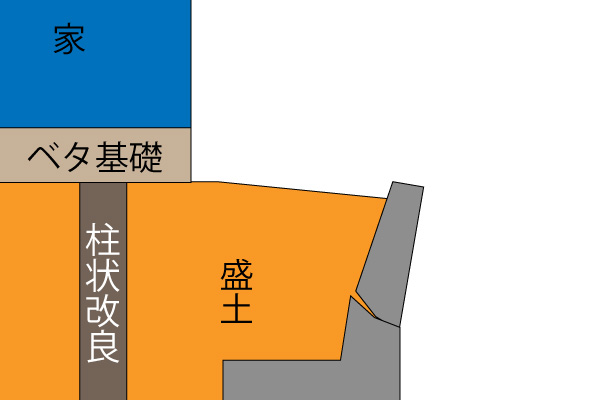
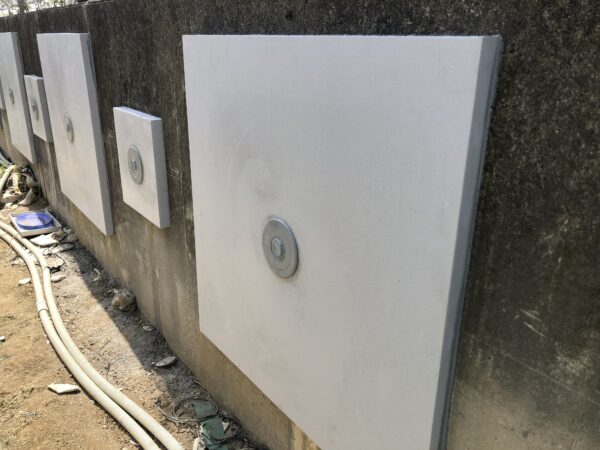
Here's what one of our previous job sites looked like.
The illustration is a bit exaggerated, but in reality, the displacement is only about 1 cm.
Reinforcement has been added here using rebar inserts and compression plates.
Since it would be virtually impossible to remove and reinstall this L-shaped retaining wall, we poured concrete to prevent further damage.
We designed and constructed the structure to account for the earth pressure around the column-shaped reinforcement, ensuring that no load is placed on the retaining wall.
To be honest, since this was a case we’d never dealt with before in the slope stabilization industry, I remember scouring all kinds of literature for information lol.
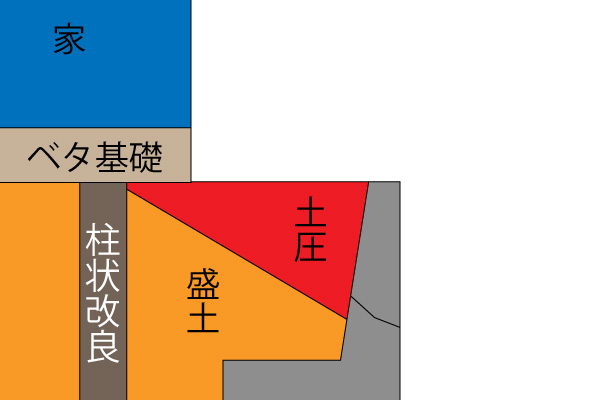
Based on the assumption that the column-type ground improvement should be fine (if this part fails, it’ll be even worse), the plan is to draw the earth pressure from the fill, which is supposed to be stable.
This is based on the assumption that the original fill is solid.
Looking back now, we took care to avoid drilling into the columns during the column-based ground improvement work, but it doesn’t seem to have made much of a difference.
Grout is stronger, so I think it would have been better to use it where it came into contact with even slightly higher-quality fill or improved soil...
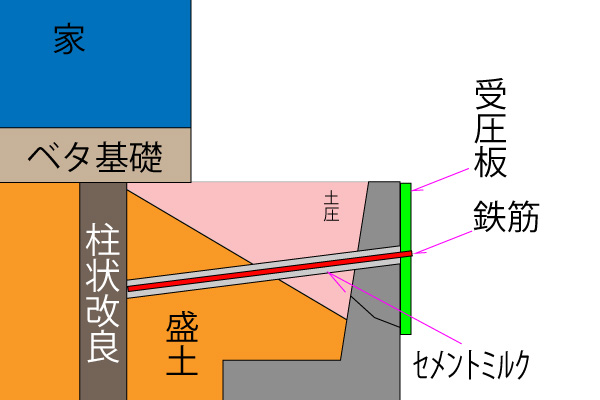
In the end, this is how we settled on it.
In public works projects, it is common to install anti-tipping measures, such as gravity retaining walls, or to install ground anchors on structures that are already in danger of toppling.
However, in the case of residential buildings, assuming that the required load isn't that high and the horizontal forces are limited, it seems that simply inserting rebar would be sufficient.
If this involves a large-scale embankment with earth pressure, the issue won’t be limited to this specific location.
The problem is that there are simply too many narrow spaces, and houses are often built very close together.
The client says they want to do something about it because, as the property owner, they’re liable—if it collapses and the people in the house below are injured, they’ll be held responsible—but it’s so funny how often you can’t do the work without going into the house below. lol
Well, the people living downstairs have been pretty accommodating, so there haven't been any problems so far, but it's still cramped, so it's tough.
Until now, I’ve mainly worked on public works projects, but I think we’ll be seeing more projects like this in the future.
We are also receiving an increasing number of requests, such as requests to reclassify "Red Zones" (Special Landslide Hazard Zones) as "Yellow Zones" (Landslide Hazard Zones).
Since this isn't the kind of work that major companies would take on, I think it's the kind of job for small and medium-sized independent contractors like us.
(Regarding the lifting of the Red Zone designation, etc., the construction work, documentation, and design must meet at least the same standards as those required for public works projects.)
How do you think the slope stabilization industry will change in the future?
I want to be able to adapt flexibly to both the good and the bad.
See you later.





The fourth diagram is amazing! ... A super advanced problem!
I really racked my brain over the calculations, but in the end, I just went with it on a whim lol.