Hello, everyone.
This is Enta.
Timken Test (Timken)
At the end of last month, we conducted an experiment with oil at our sales office.
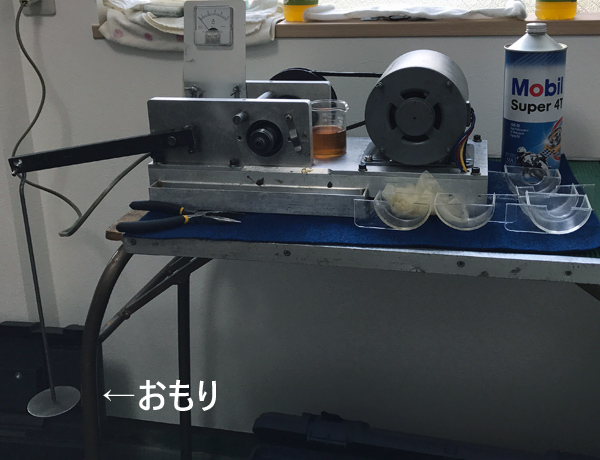
Have you ever seen a device like this?
Apparently, it's what's commonly known as the "Timken Test."
A motor rotates the round part in the center, and a metal test specimen is pressed against it.
When applying pressure, we use a weight based on the principle of the lever.
The Role of Lubricants
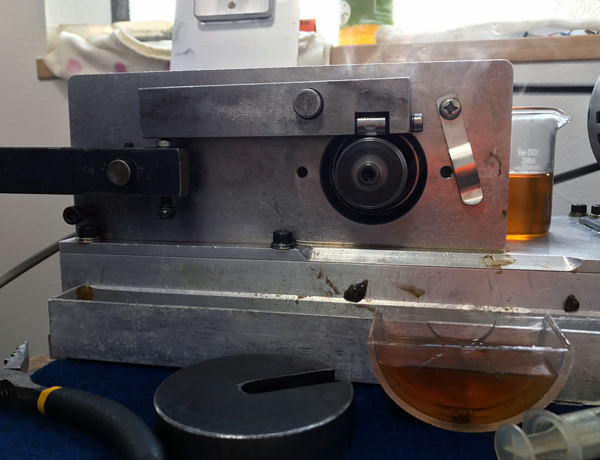
If there's no oil at all, smoke will start to come out, as shown in the photo, and the food will burn.
We use oil to improve lubrication and prevent it from seizing up.
That's the role of engine oil in a car.
The idea is to cool and lubricate the moving parts while they are in motion.
If there is less friction in that situation, heat generation is reduced, and the machine can operate at its full capacity.
Low friction means that the machine can be operated with minimal force.
And, above all, it helps prevent wear and tear on the machine.
Most of the wear and tear on machinery is caused by friction.
Oil and grease are used to prevent that from happening.
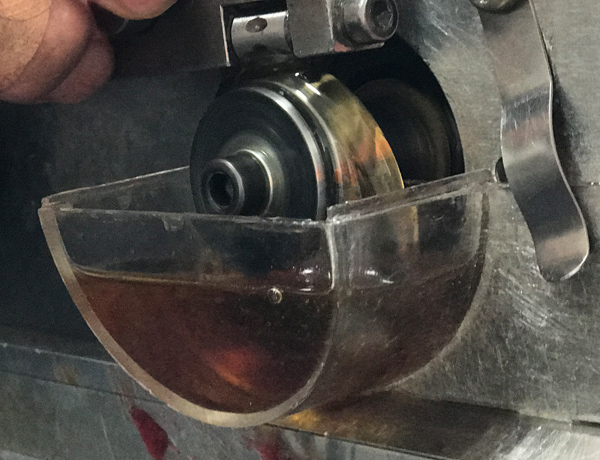
With regular oil, lubrication performance breaks down at a certain weight, and it ends up seizing up after all.
"Seizing" refers to a situation where the rotating parts stop due to pressure. In engine terms, it's what's known as "seizing up."
This means that the oil ran out in both the test specimen and the rotating part.
What's more,Since this test involves extreme pressure, it's incredibly grueling.
This is because the test involves pressing the test specimen against the rotating shaft.
This kind of situation hardly ever happens with regular machines, right?
Friction of the Test Specimen
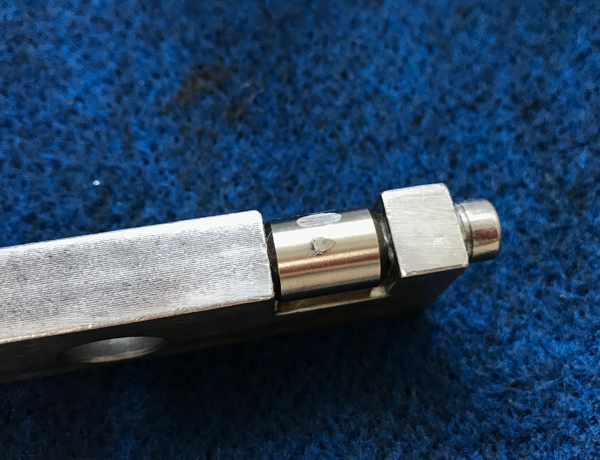
The one with the most wear is the regular oil.
The oil with the small chips in it is the one that contains a certain additive.
I'm using it while rotating the test specimen.
I was surprised by this difference.
Furthermore, even though regular oil locks at a certain weight,
After adding a certain additive, it stopped locking no matter how much weight I put on it.
That really surprised me.
By the way, I also tested the oil additive I mentioned earlier.
Using the recommended amount was completely pointless, so I tried using three times the recommended amount, but it still didn't work... This is what you call a waste of money. lol
Grease Performance
Well, well, I guess so. That might be true to some extent with oil, but grease is different, isn't it!?
Oil is light and runny! Grease is thick!! It's sticky!
So, I had them try out the grease we use for the casing and the high-grade grease we use for critical machine parts.
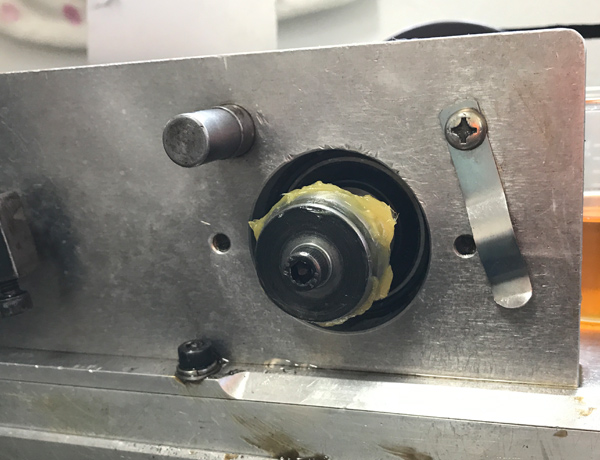
This yellow grease is for the casing, isn't it?
And we're actually using a fairly high-grade organic molybdenum here!
And just like that, it was over—I got taken down instantly by a lock-on attack...
With two weights... (By the way, each weight is 17 kg.)
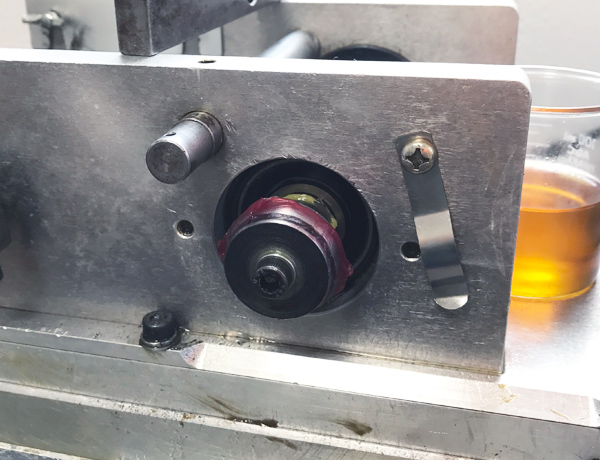
Yes, this red grease! It's that famous brand of grease.
This is, well~~~~
No way~~~
・・・・・
・・・・
・・・
Two shots... and I was taken down...

To be honest, I thought I could pull it off...
I used high-quality grease in the hope that it would help the machine's consumable parts last even a little longer.
At this point, my "grease myth" came crashing down.

As it turned out, it was proven that there wasn't much difference between any of the greases.
In particular,Even if it says "extreme pressure," there isn't really that much of a difference in performance.That's the point.
Whether you use expensive grease or inexpensive grease, the performance is the same when it comes to extreme-pressure applications.
It turned out to be a rather heartbreaking outcome.
When it comes to grease performance, it seems best to choose based on how long it stays in place and continues to lubricate that area.
For example, haven't you ever noticed that the grease at a home improvement store has hardened before you know it?
Grease can be surprisingly susceptible to water in some cases, so it’s best to choose it carefully.
If you want to minimize wear and tear in particular, we recommend choosing a bellows grease that costs 500 yen or more per tube.
Be careful with cheap grease.
Mysterious Grease
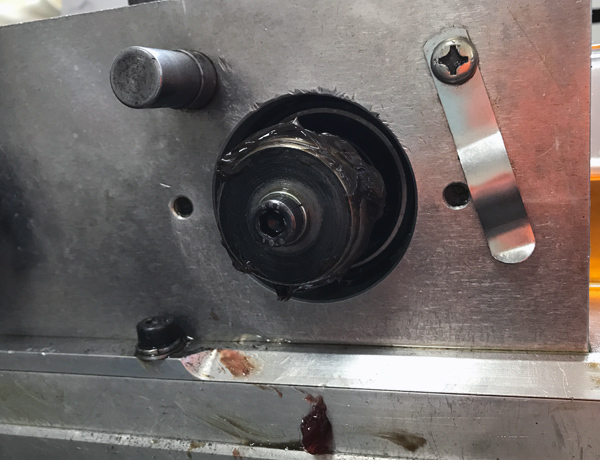
So, finally, I'm going to try this grease.
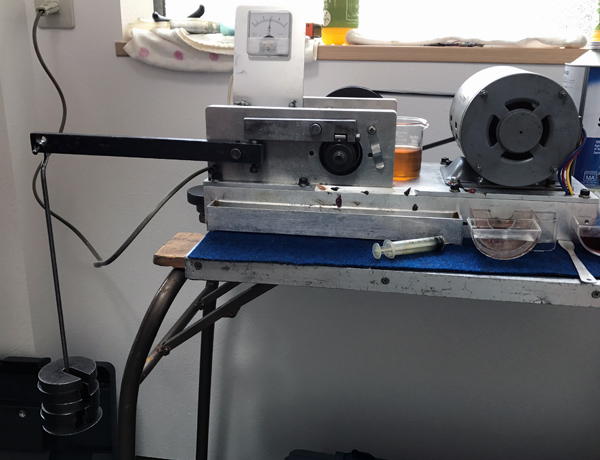
Even if I stack five of them, they don't stop at all. They just won't lock into place.
Even after I loaded all the weights onto it, it still wouldn't lock...
I was just speechless.
I was just totally dumbfounded, lol.
There is an ammeter on top of the test specimen.
As the pressure increases (or when a load is applied), the amperage goes up, but
It remained stable and showed no signs of rising.

The reason is that,I was interested in this grease, so I made a special trip here.
It's the same with additives—I don't think anyone has actually tested them in construction machinery, like rotary percussion drills or sprayers.
The machines we use operate under pretty extreme pressure, so we have to replace consumables all the time, don't we?
Just the cleaning part of the swivel costs over 100,000 yen!!
The bearings inside the hammer cost tens of thousands each, and there are plenty of them!
If using just grease can reduce wear and tear, it's a bargain.
So,We'll be conducting an experiment with this grease this time.
I'll use it for the new swivel.
So, let's check the wear on the swivel.
The plated parts in the "swivel cleaning" section will wear out.
While this grease is effective in reducing wear between metal parts, in the case of a swivel, the contact is between metal and a gasket.
So, while the results might be a little hit-or-miss, I'll give it a try anyway.
Of course, I’d like to try using it on other parts as well and let you know how it goes.
To do that, I'll be the first to try it out!
See you later.
Engine Additives for Construction Equipment | Preventing Seizure in Small Generators