



Hello, everyone.
This is Enta.
Between working on-site and having meetings about my next project, I was incredibly tired, and
The other day, I went to bed at 10 p.m. and slept like a log until 7 a.m.
It really is best to get a good night's sleep about twice a week.
I'm really feeling the fatigue, huh? lol
Lack of sleep can lead to accidents, so make sure to get plenty of sleep!
But that's beside the point.
Lately, I've been getting a few job requests through my blog.
We also receive requests for cost estimates and design work.
Thank you.
In the past, it was virtually unheard of to use the Internet to outsource work.
This is especially true for public-sector organizations like ours.
First, you go to the company to introduce yourself as a sales representative—that initial meeting is the very first step.
After meeting a few times, it was kind of like, “Want to try putting together a quote?” right? lol
Like, something that could lead to a job later on.
With online shopping becoming more common these days, it seems that the number of job requests posted on websites is also on the rise.
There are websites where you can place orders and request quotes for skilled craftsmanship online. (Most of these are in the private construction sector.)
This is a move aimed at eliminating the multi-tiered subcontracting structure.
I suppose this is a natural development given that the multi-tiered subcontracting structure in the construction industry has come to light.
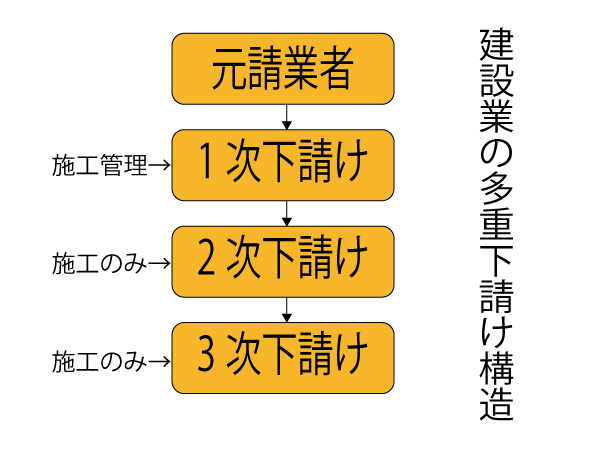
However, in the highly specialized construction industry for public works projects, there are certain aspects that simply can’t be helped.
For example, just as our slope construction company has its own dedicated construction managers and craftsmen, paving companies have their own construction managers and craftsmen,
Tunnel contractors have their own construction managers and craftsmen.
There are virtually no construction managers or craftsmen who are experts in every single aspect.
There's definitely a specialty.
This means that eliminating the multi-tiered subcontracting structure in public works projects will be impossible without companies capable of reliably providing specialized construction management.
Public works projects are absolutely impossible without a construction manager.That's it.
As a result, there will inevitably be two companies involved: the construction management firm and the general contractor. (In some cases, a single company can handle everything.)
I'm not saying you shouldn't order construction work online, but please be careful.
There are plenty of stories out there where people say they can do the work, but then there’s no project manager and they can’t even read blueprints, lol.
Even at entertainment companies, there are a few orders that come in via the Internet, but,
To someone who had previously requested a quote: “This contractor is pretty cheap—can you match their price?”
That's what I was told. That amount was by no means what a first-tier subcontractor would charge; it was an exceptionally high price.
When I asked which company it was, they said they had requested a quote for a public works project through the "Get a Quote Here" section on the website and received a low quote.
When I asked why he got a quote from them, it turned out he had a civil engineering construction management certification lol
These days, even craftsmen have certifications. You might as well assume everyone has one, right? lol
Furthermore, just because you have the certification doesn't mean you can manage construction projects.
As expected, I couldn't afford that amount, so I had to decline.
In fact, craftsmen alone cannot carry out the work. It might be fine if there were no inspections in the private sector, but,
Since we are, after all, a public utility, we conduct our work in accordance with government standards and specifications.
Construction management involves overhead lines, underground utilities, land acquisition, road restrictions, and other issues, so it’s not going to be easy.
I imagine most construction managers are probably thinking the same thing.
The reason why construction tradespeople in the private sector are able to work directly with clients is that,
It's a simple matter: it's because the clients are private individuals—such as wallpaper hangers and painters, and so on.
Isn't it mostly just a matter of making sure the wallpaper is hung neatly?
What’s more, since there are so many people who think “cheaper is better,” there are cases where they’ll use just about any materials...
In the case of public works contractors, this includes quality certificates for materials, shipping certificates, specifications for materials used, photographs, records of usage, and inventory management via receipt and issuance logs.
And so on—there are tons of tedious steps, lol
I can't keep doing this for such a low price.
It doesn't look like we'll be able to break free from the multi-tiered subcontracting structure in public works projects for a while yet.
Given the current situation, which is better: becoming a general contractor or sticking to being a subcontractor?
See you later.


That's a tough question!❗
In fact, even if there are capable people at the company, the ones who actually go out to the field are often the ones who don't really understand...
I guess there's nothing we can do about it, but... it'll be a lot of work later on!❗
Maybe they'll switch to a nomination system for administrators eventually...
Thank you for your hard work.
That's right. The administrator has already been designated, hasn't he?
"I'd give work to that person, but not to anyone else," he said.
That's a tough question.