Hello, everyone.
This is Enta.
The other day, I went to the gym to work up a sweat for the first time in a while.
During busy times, I inevitably end up going on business trips one after another, and if I skip just one, it feels like such a hassle, lol.
I guess going about twice a week really does make me feel better...
I want to do my best so I can go even when things get busy lol
But that's beside the point.
This isn't about something that happened the other day, but have you checked out the sites you've visited using Google Maps Street View?
Doesn't that make you happy?
The other day, I was looking at a slope.
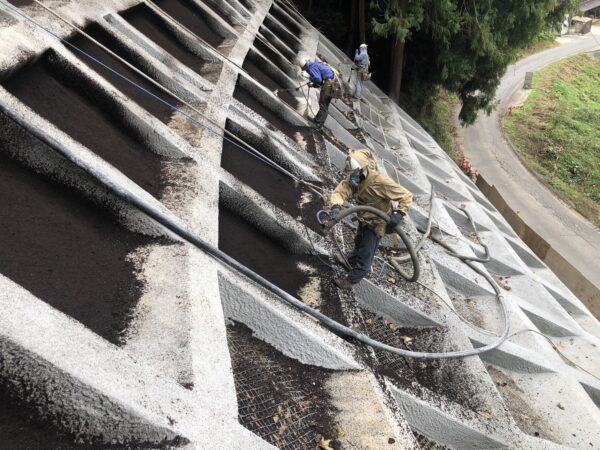
It's a little hard to tell from the photo, but this is a framed vegetation project.
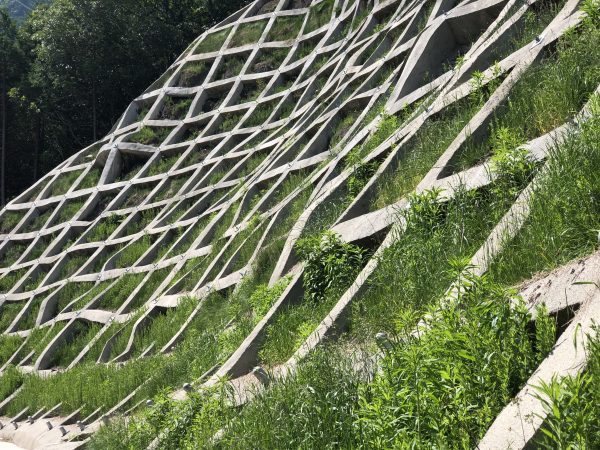
Do you think this greening initiative was a success?
It really grows well, doesn't it?
The space inside the frame was completely filled as well.
What do you think? Was it a success? Or a failure?
The correct answer is that, in the long run, it's a failure (lol).
It might sound a little mean, but I just can't stand it when it's all overgrown.
This is referred to as "cover" or "vegetation cover," and at a glance, if the area within the frame is completely filled, we can say the cover is 80% or higher.
Coverage = Vegetation Cover
This is a problem.
This is because if the percentage is over 80%, it may delay the introduction of shrubs—which is the original objective—and the arrival of birds, or they may not grow at all.
Based on my experience, if possible, I’d prefer a grassland coverage of about 60–70 percent, with gaps here and there where woody plants can grow.
I think it's better to have a solid one.
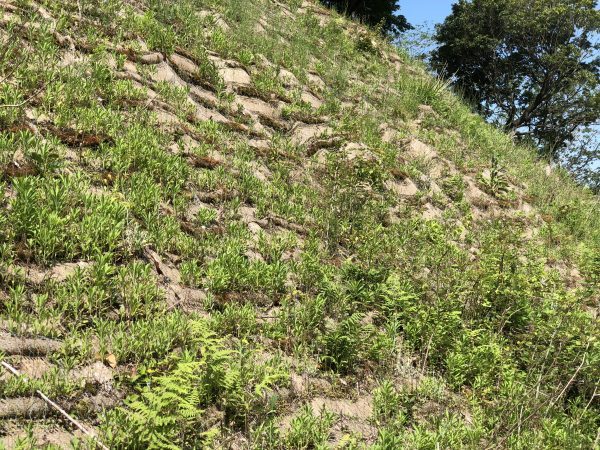
Vegetation mats with fertilizer bags were being installed on the adjacent slope.
This amount of space actually feels just right, doesn't it?
The grass is currently concentrated around the fertilizer bags, but I expect shrubs to start growing in other areas before long.
I think it’s just right when it looks really thick from a distance, but when you get up close, you realize there are actually quite a few gaps!
Back in the day, it was common for vegetation engineers to have the area grow wild to the point where 10,000 plants per square meter were the norm by the time of the inspection. (The public housing authority projects were especially bad, lol.)
If you don't, the final inspection officer will end up saying it's not even there! (lol)
When you do that, the fertilizer is used up in an instant, and the soil becomes barren.
However, things are different now. I think about 500 plants per square meter is sufficient.
Alternatively, if you stop using non-native forage grasses and switch to a seedless substrate, you’ll see quite a few native species flying in within a few months.
I think it's better not to include the seeds lol (since there's no market price for them, the seedless version ends up costing more in the cost estimate).
The warranty for vegetation is two years, but it will have grown sufficiently by then.
I think that taking it that slowly leads to more successful vegetation growth in the long run.
Creating vegetation is challenging because it involves living organisms, but with a certain amount of experience and knowledge, you can manage it.
The key to all types of vegetation is,Don't use too much seed or fertilizer.
If you do that, it will grow to some extent just about anywhere.
See you later.