Hello, everyone.
This is Enta.
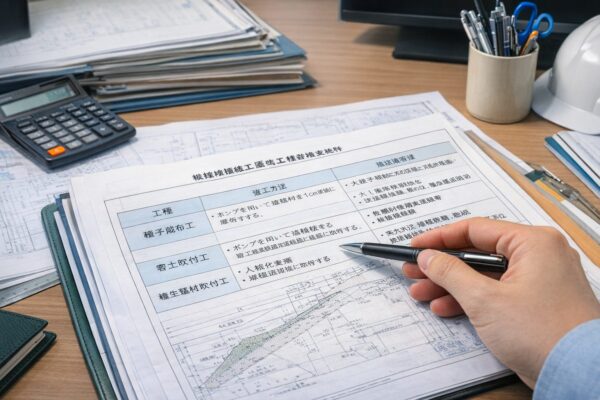
Types and Characteristics of Vegetation Restoration Projects Using Mechanical Seeding Methods
| Item | Seed Spreader Operator | Soil Blowing Work | Vegetation Substrate Spraying Technician |
|---|---|---|---|
| Installation Instructions | Use a pump to spread the base material to a thickness of less than 1 cm | Spray the imported soil to a thickness of 1–3 cm using a pump or spray gun | Apply the vegetation substrate using a pump or mortar gun to a thickness of 1–10 cm. |
| Materials Used | Base Material | Wood fibers, black soil, etc. | Artificial soil or organic growing media (soil, wood fibers, bark compost, peat moss, etc.) |
| Erosion Inhibitors and Bonding Agents | Adhesives, Coating Agents | Adhesives, coating agents, synthetic resins, fibers | Polymer resins, cement, fibers |
| Plant Seeds | Non-native herbaceous plants, native herbaceous plants, and woody plants (pioneer plants) | Non-native herbaceous plants, native herbaceous plants, and woody plants | Non-native herbs and native herbs |
| Fertilizer | Advanced Chemical Processing | Slow-release (bell-shaped), PK compound fertilizer, advanced compound fertilizer (for herbaceous plants) | Slow-release (bell-shaped), PK compound fertilizer, advanced compound fertilizer (for herbaceous plants) |
| Supplementary Materials | Fiber Mesh, Wire Mesh, Straw Mats, Woven Fences | Fiber Mesh, Wire Mesh, and Straw Mats | Fiber Mesh, Wire Mesh, and Straw Mats |
| Rainfall Resistance | About 10 mm/hr | About 10 mm/hr | 10–100 mm/hr (depending on the bonding material used) |
| Duration of Effect | About 1 to 2 months | About 1 to 2 months | Approximately 1 to 10 years (depending on the substrate and bonding material) |
| Applicable Geology | Sand and gravel (soil hardness of 23 mm or less) | The items listed on the left + gravelly soil | The items listed on the left, plus bedrock and sprayed mortar surfaces |
| Applicable Gradient | A gradient gentler than 1:1.0 | A slope gentler than 1:0.8 | A slope gentler than 1:0.8 |
| Notes | ・In soils low in nutrients, supplemental fertilization is necessary | ・When introducing herbaceous plants, supplemental fertilization is often necessary. | ・When introducing herbaceous plants, additional fertilization may be required. ・Use construction methods, base materials, and fasteners that prevent slipping |
Source: :contentReference[oaicite:0]{index=0} (H11.3, p. 223)
I listed the types and characteristics of vegetation engineering, lol.
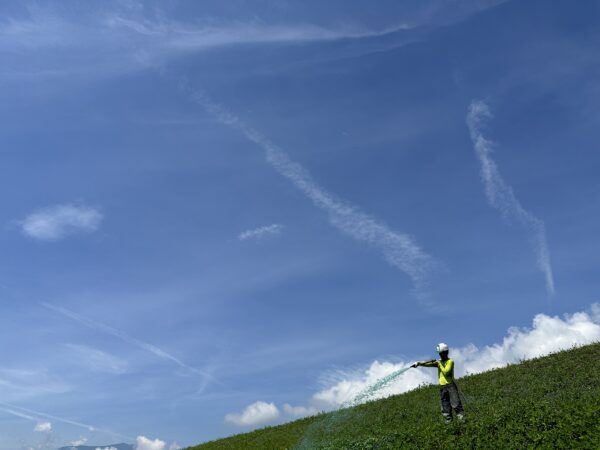
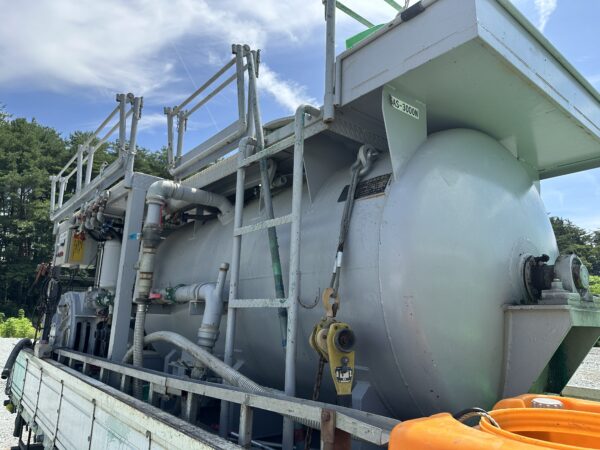
This is the seed-spreading machine featured in this article.
I’ve been wondering for a while now if “seed spreaders” (seed sprayers) will actually be needed as a contracted trade in the future, lol.
To get straight to the point,To be honest, seed-spreading services as standalone contracts are gradually becoming obsolete.That's how I feel.
What exactly is the seed-spreading method?
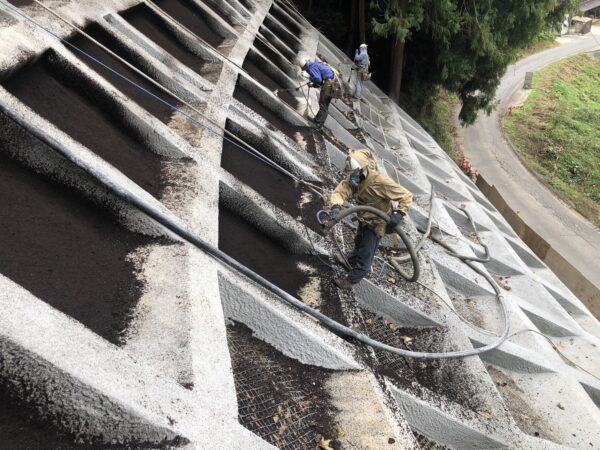
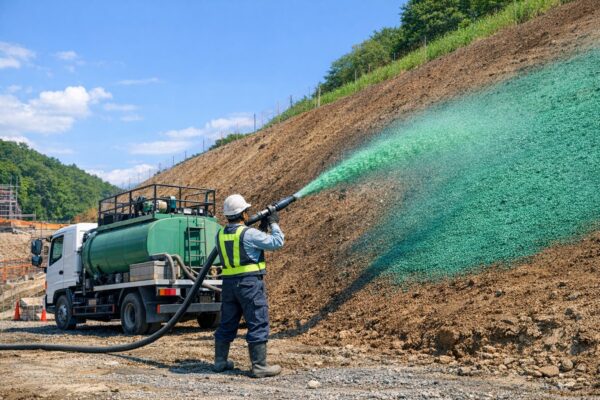
Seed seeding (including soil spraying) is a method in which seeds, fertilizer, fibers, water-retaining materials, and other components are mixed in a specialized machine called a hydroseeder and sprayed onto slopes along with water.
In design documents from the Japan Highway Public Corporation, these are sometimes referred to as "A Spray" and "B Spray."
The basic concept is “greening by dispersing seeds.”
That's all.
Although the unit price is calculated per square meter, in reality, at the contractor level, it is currently100 to 200 yen per square meterThat's the level.
I need a 4-metric-ton truck to load the materials, drive to the job site, lay out the hoses, and start spraying...
Cheap, fast, delicious... (Is this a beef bowl!?)
It's like, "I can't take this anymore!" lol
Well, I'd do it if someone asked me, lol.
What Happens When You Buy a Hydroseeder?
First, let's break down the equipment costs.
Hydro-seeder Unit:10 million yen
If you divide the cost by a 5-year loan term and 30 operating days per year (which realistically amounts to about 2 to 3 days of operation per month),
10 million ÷ 5 years ÷ 30 days = approximately 66,700 yen per day
This is the capital cost incurred simply by operating the hydroseeder.
It’s not like we work every day, and while 30 days a year might seem like a small number, that’s the reality unless you’re doing this full-time.
This is where we'll include labor costs, vehicles, and materials.
[Estimated Daily Cost]
・Hydro-seeder (capital recovery): 66,700 yen
・Labor costs: 35,000 yen × 3 people = 105,000 yen
・4-metric-ton truck: 20,000 yen
・Material costs (flat rate for up to 4,000 m²): 100,000 yen
Total: 291,700 yen/day
Please consider this to be the maximum cost, nothing more.
This is the cost just for getting this out to the job site.
Let's calculate using Aichi Prefecture's unit prices
The design unit price for seed-spreading workers in Aichi Prefecture is250 yen/m² (standard)。
There is a surcharge based on the design quantity, (for cost estimation purposes)
・1,000 m² or more: No surcharge (0%)
・500 m² or more but less than 1,000 m²: 151 TP + 3 T surcharge → 287.5 yen/m²
・250 m² or more but less than 500 m²: 25% surcharge → 312.5 yen/m²
・100 m² or more but less than 250 m²: 451 TP + 3T surcharge → 362.5 yen/m²
・Less than 100 m²: 60% surcharge → 400 yen per square meter
The system is designed so that the unit price increases as the quantity decreases.
But in reality,Small-volume projects may seem like they'll be the most profitable, but they're actually the worst.That's what you'll learn.
Assuming we completed work on 500 m² (for areas of 500 m² or more: 287.5 yen/m²),
287.5 yen × 500 m² = 143,750 yen in sales
In contrast, the cost is291,700 yen。
Net amount▲147,950 yenIt's in the red, lol
The grim reality is that just going out on a call costs nearly 150,000.
So, of course, the estimate is bound to be higher.
What is the break-even point in square meters?
The cost is a flat rate, regardless of quantity.Fixed(The material cost is a flat rate of 100,000 for up to 4,000 m².)
So the calculation is simple.
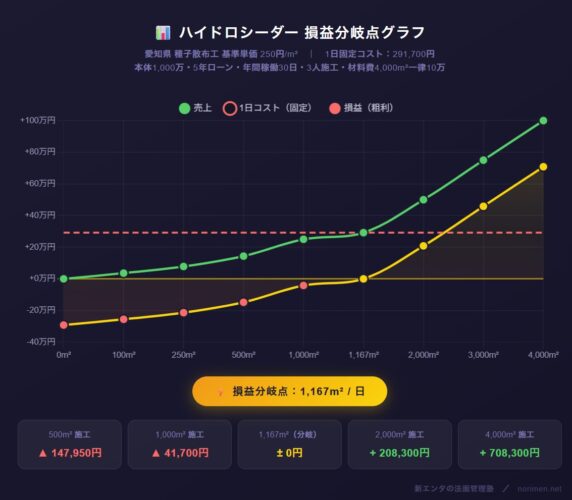
291,700 yen ÷ 250 yen/m² (unit price without surcharges) = approximately 1,167 m²
In other wordsAt least 1,167 m² per dayIf we don't carry out the construction work, we'll operate at a loss even if we run the machinery.
The key point is that the premium disappears for areas of 1,000 m² or more, lol.
In other words, the unit sales price is fixed at the minimum of 250 yen per square meter.
Here is a breakdown by construction quantity.
| Quantity of Work Performed | Design Unit Price | Sales | Cost | Profit and Loss |
|---|---|---|---|---|
| 500 square meters | 287.5 yen | 143,750 yen | 291,700 yen | ▲147,950 yen |
| 1,000 square meters | 250 yen | 250,000 yen | 291,700 yen | ▲41,700 yen |
| 1,167 m² | 250 yen | 291,750 yen | 291,700 yen | ≈ ±0 (break-even) |
| 2,000 square meters | 250 yen | 500,000 yen | 291,700 yen | +208,300 yen |
| 4,000 square meters | 250 yen | 1,000,000 yen | 291,700 yen | +708,300 yen |
If we could complete 4,000 square meters in a single day,Approximately 700,000 yen in gross profit。
This is the ideal scenario.
So what's the reality?
The problem is,Can we consistently secure at least 1,167 m² per day?That's the story.
When it comes to seed spreading for slope stabilization work, large-scale operations typically occur during the final phases of new large-scale road construction or residential land development, as well as in large-scale erosion control and landslide prevention projects.
This rarely comes up in small-scale repair or maintenance projects.
Furthermore, a recent trend is that,
・Large-scale construction projects are on the decline
・Order quantities are becoming smaller
・A price war based on market unit prices continues
In an environment like this,Ensure full operations for the 30th of the monthTo be honest, it's pretty tough (unless you're doing it full-time).
If we can only operate for 10 days a month,
10 million ÷ 5 years ÷ 10 days = 200,000 yen/day
This becomes the cost of capital.
When you add labor costs, materials, and vehicle expenses, the daily cost is425,000 yenexceeds.
At this point, the break-even point is1,700 m² per day...skyrockets.
Reality is getting insanely tough lol
Why the Role of Seed Spreaders Is Coming to an End
From a technical standpoint, hydroseeding isThe Most Cost-Effective Landscaping MethodIt has been used for many years as such.
But in reality,
・Weed control using sprayed mortar rather than landscaping (JR and others spend 5 billion on mowing alone!!?)
・Profitability for small-scale projects is deteriorating year by year.
With all these factors coming together, it’s time for the seed spreader to step in.It's definitely decreasing.
I'm sure many of you have experienced this firsthand on the job, but,
"The landscaping at that site—they used vegetation mats instead of spreading seeds, didn't they?"
These are becoming more common.
From the perspective of material costs, the unit price of the slurry (seeds, fertilizer, and fiber materials) fed into the hydroseeder has been rising, and
The situation is such that soaring material prices are putting even greater pressure on profitability.
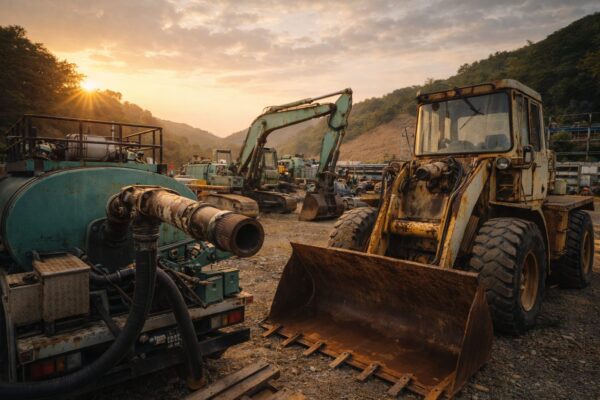
It is becoming more difficult every year to secure the volume of work needed to make a 10-million-yen machine profitable.That's the reality of the situation. (This applies to all types of construction work.)
The numbers don't lie
Make decisions based on numbers, not on gut feelings.
I think this is the most important thing on a civil engineering job site.
Not because “we’ve just been doing seed spreading work for some reason” or “we have the equipment, so we take on the job,” but rather,
How many square meters do I need to install per day to break even?Whether you can act after understanding that.
Given the conditions in this case, the answer is clear, andCan we reliably secure at least 1,167 m² per day?
If you can't do this, honestly, there's not much point in owning a hydroseeder, is there?
Amid a shrinking market for seed spreaders,The time has come to take a dispassionate look at the role of construction methods.That's what I think.
"Isn't the role of the seed spreader over?"
I think it would be fine to switch to vegetation sheets or mats (rather than choosing that option from the start).
I think that way, even as a subcontractor, you can keep more for the prime contractor, and the subcontractor can make a profit too, don't you think!?
How are things at your workplace?
See you later.