Hello, everyone.
This is Enta.
It's November.
Only two months left in the year!
It's getting colder, but let's keep up the good work!
This is a continuation of the previous post.
Reflections on the Future of Vegetation Engineering and Material Selection (Part 1)
Reflections on the Future of Vegetation Engineering and Material Selection (Part 2)
This time, based on the temperatures from last time, I’d like to think about what would be best for future landscaping.
Generally speaking, when it comes to landscaping, spring and fall are by far the best times to carry out the work.
The reason is that the temperature is stable.
That pretty much sums it up, but what should we do about it?
How can we prevent plants from scorching in the summer (due to intense sunlight) and freezing in the winter (due to frost damage)?
Here's the answer, plain and simple!!!
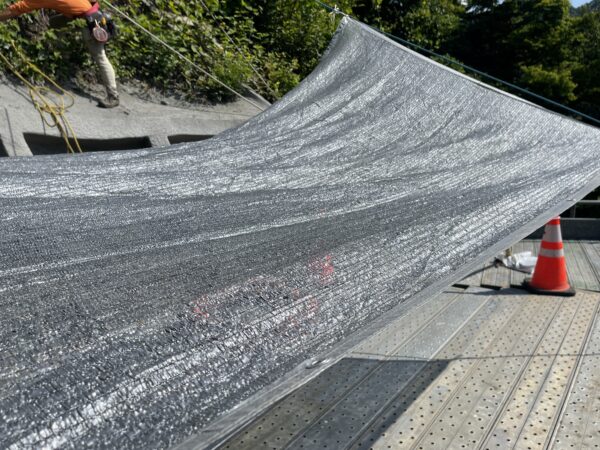
I've been saying this every year for nearly 20 years now!
Gauze!!
This is the answer—and the savior.
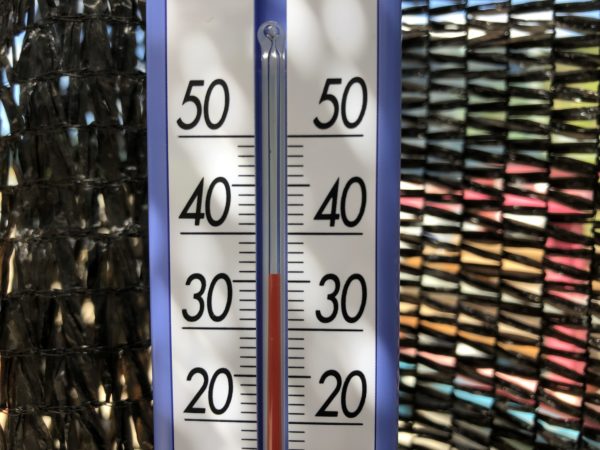
Do you remember what the temperature was like when we set up the shade cloth in the scorching heat?
The Best Ways to Beat the Heat! (Part 3)
The temperature inside the shade cloth can vary by more than 10 degrees!
Absolutely!
It's because of this that our crops are protected, isn't it?
The reason we use shade cloth in both winter and summer is to protect against the sun’s rays in summer and against cold damage (frost) in winter.
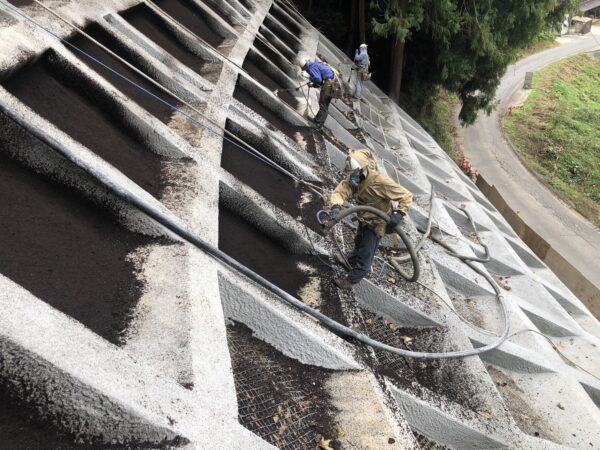
However, we cannot cover the slope we are constructing with shade cloth.
So, what should we do?
What was it, anyway, before it became gauze?
Please consider this.
What do you think it is?
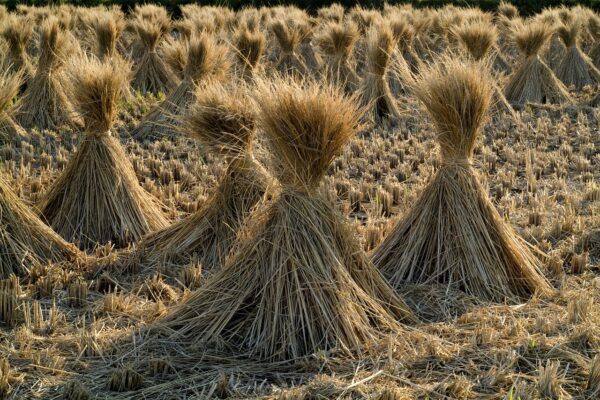
"In the past, straw was widely used as a natural covering material to protect crops from the cold, frost, drought, and direct sunlight.
Nowadays, that role is played by a synthetic material called “kanreisha.”
"In other words, the idea of 'protecting crops with straw' evolved into what we now know as shade cloth—a material that is lighter and easier to handle."
Detailed Explanation
1. The Role of "Straw" in the Past
Straw is a traditional agricultural material in Japan and has been used for a variety of purposes, as described below.
Uses and Purposes
Frost protection (straw for frost protection): Prevents radiative cooling at night and keeps seedlings warm
Preventing Drying (Straw Mulch): Retaining Soil Moisture and Preventing Mud Splatter
Sunshade (straw cover) Prevents leaf scorch caused by strong sunlight
Wind and Cold Protection: Prevents damage from direct wind exposure and freezing caused by cold snaps
In other words, straw can be considered the forerunner of “natural mulch and covering materials.”
2. The Role of Modern “Cold-Weather Fabric”
Shade cloth (made of polyester or polyethylene) serves as a more uniform and durable alternative to straw.
Uses: Similarities with Straw
Heat Retention and Frost Protection: Prevents nighttime temperature drops (similar to the heat-retaining effect of straw)
Shade: Softens the sunlight (like a straw cover)
Insect and Bird Control: Physically blocks pests while maintaining airflow (something that was difficult to achieve with straw)
Lightweight and Reusable: Easier to handle than straw and can be used repeatedly
References and Sources
National Agriculture and Food Research Organization, “Changes in Coating Materials for Agricultural Supplies” (2018)
Japan Agricultural Mechanization Association, *The Modernization of Agricultural Technology and the Materials Revolution* (2015)
Ministry of Education, Culture, Sports, Science and Technology, *Traditions and Changes in Japanese Agriculture*: High School Agricultural Textbook Edition (2019)
But these days, you can’t exactly cover the whole thing with straw, can you? lol
Well, it’s just not possible after doing vegetation restoration work, is it?
I'm sure some of you have already noticed this, but what should we do?
What is the best construction method?
So, I think I'll give it a try.
See you later.