Hello, everyone. This is Enta.
The other day, while I was organizing some papers, I actually came across an old pay stub from my time at a major company.
Now that I'm 50, I found myself thinking about all sorts of things as I looked over my bank statements from when I was 22 and 29.

March 1998: Pay stub for a 22-year-old
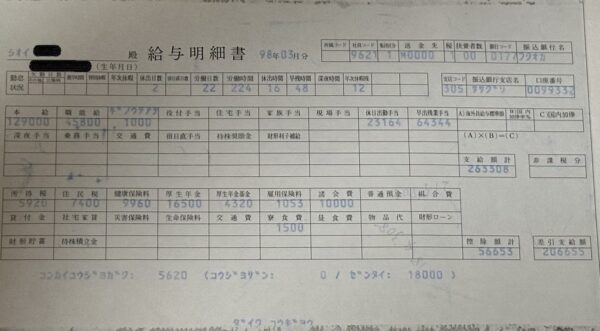
First, here's the one from March 1998, right after I joined the company.
- Base Salary: 129,000 yen
- Skill-Based Pay: 45,800 yen
- Holiday Work Allowance: 23,164 yen
- Early Shift and Overtime Allowance: 64,344 yen
- Total Amount Paid: 263,308 yen
- Net Pay: 206,655 yen
22 workdays, 224 hours worked.
That works out to more than 10 hours on site every day out of the 22 days in the month.
Since it's probably March, I imagine this is a time when things are starting to slow down a bit.
This is the amount of overtime I'm working in my third year.
I remember that with a take-home pay of 206,000 yen and being single, I had no trouble making ends meet.
Actually, I was deep in debt from pachinko and my car, lol.
Pay stub from June 2005, when I was 29 years old
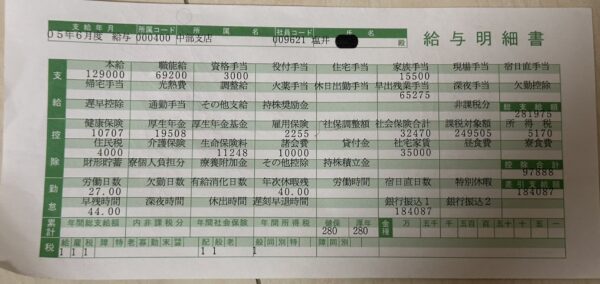
The second photo is from June 2005, when I was 29 years old.
- Base Salary: 129,000 yen
- Skill-Based Pay: 69,200 yen
- Certification Allowance: 3,000 yen
- Family Allowance: 15,500 yen
- Early Shift and Overtime Allowance: 65,275 yen
- Total Pay: 281,975 yen
- Net Pay: 184,087 yen
Base salary remains at 129,000 yen even after 7 yearsThat's just how it is, lol (It's really bad, lol)
The increases were in the skill-based pay (45,800 → 69,200), as well as the certification allowance and family allowance.
There were 27 working days and 44 hours of early and late work.
That just goes to show I was out almost every weekend, lol.
Plus, I think the system was set up so that no matter how much overtime you worked, you wouldn't get paid for anything over 44 hours lol
My total gross pay has gone up to 281,975 yen, but because my deductions have increased, my take-home pay is actually 184,000 yen.
That insurance policy I signed up for when I was young—after getting completely talked into it by that insurance saleswoman—is such a pain now~
That’s why the cost of living for families goes up.

What the Receipts Reveal About That Time
When you look at the two side by side,
① My base pay just isn't going up at all
For seven years, base pay hasn’t changed by a single yen. The system is designed so that pay increases are adjusted through competency-based pay and various allowances. After the bubble burst, this was standard practice even at major companies.
② A take-home pay structure based on the assumption of overtime
In both 1998 and 2005, if overtime pay were eliminated, take-home pay would drop sharply. It’s what’s known as a “pay-based-on-overtime” salary system.
③ The working hours are insane
In 1998, there were 22 workdays with a total of 224 working hours, plus 48 hours of work on days off.
In 2005, I worked 27 days a month and put in 44 hours of early shifts and late shifts. Since I worked a lot of holidays, it felt like I had almost no days off.
According to the Ministry of Health, Labor and Welfare’s “Criteria for Recognizing Brain and Heart Diseases as Work-Related Injuries,” the threshold for death due to overwork is defined as overtime work totaling approximately 100 hours in the month prior to the onset of the condition, or an average of more than 80 hours per month over a period of 2 to 6 months.
Back then, there were months when—including work on days off—my hours approached or easily exceeded this level.
At first glance, this might seem like a grueling workload, but since there was such a big difference between busy and slow periods, I felt like I was bracing myself for the end of the fiscal year.
Plus, as I mentioned above, anything over 44 hours didn't count! Those were the days.
I was already a tough cookie back then, lol.
I laid pavers, rode a wheel loader, hauled materials, and managed the construction site lol
Even so, I think the construction company’s workers earned about twice as much as I did.
Has the industry changed from what it was in the past?
According to the Ministry of Land, Infrastructure, Transport and Tourism, limits on overtime work have been in effect in the construction industry since April 2024.
(Generally 45 hours per month and 360 hours per year, according to the Ministry of Land, Infrastructure, Transport and Tourism’s “Work Style Reform in the Construction Industry”)
It really feels like a world of difference from back then, lol.
It's just my personal opinion, though.
Back in the day, I made a decent take-home pay because I got paid generously for overtime. (Even if there were some upper limits.)
Given the current restrictions on working hours, how can we maintain wage levels?
This is a major challenge for the industry, isn't it?
Specialized contractors, such as those specializing in slope stabilization, are particularly vulnerable to fluctuations in the general contractor’s budget.
Even if we try to raise labor costs, the industry as a whole won’t change unless the clients are willing to revise their labor rates and unit labor costs.
The labor unit rates for public works design, published annually by the Ministry of Land, Infrastructure, Transport and Tourism, have been revised upward in recent years, but
I think there are still some challenges when it comes to applying this to the field.
They’re demanding a pay raise even though unit prices haven’t gone up and output isn’t increasing due to overtime restrictions.
How difficult this is...

From my 50-year-old self to my younger self
Looking back at my pay stubs, I think to myself, “Wow, I really worked 224 hours a month—you’re amazing! And on that measly salary!” lol
But I want to make this clear to the younger generation today.
From now on, we need to move away from an era where people “earn money by working overtime” and toward one where they “earn money through skills, certifications, and efficiency.”
From the Construction Career Up System (CCUS)—which is still a crappy system—to industry-wide efforts to improve working conditions for skilled workers,
I feel like a system for fair evaluation is gradually falling into place. (I feel!? I feel??)
But actually, I recommend working as much as you can! That’s the fastest way to become good at your job! (Even though this contradicts what I said above 👆)
Personally, I don’t see old pay stubs as mere nostalgia—I see them as a “record of changes in the industry.”
I think I'll keep this one for a while, lol (maybe I'll write another post using a pay stub from a different year).
Do you still have your pay stubs from when you were younger?
It's funny to look back on that now.
Let’s reflect on both the good and the bad, and keep doing our best from here on out!
See you later.