

Hello, everyone.
This is Enta.
I started overhauling the mixers a few days ago, and I’ve successfully finished removing the rust from the first one lol
Next, I'll thoroughly clean off the dirt and apply a rust-preventive coating.
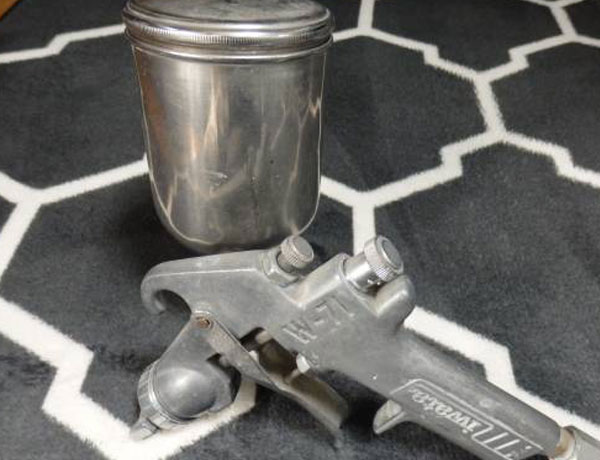
I use an airbrush to apply it, but that's a real pain, isn't it?
That's hard!
But that's beside the point.
Double Drilling (Double-Pipe Drilling)
— Outer Casing —
This is the drilling method used in rotary percussion drilling. (Applies to both skid-type and crawler-type rigs.)
This is the outer casing.

As the name "outer" suggests, this is the outer casing used during drilling.
The sizes increase in the following order: φ90 → 115 → 135 → 165.
This is what government agencies refer to as the nominal bore diameter.
But!φ90 is the nominal diameter of the pipe; the actual circumference of the pipe is 96 millimeters.That's it.
And the outer circumference of the bit is still large!
Some of you might be thinking, “Huh?” But, for example, a drill bit with a φ90 bore diameter has an outer diameter of about 105 mm.
There is a slight difference of a few millimeters depending on the manufacturer.
For a drill hole diameter of φ115, the length is approximately 125 mm.
Basically, it means that a 90mm bit is a little too big to drill a hole large enough to fit a φ90 pipe.
From a design perspective, this means it’s erring on the side of safety. (This increases circumferential friction.)
*The bit below is pretty worn down, lol*
If you insert the inner casing into this, it will look like the image below.

And that completes the double-pipe drilling.
Hammer
Since the hammers on the rotary percussion machine are mounted on the main body of the machine, they are classified as back hammers.
While the down-the-hole hammer was a front-hitting hammer, the air hammer and percussion hammer are back-hitting hammers.

There is a hammer built into the red part.
In terms of power, the backhammer is less powerful than the down-the-hole hammer.
Double-Pipe Structure

Water and air for drilling are supplied from the red circle.
When drilling through the gap marked with the green circle, the slurry (drilling cuttings, etc.) rises upward.
The slime is designed to be discharged to the outside through a part called the swivel.

That's a cross-sectional view from above, isn't it?
This is a bit sloppy, but please cut me some slack lol
This is double-pipe drilling (double drilling).
I hope this gives you a general idea of what it's like.
There are plenty of other drilling methods besides these.
I think these are typical examples of ground anchor installation and rebar insertion (rock bolts) work.
As for other construction methods, there are various vested interests involved, so I can’t discuss them publicly. I hope you understand lol.
There are also ways to increase drilling speed that make you think, “Seriously, this is impossible!!”
Since you can't see what you're doing, digging is a field that requires a high level of skill, so it's very difficult.
I’d like to try all sorts of things and keep developing my skills!
Various Drilling Methods (Part 1)
Various Drilling Methods (Part 2)
See you later
M's EDH3.5 Drifter Review | Key Evaluation Points in the Field