Hello, everyone.
This is Enta.
Did you know this?
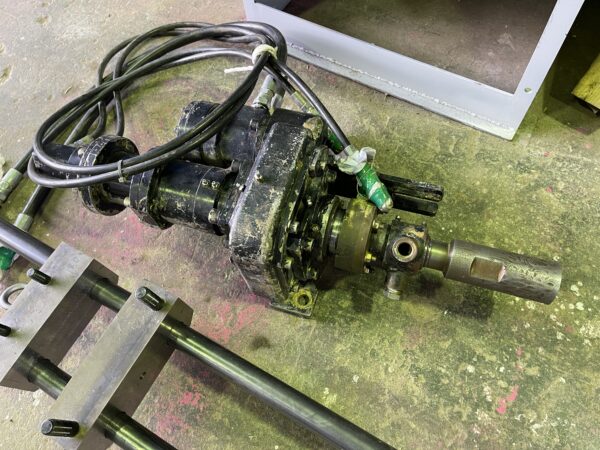
It's a machine called EDH3.5.
As you can probably tell just by the name, this is M's Drifter.
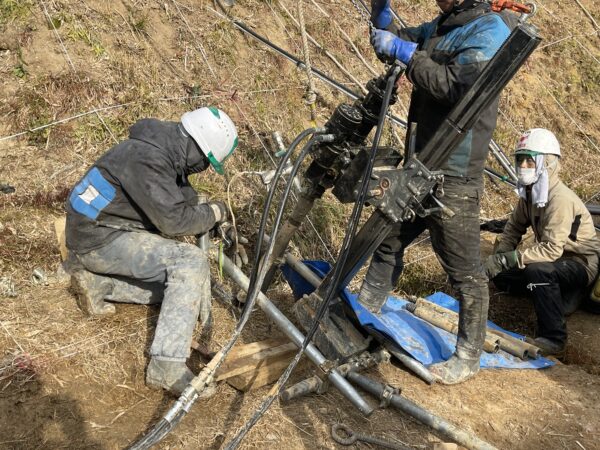
We used it on-site after securing it very tightly.
To begin with, since it’s designed with a hammer mounted on a core-pulling machine, it doesn’t have a standard guide cell.
For that reason, the only option was to secure it by wrapping it around a single-wall pipe, which is why it ended up looking like this.
The first thing that stands out about this machine is its weight.
The hammer alone weighs 50 kg, and the rails and accessories shown in the photo weigh 20 to 30 kg, bringing the total weight to 80 kg or more.
It's pretty rare to find a hydraulic system that weighs less than 100 kg.
Plus, since it's hydraulic, it's pretty powerful, so it never stopped spinning!
With air-filled tires, the rotation sometimes stops, but this EDH3.5 handled it just fine.
Well, part of it was that the natural rock was soft, but we were also using a rock drill at the same time, so the difference was really obvious, lol.
Here's the finished guide cell after we wrapped up at the site lol (couldn't test it)
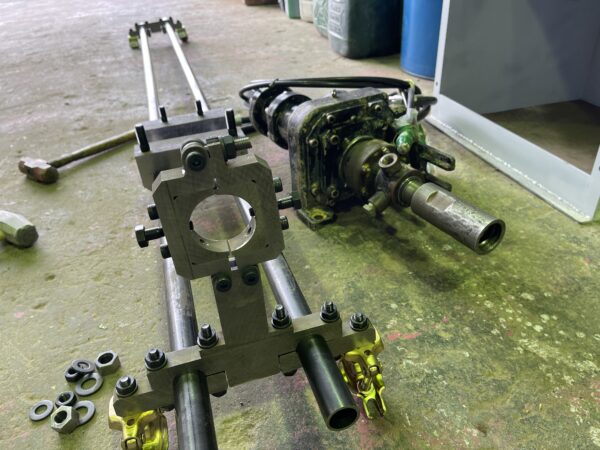
It is designed so that single pipes can be attached at the top and bottom, allowing it to be used as either a suspended or skid-mounted system.
We can easily drill holes up to φ115 mechanically, and we can also handle double-wall pipes.
Since we only used the φ65 this time, it was more than powerful enough.
Of course, it comes with a hammer, so it can effectively chip away at rock even when striking it.
However, it’s not the kind of super-powerful hammer you might be thinking of.
Just think about how heavy this machine is for its size, lol.
The EDH3.5 hammer fires four shots, each with a force of 35 J (joules).
Basically, it strikes four times for every full rotation of the disc spring.
Since that single blow is rated at 35J, I know it probably doesn't mean much to you, but it's roughly equivalent to the impact force of a mid-range electric hammer.

Here's a comparison of power hammers for your reference.
Roughly speaking, it feels like getting hit hard with a sledgehammer, lol.
This shows how another company uses them; apparently, they were originally designed for this purpose and are being put to good use with rock bolts in tight spaces in places like Tokyo.
This time, it was used on a slope.
Mechanically, it’s a very compact and easy-to-use machine, but of course, it has its drawbacks as well.
We have a hydraulic unit, and it weighs 200 kg.
It's very compact, but since it's water-cooled, it requires a constant supply of water.
It requires a constant flow of water—like when you lightly turn on the faucet—and the hot water coming out of the unit is pretty hot, lol (it was about 50 degrees).
Even during construction in the middle of winter, the machine temperature exceeded 60 degrees—I wonder what it will be like in the summer?
It's hot enough to take a bath in, after all, lol.
With a recirculating system, it seems like the coolant would flow out of the unit and then into the drilling fluid, right?
Overall, it's a very compact and well-made machine.
It can drill with a proper double-pipe setup (obviously), not some fake double-pipe setup lol.
Also, since it's so lightweight, I think it's the best machine for taking with you anywhere.
It would be great if, in the future, we could use machines like this to build on small lots without being restricted by patents on the machinery itself.
If you're interested, please contact M's.
By the way, since there are no guide cells or similar items, please come up with your own solution or contact Enta.
See you later.