

Hello, everyone.
This is Enta.
Lately, it’s been starting to feel like the rainy season.
It's crazy how slow things are at the slope construction company...
Just like last year, things are still pretty dire, but it seems like only the big companies are doing well...
We small and medium-sized slope construction companies are in a really tough spot, but let's hang in there and keep pushing forward!

(A dredger I photographed the other day at a job site near the ocean)
But that's beside the point.
This is a continuation of my previous post.
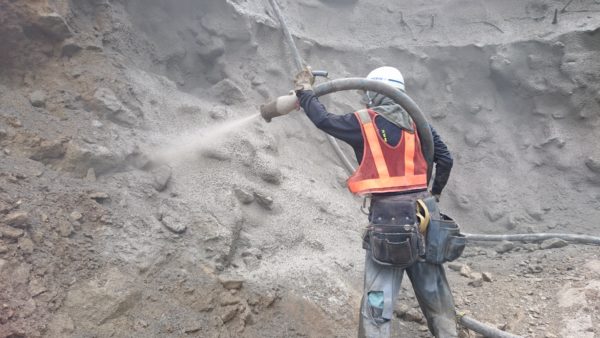
In this post, I’d like to write about sprayed mortar.
Basically, when it comes to spray-applied mortar, any shortcuts or poor workmanship are limited to the mortar itself.
All you have to do is spray it onto something that's already finished.
This is where we see the distinction between on-site mixing and plant mixing.
What Is On-Site Mixing?
We will install the machinery on site.
The equipment will be installed in the following order: sand hopper, Belcon, weighing machine, Belcon, and spray machine.
Below is a typical plant operated by a slope stabilization company.

This is what is generally referred to as an "on-site layout" for machinery.
Sand feeding → Batching plant → Sand metering → Batching plant (cement feeding) → Spray machine (water feeding) → Mixing → Spraying
The materials (mortar) will be dispensed in this order.
In the case of mortar supplied from a ready-mix concrete plant, the process is as follows:
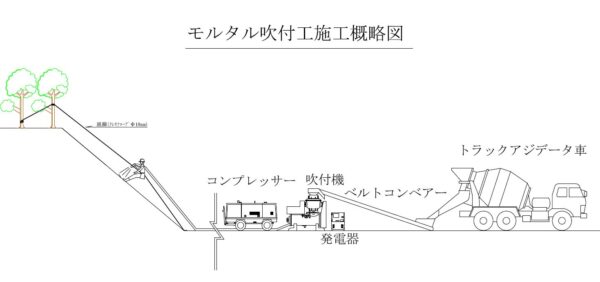
If you'd like the data,Shioda Development Co., Ltd. WebsitePlease use this link to download it.
There are two types: dry mortar (mortar without water added) and mixed mortar (regular mortar), and
In the case of air-cooled systems, the amount of water needs to be determined, so they are typically plants, but,
In the case of ready-mixed mortar, since the mixture is already prepared, the plant will not have equipment such as the weighing machine shown in the illustration above.
The most common construction defect in sprayed mortar (concrete) is the mix design.
Basic Formula
Indicated Dosage
| Sand (kg) | Cement (kg) | Water (kg) | Mixing Ratios |
| 1680 | 420 | 45–55% | 1:4 |
This is the basic formula.
Adjust the amounts of sand and water—and thus the mix ratio—based on site conditions and local conditions (such as the type of sand).
And while we’re supposed to apply the material using that specific mix, there are some “gunmen” (the people operating the spray machines) who arbitrarily change the mix.
The reason for making the change on my own is that the material isn't coming out of the spray gun the way I expected.
Most people just add more sand, though.
So, if you ask whether actually doing that will change anything, the answer is: nothing will change.
The strength is also about the same.
Since the mix ratio is excellent to begin with, the concrete will still achieve sufficient strength even if the sand content increases slightly.

But as a construction manager, I just can't overlook that, lol.
In that case, you should start by doing test mixes, adjusting the amounts of sand and water to see what works, and then finalize the mix ratio.
There is no requirement to follow the formula exactly when applying it.
This means that as long as you determine the actual mix design based on this standard mix design, there will be no problems.
Basically, as long as the mix ensures sufficient strength and is approved by the authorities, there’s no problem at all.
So, the slope contractors have known about this for a very long time, right?
It's common knowledge, but is it a taboo in a sense?

So why do we add more sand? Well, when the spray distance increases, it’s better to have mortar with less viscosity so it can be sprayed farther.
The better the mix ratio, the stickier the material becomes.
Basically, imagine the cement clinging to the inside of the hose.
Therefore, by using more sand, the cement adheres firmly to the sand and flows smoothly through the hose.
That's the general idea.
I totally understand how you feel.
But I really hope they pull it off! (That’s telling, lol)
Using an admixture or something similar is a pretty effective way to easily solve this problem.
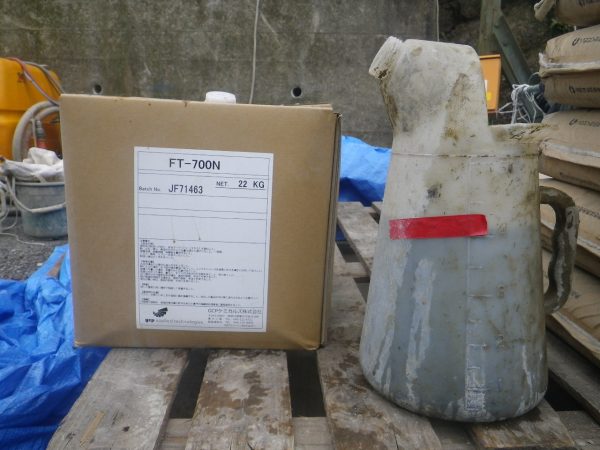
It's expensive, but the former LeoBuild (nowMaster Lock FLC400) and things like that.
During the summer, with a little ingenuity, you could even use a slow-setting flow agent like FT700, right?
See you later.