Hello, everyone.
This is Enta.
Have you heard of carbon neutrality?
I just found out about this myself recently, but it’s the CO2 issue that’s been a concern for some time now.
To put it simply, it's like, "Stop emitting CO2!" lol
In particular, as part of its national policy to promote the shift to electric vehicles, the government has set a goal of “banning gasoline-powered cars” by 2030.
And it seems the automotive industry is working hard toward that goal.
There is a high likelihood that this trend will definitely reach the construction industry as well.
As expected, our CO2 emissions are quite significant.
The same goes for the stickers indicating compliance with emissions regulations for construction machinery.
These days, when you buy a new car, it complies with the Third Emission Standards.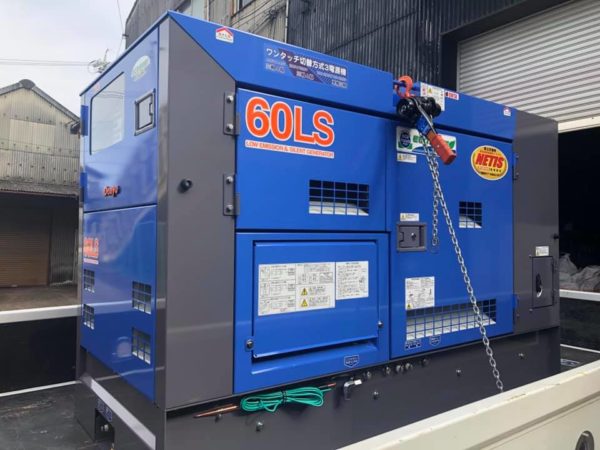
I just noticed from the photo that the generator I bought the other day is actually registered with NETIS, lol (I had no idea).
If there is a growing push for better fuel economy and higher efficiency in the future, it is entirely possible that our older machines will no longer be usable.
This isn't about the previous controversy, but I recall hearing that passenger cars registered more than 13 years ago would face a 39% tax increase (20% for kei cars), right?
There is a possibility that something similar to that could emerge in the construction industry in the future.
Currently, within the existing regional scoring system, points are awarded for CO2 reductions, or for creative ways of using this machine to reduce CO2 emissions by a certain amount.
That's probably how it will turn out.
Our friends, the Slope Guys! (Just as awesome as the ball in *Captain Tsubasa*!)
2.3 kVA Compact GeneratorI did some calculations to see if I could power it with solar energy.
The hammer drill used for slope stabilization work has a power consumption of 1,100 W and is operated for 6 hours.
Also, since using just one unit is a struggle, we’ll use two. (Inverter loss: 85%, available discharge capacity: 70%)
In conclusion, the battery capacity is now 2000 Ah (including losses).
Convert that to solar panels: 4,000 W = 4 kW (rounded up to account for losses)
14 panels, assuming the use of panels capable of generating 300W
Assuming each sheet is approximately 1.7 m², 1.7 m² × 14 sheets = 23.8 m²
If you lay out a solar panel measuring about 5 m × 5 m on site, you can drill holes with a hammer drill without emitting any CO2—as long as the weather's good! lol
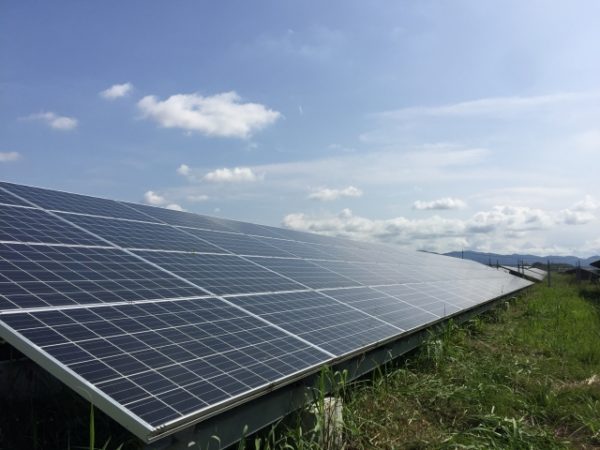
If it's sunny!
That's the basic premise—if it rains or is cloudy, we'll either have to stop working or switch to other tasks, but in a way, it really makes a big impact, lol.
It’s not at all realistic, but it would be kind of funny to have a 5m × 5m solar panel just sitting there on site. lol (Though it would be way too expensive and probably impossible.)
It does seem that using this clean energy source may be impractical after all, so there may still be room for further consideration; however, for the time being, CO2 regulations for internal combustion engines look set to become stricter.
I realized that since this actually affects us more than we might think, we need to take a close look at it and give it some thought.
To put it bluntly, what about using products that clearly state their CO2 emissions during production?
How much CO2 is emitted during the production of the work gloves I use every day, and are they low-carbon products?
The same goes for the materials we use.
What about the wire mesh? What about the prestressed steel strands?? And so on.
You definitely can't overlook moves like this.
Please take a moment to think about it, everyone.
See you later.