Hello, everyone.
This is Enta.
Have you seen the Ministry of Land, Infrastructure, Transport and Tourism’s revised cost estimation standards, announced on March 2, 2026?
Since this is directly related to slope stabilization work, I’d like you to read it carefully, but,
This seems like it might be related to the craftsmen as well, but since it concerns the quotation and cost estimation stages, as well as design changes, it’s neither directly related nor entirely unrelated.
I think this is something administrators should be aware of.

The Ministry of Land, Infrastructure, Transport and Tourism has revised its cost estimation standards. So, what’s changed?
The four main points of this revision are as follows.
(1) Increase in the General and Administrative Expenses Rate (first increase in four years)
(2) Complete Abolition of the Two-Day-Weekend Adjustment Factor
③ Expansion of funding for measures against extreme heat and cold (raising the cap on on-site environmental improvement expenses from 50% to 100%)
④ Revision of labor rates to reflect heatstroke prevention measures (6 job categories)
I'll write them down in order.
① An increase in the general and administrative expense rate—simply put, this means the unit price of orders will go up.
With this revision, the general and administrative expense ratio will be9.74–23.571 TP3T to 10.63–25.131 TP3Twas raised to .
(Source: Ministry of Land, Infrastructure, Transport and Tourism, Press Release on Revisions to Estimation Standards for Civil Engineering Works and Services for Reiwa 7)
This is the first revision in four years.
Exactly how much will it change?
For a river construction project with direct construction costs of 100 million yen, the general and administrative expense rate has increased by approximately 1.21 percentage points, bringing the estimated price toAn effect that boosts the figure by approximately 1.6 million yenIt is said that there is one.
1.6 million yen.
Some people might think this is a small amount, but this is strictly speaking just the general headquarters expenses of the prime contractor.
It's not the kind of project that comes directly to a subcontractor like us, a slope construction company.
The Ministry of Land, Infrastructure, Transport and Tourism has stated that it will “step up fact-finding surveys to ensure that skilled workers receive fair wages,” but,
Whether this actually reaches the craftsmen on the front lines is another matter entirely.
That’s a separate issue from whether the general contractor actually passes the work down to the subcontractors, isn’t it...

② The complete abolition of the two-day-off adjustment—isn’t this a double-edged sword?
Based on the determination that the two-day weekend system has become “well-established” at directly managed sites, we will end the trial period and completely abolish the two-day weekend adjustment factor.
In other words, this means the adjustment for the additional costs incurred by implementing a two-day weekend will no longer apply. Roughly 1.05%.
Huh? Isn't that a disadvantage for the construction company?
If that's what you thought, you're right.
The fact that the adjustment factor has been abolished means that the costs associated with a two-day weekend are now considered to be “a given” and factored into the cost estimate.
The Ministry of Land, Infrastructure, Transport and Tourism has determined that “this practice has become established at sites under its direct jurisdiction.”... (Is that so!?)
Two days off per week = higher costs, yet the budget amendment is being scrapped.
On the other hand, I think this could also be interpreted to mean that having two days off per week is no longer mandatory—but what’s the reality here!?
Does this mean we can proceed with construction flexibly, taking the schedule into account?
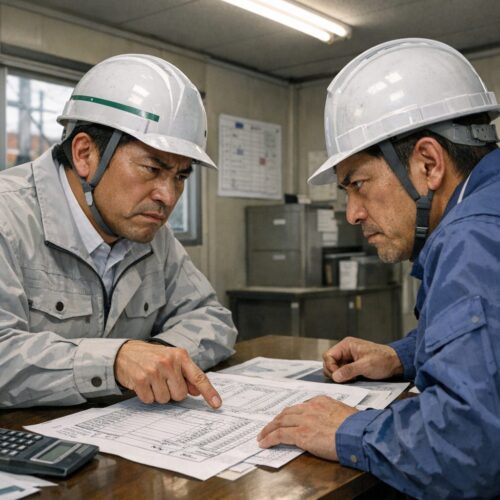
③ The cap on expenses for countermeasures against extreme heat has been raised from 50% to 100%. Equipment costs at construction sites will increase.
I think this is the part of this revision that most directly affects those on the front lines.
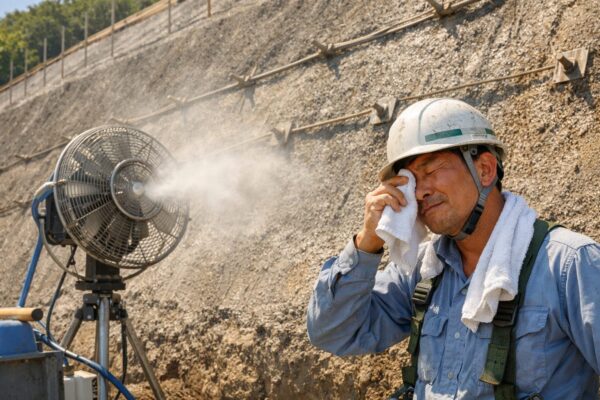
Regarding the costs of facilities and equipment for heat and cold protection (such as mist fans, spot coolers, etc.),
There is a system in place to account for these costs separately from the “Site Environment Improvement Costs” under general temporary facility expenses.
Until now, the upper limit on the amount recognized wasUp to 50% for on-site environmental improvement expensesThat was it.
This time,Within 100%It will be expanded and will also be subject to design changes. (Source: Ministry of Land, Infrastructure, Transport and Tourism, Revisions to Cost Estimation Standards, etc., for Reiwa 7)
The upper limit has doubled.
This revision reflects the actual situation.
Especially when working in mountainous areas or on slopes—like at a slope-construction site—the sun is just too strong (lol), and the summer heat is out of this world.
One mist fan just isn't enough, is it?
No way! You can't even attach it to a slope in the first place, right? LOL
For example, if the cost of improving the worksite environment were 800,000 yen as part of the construction cost, then,
Previously, the maximum amount that could be spent on equipment to combat extreme heat was 400,000 yen, but going forward, it is estimated that up to 800,000 yen will be available.
However.
This simply means that “the maximum amount that can be reported has increased.”
The temperature at the site itself will not change.
Even if we add more mist fans and take more breaks, the harshness of the scorching sun beating down on the slope remains the same.
The fact that we can now set aside funds for these measures is a step forward, but the fundamental problem of “carrying out construction during the summer” remains unresolved.
As far as I'm concerned, the only option I have right now is to drastically reduce the construction time.
④ Revision of labor rates; inclusion of downtime in cost estimates for the first time
There are some groundbreaking aspects to this revision.
The work suspension period for heatstroke prevention is,First reflected in the progress trackingThat's how it turned out.
This is actually pretty big.
In previous calculations, even when work was suspended during the summer when the WBGT (heat index) reached 31°C or higher, that downtime was not reflected in the calculations.
In short, even though work had stopped on-site, the cost estimate was calculated on the assumption that work had not stopped.
In short, it means that unit prices will go up, even if only slightly.
In fiscal year 2026, jobs such as rebar workers and temporary fence installation and removal workers, etc.6 TradesThe revision to the unit rates will apply to [target group].
Although the scope does not currently include work types directly related to slope construction, we hope to see this expanded in the future.
By the way, why is it necessary to review the unit price?
According to guidelines issued by the Ministry of the Environment and the Ministry of Health, Labor and Welfare, when the heat index (WBGT) reaches 28°C or higher, “strenuous exercise should be suspended,” and when it reaches 31°C or higher, “exercise and similar activities are generally prohibited.”
During the summer at construction sites, especially when working on slopes, WBGT values can consistently exceed 31°C. (Isn’t that almost always the case?)
In other words, this is an issue that doesn't reflect reality—specifically, that "the time during which work had to be suspended was not included in the total."
This explanation got way too long, so I'll continue next time lol
See you later.