



Light Industry has developed the “Remote Sky Drill” (a wireless-controlled backhoe drill), an ICT drilling system designed to enhance productivity for rebar installation and rock bolting operations. This system enables a single backhoe operator to perform all tasks—from setting the drilling position to drilling and managing the drilling depth—thereby contributing to labor savings. The simplification of the equipment’s accessories allows for rapid movement to the construction site, further improving operational efficiency.
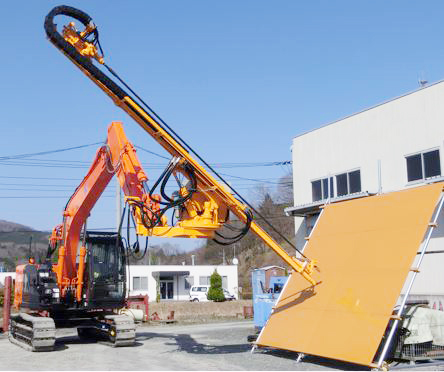
A single backhoe operator can handle everything from setting the drilling location to drilling.
The Remote Sky Drill is equipped with a sensor box containing a guidance camera, distance sensor, and IMU (inertial measurement unit), as well as a length measuring device and an auxiliary camera, all mounted on the drilling rig; the operator's cab is equipped with a monitor and a wireless remote control.
When setting the drilling location, the backhoe operator can perform the task alone by monitoring the camera feed and the drill’s angle relative to the slope on a monitor; therefore, the drill operator who was previously required is no longer needed.
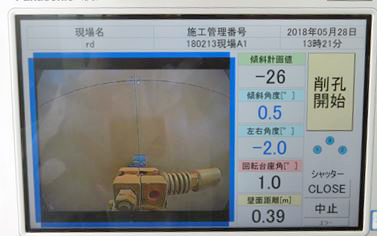
You can check camera images, tilt angles, and other information from the driver's seat.
Drilling begins when the monitor is tapped, and since the drilling depth is displayed immediately, the backhoe operator alone can manage the drilling depth. Various data—such as the date and time of construction, location, angle of inclination, and drilling depth—are recorded and can be managed centrally.
The drilling machine’s power source was changed from pneumatic to hydraulic, increasing its drilling force. By sourcing the hydraulic power directly from the backhoe itself, the auxiliary components required for operating the drilling machine—such as the hydraulic unit and hydraulic hoses—were made more compact, improving maneuverability. This allows for rapid movement to the next drilling location, contributing to overall operational efficiency.
In addition, because the drill is lighter, it can be mounted on smaller backhoes—down from the conventional 0.8 m³ class to the 0.5 m³ class—which improves maneuverability on tight job sites.
We are currently applying this technology at a site in Kyushu to verify its drilling performance and other characteristics. Moving forward, we will work on verifying cost reductions and narrowing down the required performance specifications in preparation for full-scale deployment at actual job sites.



Thanks for your hard work. I’d like to hear your thoughts and impressions about this machine, Enta—including everything related to its development, such as costs, labor expenses, productivity, safety, and other factors. ^_^
Thank you for your hard work.
I don't really want to say too much about other companies' machines, but the key feature of this one is that a single person can handle both the installation and the drilling.
However, since it’s ultimately people who insert the rebar, that means there must be at least two people—one operating the machine and one working at the workstation.
Will this ultimately lead to cost savings? I think it will significantly reduce the time required for installation and drilling.
The way I see it, I think this is just the beginning of machine development.
To be honest, we have a packed schedule ahead, so I think we’ll probably just stick to experiments with the single-hole drilling machine for now.
There are concerns that air-powered drilling machines lack power relative to the noise they produce. If they were converted to a hydraulic system, we could conduct drilling experiments in a variety of ways.
I can't say this myself, but as far as I know, I'm extremely interested in Light Industries' future machinery development.
It really feels like the industry leader.