Hello, everyone.
This is Enta.
This is a continuation of the previous post.
I Tried Measuring the Limit of Packer Pressure!
I Tried Measuring the Limit of Packer Pressurization! (Part 2)
I Tried Measuring the Limits of Packer Pressurization! (Part 3)
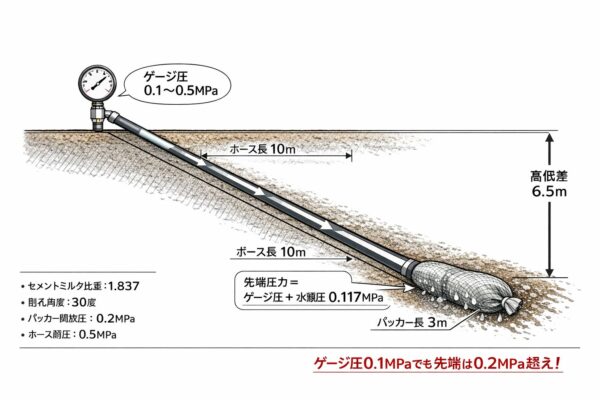
Inject while watching the gauge. What's going on with the packer?
This is the most important part.
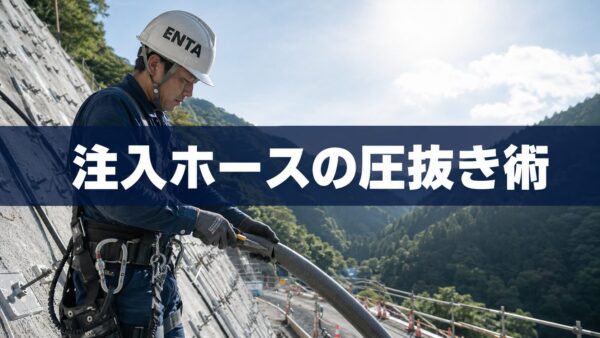
As you apply pressure while monitoring the gauge on the hose nozzle, what is actually happening at the tip of the packer?
Those are the on-site conditions.
Drilling angle: 30 degrees
Poly Hose: 10 m
Packer: 3 m
Total length: 13 m
Since the drilling angle is 30 degrees, the actual elevation difference is:13m×sin30°=13×0.5=6.5 m
If we multiply this height difference by the specific gravity of the cement slurry and the acceleration due to gravity:1.837×9.8×6.5=0.117 MPa
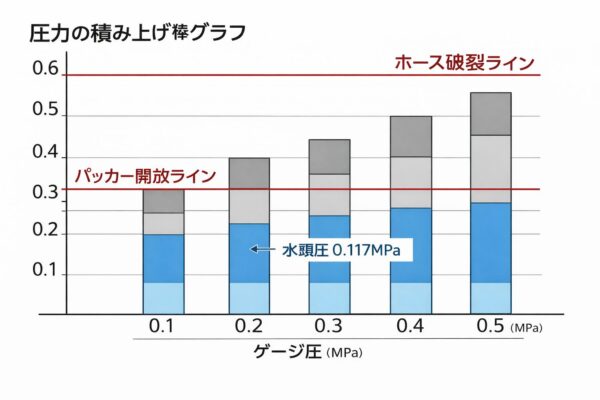
| Gauge Pressure (Hose Connection) | + Intracranial Pressure | Packer Tip Pressure | Status |
|---|---|---|---|
| 0.1 MPa | +0.117 | 0.217 MPa | ⚠️ Fabric Stitches Coming Apart |
| 0.2 MPa | +0.117 | 0.317 MPa | ⚠️ Fabric Stitches Coming Apart |
| 0.3 MPa | +0.117 | 0.417 MPa | ⚠️ Fabric Stitches Coming Apart |
| 0.4 MPa | +0.117 | 0.517 MPa | 🚨 Risk of Hose Rupture |
| 0.5 MPa | +0.117 | 0.617 MPa | 🚨 The hose will definitely burst |
By the time the gauge reads 0.1 MPa, the packer’s fabric has already opened up, lol.
"Applying pressure gradually" is actually quite accurate; considering the hydrostatic pressure, I think a gauge pressure of around 0.2 MPa is actually quite dangerous.
Some people apply pressure all at once, but that’s very likely to break the packer.
At 0.4 MPa on the gauge, you’re already in the danger zone for a hose rupture, and 0.5 MPa is definitely out of bounds lol
How often should I actually check on things?
To ensure that the pressure at the packer tip does not exceed 0.2 MPa:
Allowable gauge pressure = 0.2 − 0.117 = 0.083 MPa
In other words, a gauge reading of 0.08 MPa or less is considered a safe operating guideline.
Some of you might be thinking, “Is that low pressure really okay?” but according to the calculations, this is the correct value.
To begin with, a packer isn't necessarily intended for pressure injection, and...
Since this tool is designed to hold the cement slurry in place and prevent it from spilling,
Applying too much pressure can be counterproductive.
The specific gravity of cement slurry is 1.837. It is about 1.8 times heavier than water.
Considering the drilling angles and depths used in recent ground anchor construction, a gauge reading of approximately 0.08 MPa or less is a safe guideline.
≈0.1 MPa
If the drilling length increases or the elevation difference becomes greater, the pressure will continue to rise.
So,
Do not increase the pressure from the packer injection to more than 0.1–0.2 MPa!
Please keep this in mind.
There are times when the pressure doesn't even go up to 0.2 MPa, right?
Could it be that...
See you later.