Hello, everyone.
This is Enta.
I Tried Measuring the Limit of Packer Pressure!
I Tried Measuring the Limit of Packer Pressurization! (Part 2)
In my previous post, I wrote that you must never apply more than 0.5 MPa to the packer.
The hose bursts, and the packer’s mesh stretches out, causing the cement slurry to gush out everywhere. This is something I actually confirmed during an experiment.
So, here’s that fifth thing I mentioned at the end of my last post.
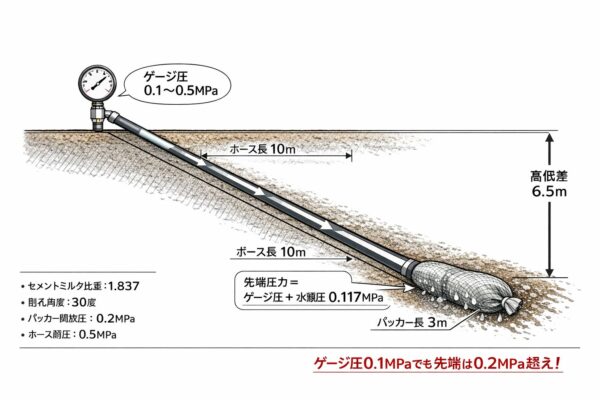
"The difference in elevation puts an incredible amount of pressure on the tip of the packer."
Today, we're going to take a closer look at this.
Actually, there are a lot of workplaces where people do this without even realizing it.
That's why there are a lot of people who say things like, "Pakka- always breaks," or "You can't trust it."
I'm sure you know that cement slurry isn't water, lol.
First of all, cement slurry is much heavier than water.
It goes without saying, but since this weight directly affects the pressure, I'll make sure to calculate it properly lol
Calculated using a standard cement slurry mix (1,230 kg per 1 m³, W/C = 50%).
| Ingredients | Weight | Specific Gravity | Volume |
|---|---|---|---|
| Cement | 820 kg | 3.16 | 259.5 L |
| 水 | 410 kg | 1.00 | 410.0 L |
| Total | 1,230 kg | — | 669.5 L |
Specific gravity = 1,230 ÷ 669.5 = 1.837
Since the specific gravity of water is 1.0, cement slurry is a liquid that is about 1.8 times as heavy as water.
This weight builds up as pressure the further down you go.
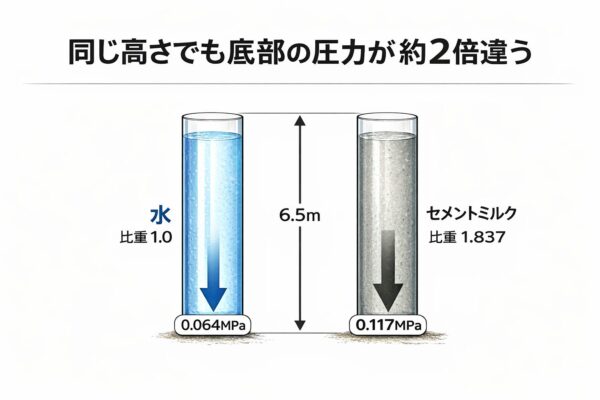
Let's calculate the hydrostatic pressure based on the elevation difference.
Those are the site conditions for this project.
Drilling angle: 30 degrees
Poly Hose: 10 m
Packer: 3 m
Total length: 13 m
Since the drilling angle is 30 degrees, the actual elevation difference is:13m×sin30°=13×0.5=6.5 m
If we multiply this height difference by the specific gravity of the cement slurry and the acceleration due to gravity:1.837×9.8×6.5=0.117 MPa
Even when the gauge reads zero, the packer is already under a pressure of 0.117 MPa.
While water (specific gravity 1.0) would require only 0.064 MPa, cement slurry is subjected to approximately twice that pressure.
I'm sure you've already figured out the conclusion, but please let me continue this story next time lol
See you later.