Hello, everyone.
This is Enta.
Last time, we talked about the pressure in the packer.
I Tried Measuring the Limit of Packer Pressure!
What we learned from this experiment was that even if the pressure is increased to 0.2 MPa or higher, the weave of the packer fabric opens up, making it pointless.
At 0.2 MPa or higher, cement slurry starts gushing out.
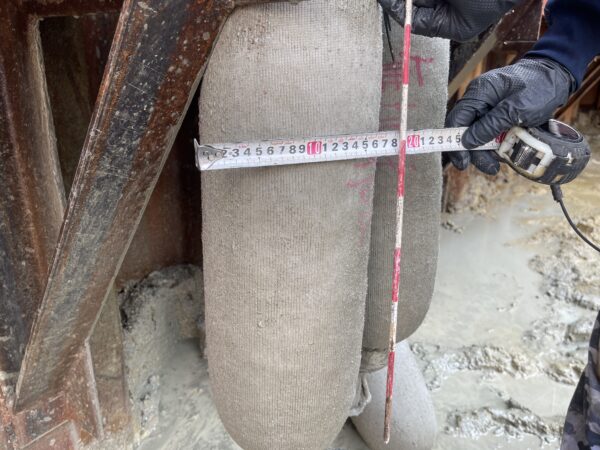
Therefore, a maximum value of 0.2 MPa is sufficient.
And there's one more important thing.
Occasionally, some people say to increase the pressure to 0.5 MPa or higher.
However, please do not do this under any circumstances.
There was something I learned from this experiment.
That happened before Packer,The plastic pipe is about to burst!w
There are only three videos, but we actually conducted twice as many experiments—six in total.
At first, the packer tests were conducted to see how much stress the packer could withstand and to check the condition of the areas where it was secured.
Because of that, I used to raise the pressure higher than necessary—up to 0.6 MPa or so—but the polyethylene pipes would generally burst at around 0.5 to 0.6 MPa.
At first, I wondered if the packer was leaking because it was cut wrong, or if the tie-off band was causing the problem.
I had imagined things like that, but in reality, it turned out that the mesh had stretched or that the polyethylene pipe itself wasn't strong enough.
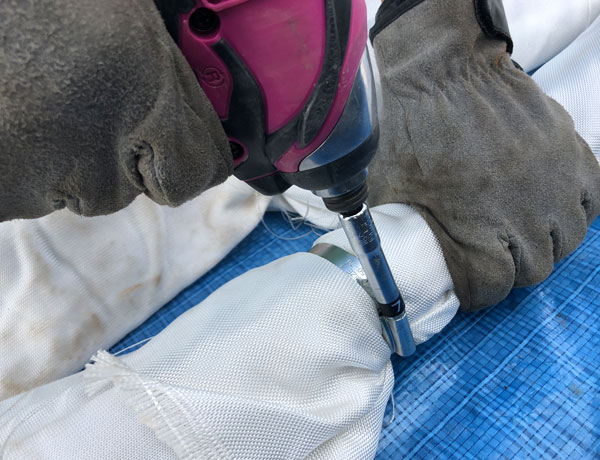
In conclusion, it is definitely better to set the maximum value for the packer pressure to 0.2 MPa as a general rule.
Any more than that, and the packer will likely be a waste.
1. The possibility of the packer rupturing
2. The possibility that the packer's tie-off point could come undone
3. The hose may burst
4. The hose may rupture, making it impossible to maintain pressure.
5. Due to the difference in elevation, the tip of the packer is subjected to tremendous pressure.
I'll try to explain the reason for this in my next post.
See you later.