

Hello, everyone.
This is Enta.
The other day, someone said they couldn't find the application form for Real Entertainment's Slope Management Seminar, so,
I redesigned the banner at the top of the page lol

This is how I originally made it, but here's how it looks after the changes.

I don't think anyone would get this wrong lol
Click the banner above to open it!
We've been told there are currently 21 people, so please make your hotel reservations as soon as possible.
But that's beside the point.
Do you all know how general contractors make a profit?
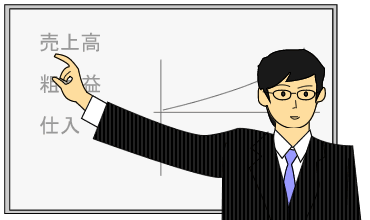
Let's look at this from the perspective of construction cost estimation.
The breakdown of the total construction costs is as follows:
Direct Construction Costs
------
General Temporary Construction Costs —
General and Administrative Expenses —— Indirect Construction Costs
Site Management Fees —
Broadly speaking, these are divided into direct construction costs and indirect construction costs.
For general contractors, indirect construction costs typically amount to approximately 30% to 50% of direct construction costs, depending on the project value.
For example, if direct construction costs total 10 million, that means there are indirect costs of about 5 million.
As the amount increases, the expense ratio also changes.
If a first-tier subcontractor submits a quote to the general contractor with direct construction costs of 10 million,
The general contractor will cover labor costs (for the site representative) and some temporary equipment from the 5 million budget and carry out the construction work.
The more the general contractor cuts costs in this area, the more money they make. (The money left over is profit.)
*On a project worth around 15 million, the main contractor’s profit margin is pretty limited, and,
It might end up being a wash, but I've written this in a way that's easy to understand.
It would be great if first-tier subcontractors could get paid for both direct labor and overhead, but that depends on the nature of the project.
When a first-tier subcontractor brings in a second-tier subcontractor, the costs are covered within the direct labor costs, but there are times when we set a budget and still end up in the red.
However, since we’ve already submitted a quote to the general contractor, there’s no way we can change it at this late stage, and
In most cases, we have to turn a profit.

What should you do in that situation?
It's a simple story, really—it's about squeezing the subcontractors (forcing them to lower their contract prices).
This is the easiest way.
The larger the company, the more this might be an unavoidable situation.
At branch offices, the operations and purchasing departments are separate.
Even if the Construction Department draws up a budget, it’s a no-go if the Purchasing Department says no, and some companies have fairly fixed nationwide unit prices (based on the lowest price).
Since Purchasing is the department that decides everything from materials to construction unit prices, the Construction Department ends up coming up with something that’s sort of like a budget, but not really a budget, lol.
However, since the Construction Department handles the negotiations, the supervising engineer ends up having to ask a subcontractor to handle it, which is a source of frustration.
To put it bluntly, the pattern where general contractors squeeze their subcontractors to turn a profit has remained unchanged, both now and in the past.
There are two other methods as well.
That's a design change!
Switching to construction methods that are advantageous to your company or that offer benefits in terms of materials can change your profit margin.
*"Material benefits" refer to materials for which there is a difference between the list price and the delivery price.
The last point is to get the work done quickly.
This might actually be the most legitimate way to make money, lol (though subcontractors don't have much wiggle room).
1. Reduce the contract amount for subcontractors
2. Make design changes
3. Finish it quickly
I think this pretty much covers it.
What do you all think?
At first glance, some of the job titles might seem really off-putting, but that’s just the nature of this line of work.
The government agency awards the contract to the general contractor.
The general contractor assigns work to a subcontractor.
A subcontractor uses its own employees to do the work.
Employees receive their pay.
The system is designed so that sufficient funds are allocated to every area.
If that amount (the contract price) is too low or too high, it will be called out.
That's how it works. Basically, lol.
This is a rough overview of how general contractors in the construction industry make money.
I'll skip the details lol
But it’s highly likely that we won’t be able to do things like this anymore, isn’t it?
I'll do that tomorrow, then.
See you later.