



Hello, everyone.
This is Enta.
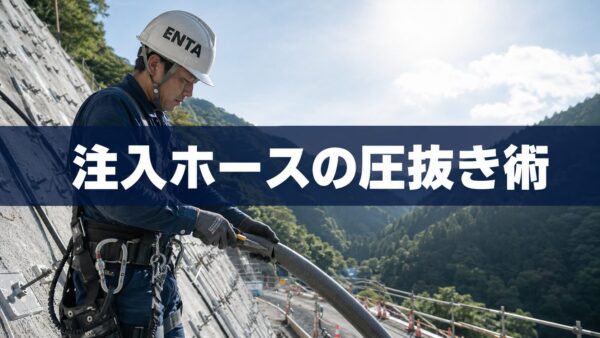
Cement slurry is injected during rebar insertion and ground anchor installation.
If the cement slurry keeps flowing in, how far should you let it go?
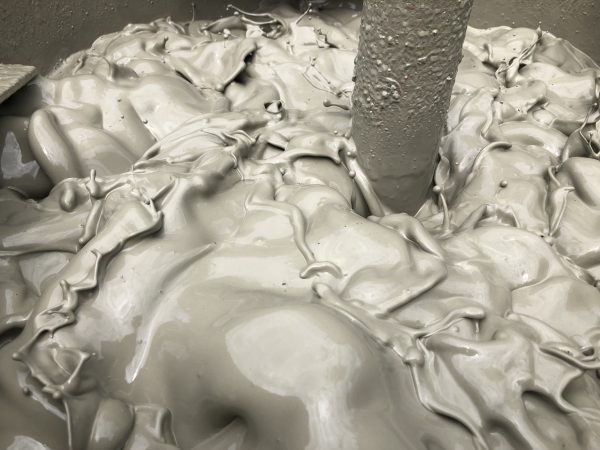
For example,
Suppose there is a rebar insertion job involving a 90-mm-diameter borehole and a depth of 5.0 m.
The injection volume is
0.045 m × 0.045 × π × 5 m = 0.0318 m³.
Assuming a design loss factor of 2.3, this comes to 0.0731598 m³
Since the amount of cement in cement slurry is 1,230 kg per 1 m³,
0.0731598 × 1230 kg ÷ 25 kg/bag ≈ 4 bags. (100 kg)
Please note that the figures above are merely design values.
I'll provide the actual measurements.
Since the hole diameter is larger, as shown in the link above, the actual quantity differs from the design specifications.
Let's calculate using the actual hole diameter of 105 mm. (This may vary by a few millimeters depending on the manufacturer.)
0.0525 × 0.0525 × π × 5 m × 1,230 ÷ 25 × 2.3 ≈ 5 bags (125 kg)
That alone makes a difference of about 20%, doesn't it? lol
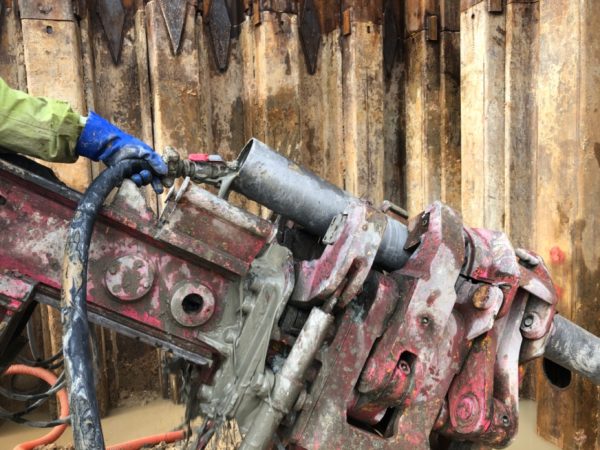
Well, anyway,
According to actual measurements, 10 bags fit where 5 were supposed to.
That's twice the design specification.
How many times the original amount do you inject?
The Design and Construction Guidelines for Ground Anchor Works state that the anchorage section should be grouted continuously.
A long time ago, as part of landslide prevention work on National Route 42, I poured 5 cubic meters of cement slurry into a mountain that just wouldn’t give way!
The contractor working for the Ministry of Land, Infrastructure, Transport and Tourism said that's what it said and wouldn't listen to our opinion.
Even though I had suggested that we use a packer.
What should I do if I pour 5 cubic meters with a single pour and the concrete still doesn't rise?
Since you said I could adjust the injection volume, I put in 5 m³ for now.
"Give me the next instructions," lol
In cases like this, when you first try to figure out where the problem lies, it comes down to the design.
The design assumes that there is a consolidation layer there.
However, in reality, it cannot be secured because there is no securing point there.
That means we didn't fully anticipate this during the design phase.
That said, there’s no way we could possibly anticipate everything, so we’ll just have to make design changes on-site.
That's because they follow the book to the letter instead of listening to experienced technicians.
The book covers only the basics; it does not address special cases.
You can only gain experience with the unexpected through on-the-job experience.
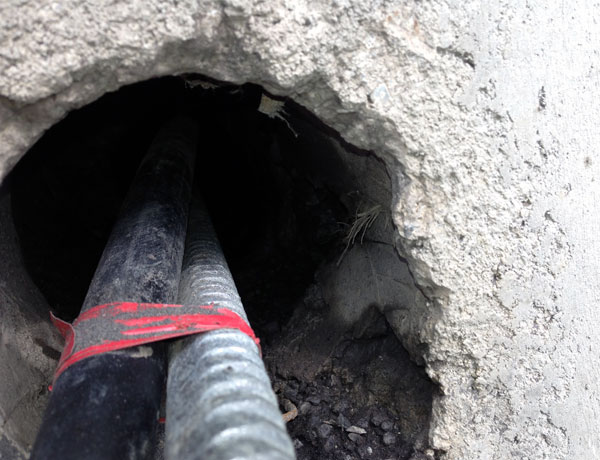
While there is information provided regarding ground anchor installation, there is no specific mention of rebar insertion work.
That's because ground anchor contractors rank at the top.
However, there are a whole lot of things that aren’t even covered in the ground anchor manual—so what do you do in those situations?
With that in mind,
So, how far should we inject it?
When that happens, the first thing to consider is, of course, a packer.
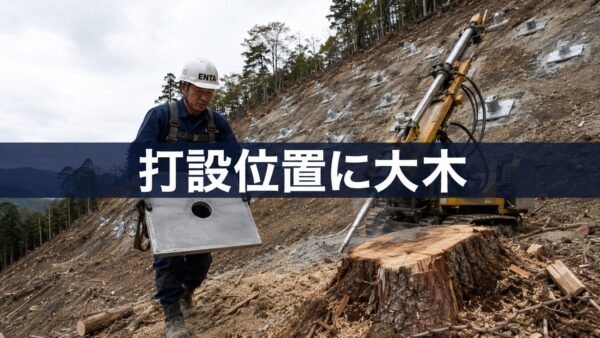
It's nonsense to keep injecting cement slurry into a mountain that can absorb as much as you want!
The risks involved at that time are as follows.
1. Runoff into rivers and other waterways
2. Runoff into Fields and Farmland
3. Runoff into culverts and other structures
4. Blockage caused by backfill material (such as crushed stone) behind the retaining wall
5. Blockage in the Mizumichi (pipe flow)
6. Weight Gain in Thin Layers (Uneven)
7. Even when injected, the cement slurry does not penetrate the rock mass.
8. Since the injection is by natural flow, if there are any holes, it will flow in as much as it wants.
If you want to ensure reliable construction while avoiding risks, a packer is the only choice. (For now, at least.)
So, tomorrow we'll be marking out the lines for the paver.
See you later.


Sometimes it flows out of a river a few kilometers downstream, doesn't it?
Now that I know the reason... it's not so bad, lol.
It's important to know your limits, lol.