Hello, everyone.
This is Enta.

Risks and Troubleshooting in Grouting Operations (Part 1)
This is a continuation of my previous post.
1,230 kg per cubic meter ≈ 50 bags
That means, in the case of the recent rebar insertion project with a borehole diameter of φ90 and a borehole depth of 5.0 m,
If the volume is about 10 times the design volume, that comes to 1 cubic meter, which amounts to about 46,000 yen (rough market price).
Let's consider this from the perspective of using a packer.
The processing cost per piece is estimated to be around 10,000 yen.
Let's assume the market price of packing material is 6,000 yen.
Assuming that it is unknown where and in which section the cement slurry is leaking,
When considering the "All-Packer" (full) configuration,
5.0 m × 6,000 yen = 30,000 yen (materials)
30,000 yen (materials) + 10,000 yen (on-site processing) = 40,000 yen
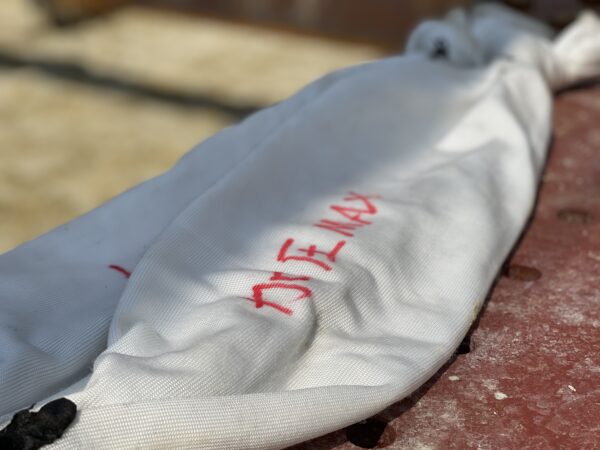
Roughly speaking, this is equivalent to the cost of using a packer when using about 44 bags of cement.
Please calculate the total amount and think it over.
If players can move up the field as far as they want on a single play, it’s up to the coach to decide at which line to switch to a packer.
At first, government officials are quick to say, “Let’s just change the design,” but once the order reaches a certain volume, they ask, “Why didn’t we just go with the packer!?”
...is what they'll say.
On top of that, there are many people who say they just can't watch this much.
So, should I prepare a document stating that all the funds received through the injection have been accounted for, and have it signed and stamped, or should I just submit it?
To be used as a meeting log or memorandum of discussion.
To be honest, in mountains where grout pours in by the bucketful, we hardly get any slime back during drilling.
The fact that the slime hasn't come back either is suspicious.
I think it’s a good idea to try injecting grout into one joint to see how it turns out.
If a packer is used, the injection volume will be as designed or slightly lower.
On top of that, there are processing costs, but with a mountain that can hold as much as you want, you can hedge your risks in various ways.
As I wrote in (Part 1), continuing to administer the injection carries significant risks.
Risks and Troubleshooting in Grouting Operations (Part 1)
Anyway, what about warranties and such in the event of a leak to another location?
Who's going to take responsibility?
If cement slurry were to leak somewhere far away and cause fish to die...
This is extremely dangerous, so please exercise extreme caution.
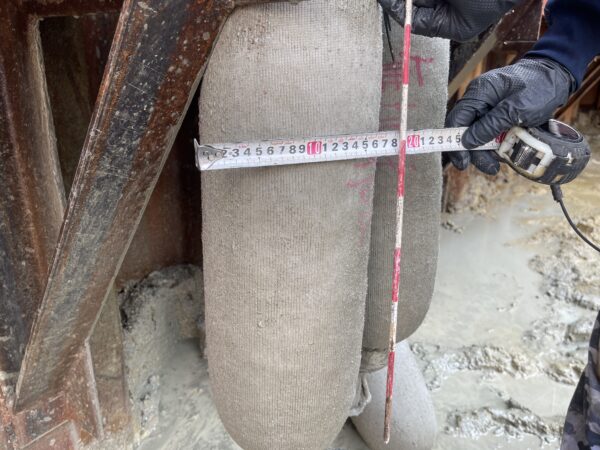
Using a packer drastically reduces the risk of leakage, so it is recommended for mountains with many cracks and joints.
However, for rebar insertion work, we recommend using an all-packer whenever possible.
This is because, in rebar installation, full anchorage is the standard practice.
When making a packer, there are inevitably parts that need to be sealed (at the ends).
Since the length of the cement slurry coating in that area is reduced, this may be pointed out during an inspection.
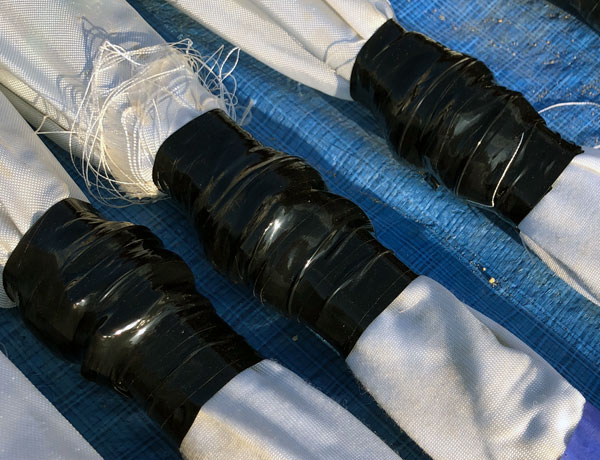
Please try to make it as small as possible.
In reality, there’s a margin of about 30 cm in the rebar length, so it’s on the safe side, but it’s good to know just in case.
(I believe the original length is listed in the design calculations, assuming that the selection of wire rope is rounded up to the nearest 0.5 m.)
If cement slurry is flowing in rapidly, carefully check the surrounding rivers, farmlands, and the base of the embankment, and
If possible, let's make a decision early on and move forward.
It's fine to follow the book, but I think the field is always a constant process of creativity and ingenuity.
When it comes to rebar placement, one construction method involves performing two or three rounds of follow-up grouting to ensure the rebar is raised gradually and steadily.
As long as you gradually make the large hole smaller and it fits snugly in the end, there's no problem.
I think it would be best to constantly consider the situation and choose the construction method that best suits the site.
See you later.