Hello, everyone.
This is Enta.
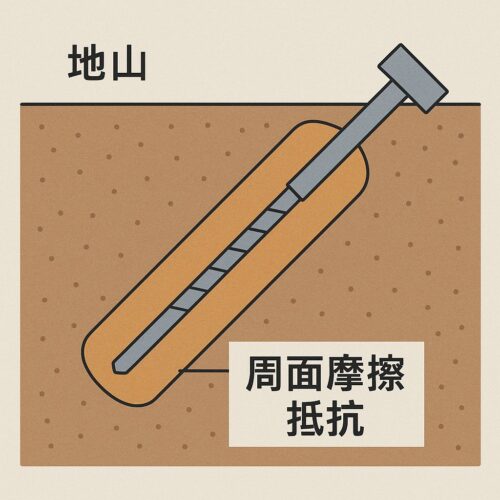
Since the last time, we've been moving further and further away from the topic of surface friction.
This time, we’ll continue from last time with soil bearing capacity.
Generally, factors such as soil bearing capacity are determined based on the results of borehole surveys, which are used to define the cross-sectional area.
Approximately how much bearing capacity does that surface have?
Estimated values are also available based on general soil properties.
However, while borehole surveys are typically conducted at two or three locations on large sites, they are usually limited to a single location on small sites.
Depending on the situation, near a past worksite...

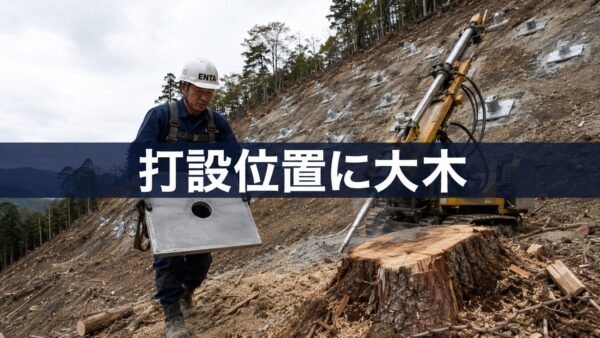
When we actually start cutting into the mountain, we sometimes find that the rock is softer than expected.
However, in real-world situations, things can often be slow in various ways.
There are times when you don’t realize until after the mountain has been cut that it’s already too late—because once the materials have been ordered, changes can’t be made.
Excavation of Natural Ground → Installation of Ground Anchors → Installation of Load-Bearing Plates → Tensioning and Anchoring
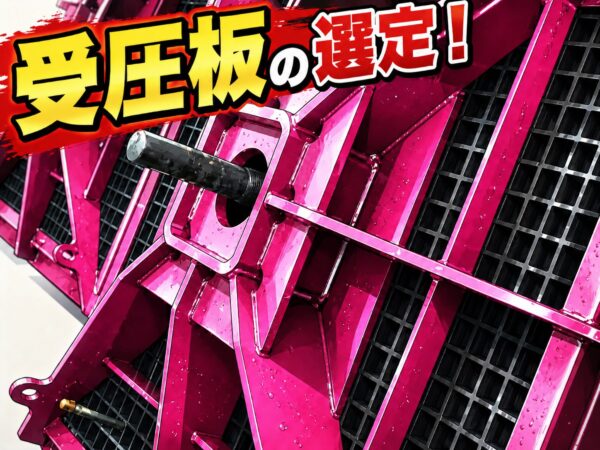
We place an order for pressure plates when excavating natural ground.
The pressure-receiving plate cannot be changed.
Use the load-bearing plate immediately after installing the ground anchors!
But the natural ground has no bearing capacity!
It's definitely going to sink!!!!
Oh man, I'm in a bind.
What should we do??
I've only experienced this once before.
At the time, it was a last-resort solution, but looking back now, I think it was actually a brilliant idea lol.
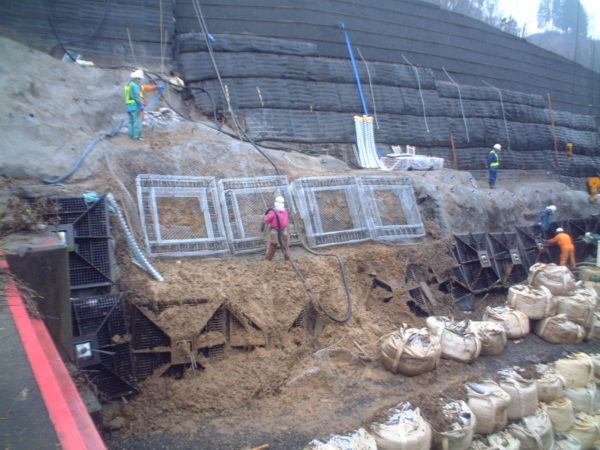
As you can see at this site, the ground anchors around the perimeter are actually tilting because the bearing capacity of the soil is insufficient.
At the time, another company was responsible for installing these ground anchors.
I told them this wasn't a good idea, but they ignored my warning and went ahead with the work anyway.
Eventually, this was pointed out by both the government agency and the general contractor, and ultimately, the back of the load-bearing plate came loose, leading to the responsibility for the rework and redesign falling on me—since I was the one working on the legal framework and rock bolts at that same site...
It's true that the finish was really poor.
Remove the ground anchors, recompact the soil so that it can support the load based on the local soil bearing capacity, and retension the anchors.
1. Relieving the load on the ground anchor (removing the wedge)
2. Removal of the pressure plate
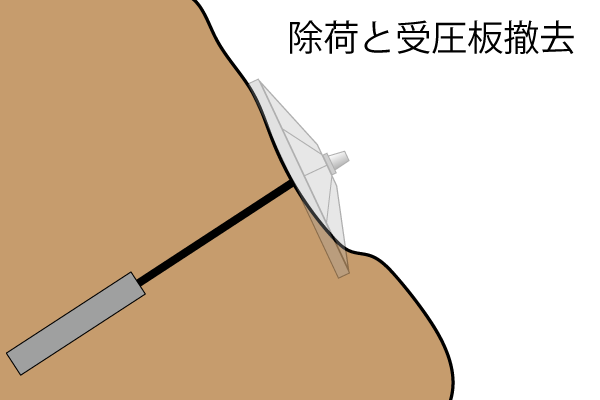
3. Taking into account the bearing capacity of the soil, level the ground and create a flat surface by using either a zabuton frame, a formwork frame, or reinforced concrete with sprayed mortar to ensure an adequate bearing area.
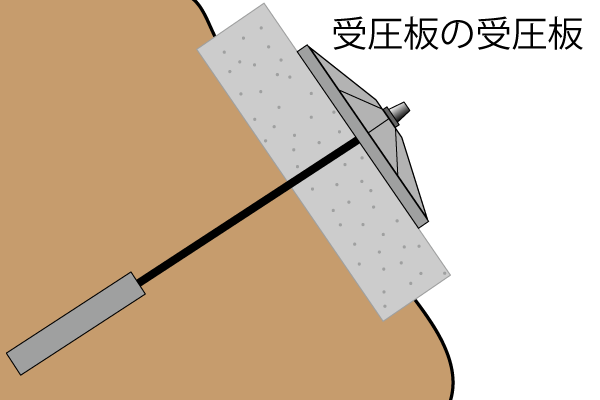
4. Install the purchased pressure plate and tension it.
So, I guess I managed to avoid it, lol.
There will be some additional work, such as installing the zabuton frames, but that’s better than having any waste, right?
The design isn't 100% perfect, and since there's an element of prediction involved, it can't be helped.
Of course, since we’re working with nature, regardless of the design, we build in a way that’s feasible on-site.
If we can quantify that—say, "Roughly how much?"—we'll be able to handle situations like this, right?
Just like in the previous calculation,
And being able to do calculations like that in an instant makes you seem like a really capable director, doesn't it!!!!?
Well, I think it’s a good idea to keep that in the back of your mind.
Conversely, in cases where the design team is unable to deliver a load-bearing plate with sufficient load-bearing area to the job site (due to weight restrictions),
It's also a viable option to create the load-bearing plate using spray-applied material like this.
With a little creativity, anything is possible on site!!??
See you later.