Hello, everyone.
This is Enta.
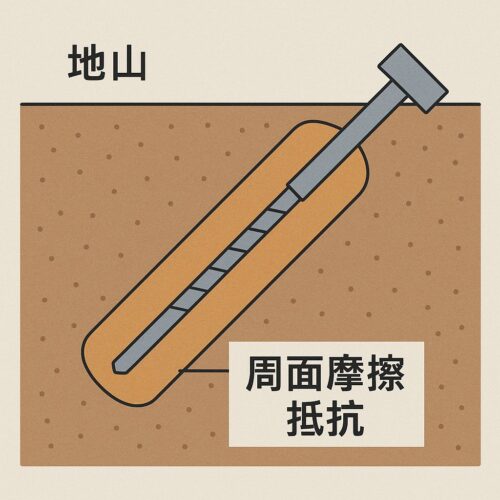
I was working on a simple calculation sheet for circumferential friction, but due to various circumstances, I wasn't able to finish it in time, so,
In this post, I’d like to write about soil bearing capacity and compression plates.
There is an item called "ground bearing capacity" in the design calculations.
This isThe maximum load that the ground can support without subsiding or failingThat's it.
This is a condition in which, even when a constant load is applied from above, there is no differential settlement and the surrounding area does not bulge upward.
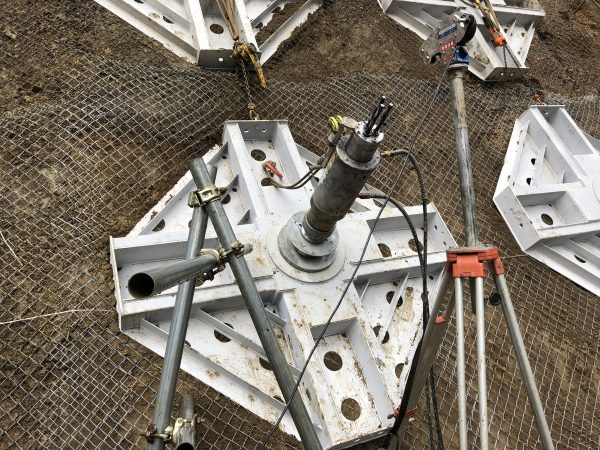
This pressure-receiving plate is raised all around its perimeter.
The bearing capacity of the soil is completely insufficient.
In the field, when the natural ground collapses or deforms due to tensile stress, this is referred to as the ground having insufficient bearing capacity.
What should we do as a countermeasure in this situation?
The simplest solution is to replace the pressure plate with a larger one.
It's a simple concept—whether you press with the same amount of force using your fingertip or your palm—but I'm going to try to explain it in a slightly more complicated way lol.
For example,
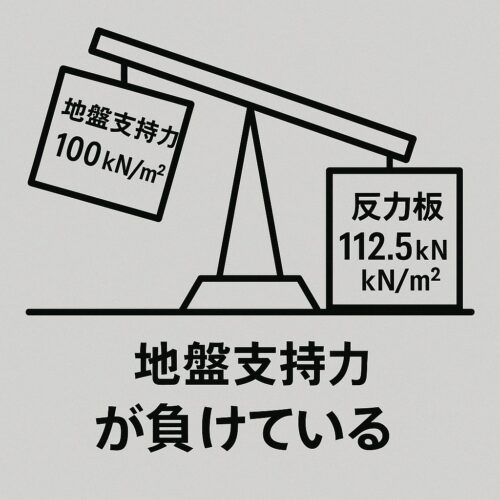
Let's assume that the bearing capacity of the soil at this site is 100 kN/m².
Let the tensile force be 450 kN.
Let the area of the load-bearing plate be 2 m × 2 m = 4 m².
450 kN ÷ 4 m² = 112.5 kN/m²
This is the load applied to the pressure plate.
And since the soil bearing capacity is 100 kN/m²,
100 kN/m² < 112.5 kN/m²
So that means the natural ground is losing, right?
It's sinking deeper and deeper into the ground lol
So, what should we do in this situation? (Keep in mind that this is strictly for the design phase; on-site, different measures would be taken.)
Let's try making the pressure plate larger.
For a load-bearing plate measuring 2.1 m × 2.1 m, the area is 4.41 m².
450 kN ÷ 4.41 m² = 102 kN/m²
This one's a no-go, too.
2.2 m × 2.2 m = 4.84 m²
450 kN ÷ 4.84 m² =93 kN/m²
It fell below 100 kN/m²!
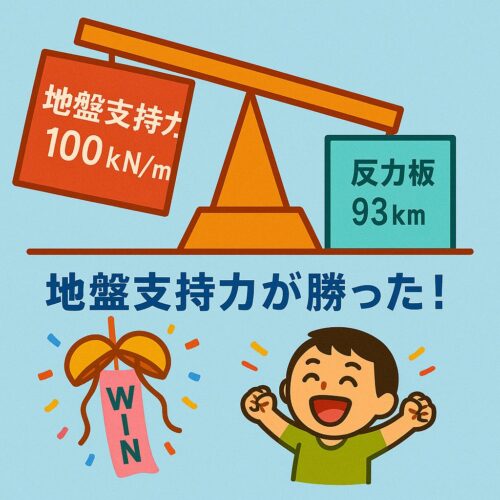
*No matter how many times I tried, I kept ending up with a drawing where the ground bearing capacity was insufficient, so I’ve given up.
*AI still doesn't do what I tell it to, lol*
*Since the ground bearing capacity is higher in this illustration, the ground bearing capacity wins!
Although we can't set the pressure plate with this much precision, this is the general approach we take in our calculations.
If you know this, even in situations like the one shown in the photo above where the ground doesn't have sufficient bearing capacity, you can still...!!!
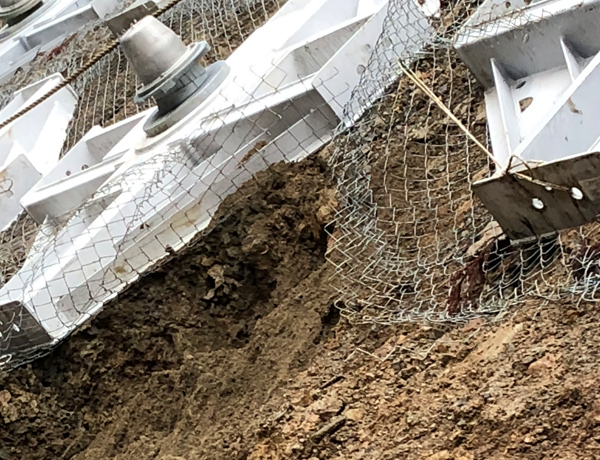
Even if it collapses like this, we might still be able to take countermeasures.
This is one of those times when the load-bearing plates have already been ordered and delivered to the site, but the ground bearing capacity is totally messed up, lol.
What do you do when it's obvious that the site's bearing capacity is in serious trouble?
If we could perform a simple calculation of circumferential friction, we could discuss circumferential friction resistance, but,
Keeping in mind the possibility that it might not work out, I think I'll try writing a "The Site's Bearing Capacity Is Clearly a Disaster!" edition next time lol
Things have been hectic since last week...
See you later.