Hello, everyone.
This is Enta.
Today, I went to the Iwakura Cherry Blossom Festival again to help out the Chamber of Commerce—sort of? lol
Well, it's still mostly just buds—only about 20% in bloom—so it's not much to look at at all.

The peak of the cherry blossoms is expected to begin sometime this week or later.I think so. But the weather at the end of the month is...
But that's beside the point.
How to Conduct Suitability Tests for Ground Anchor Construction
This is the second installment, following up on the one from the other day lol
In the previous...
You can't get a perfect score, right!?
Starting with,
So what are we going to do!?
It's kind of like that, but I'll just get straight to the point, lol.
Manual operation yields the best data.
Huh?!
Huh?!
What?!
That's the vibe, right? lol
Measuring the hydraulic cylinder portion of a hydraulic jack with calipersThat's what happens.
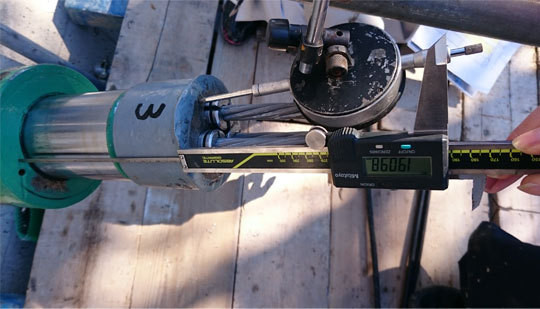
The dial gauge is already pointing in a completely ridiculous direction, but the calipers are straight!
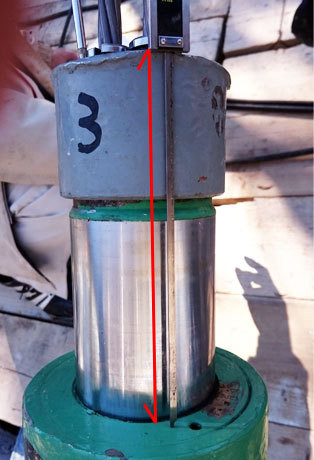
We're going to measure the extension of the cylinder indicated by this red arrow, so please have a digital caliper with a 1/100 scale for 30 cm ready.
Also, if possible, it’s more accurate to mark both the jack body and the jack head with a marker.
It's fine to measure just the cylinder.(It is important to always measure the same spot.)
If we conduct a test using this measurement,Quite accurateThat's it!
In my case, I follow the construction plan, which specifies that measurements should be taken with calipers.
*Based on experience, when installing anchors using a load-bearing plate in areas with insufficient soil bearing capacity, it is necessary to ensure that measurements can be taken on the load-bearing plate side using a dial gauge or calipers.
(This is because an adjustment will be necessary if it sinks by a few centimeters.)
Back in the day, I just couldn’t seem to get good data no matter what I did—like when the dial gauge would go all wobbly during inspections, or when I’d walk as quietly as possible on the scaffolding to take measurements, only to hear a loud thud right at the end. I went through a lot of trial and error when I was younger, but then it just occurred to me to start measuring the cylinders. (Maybe the heat was making me a little spacey? lol)
When I get back to the office and enter the data, I’m like, “Huh? Wait a minute… What’s this?”—and it turns out to be great data!
Since then, that's pretty much all I've been doing, and here we are today—the levels hardly ever drop, and the data smoothly stays within the upper and lower limits.
People say that to me sometimes.Won't the pressure plate sink?
Actually, there are times when it sinks, but,SegmentationAs such,
| In the case of a legal framework
It hardly sinks at all. If the value exceeds 600 kN, monitor the situation. If the boundary between the retaining structure and the natural ground is subsiding, also measure the amount of subsidence on the retaining structure side. In the case of a pressure-receiving plate If the backfill is soil: Exercise caution for loads of 200 kN or more; in some cases, use a dial gauge on the load-bearing plate. If the backing consists of bedrock, a cushion frame, sprayed mortar, etc.: If the load exceeds 600 kN, cracks may form and the structure may sink. In the case of retaining walls It won't sink. |
As long as the ground underneath isn't just dirt, you don't really need to worry about it. (Just my experience as an entertainer, lol.)
And around 600 kN is a good rough estimate.
And let’s go ahead and write that down in the construction plan with confidence! (This part is at your own risk, lol)
That said, there are still many people out there who insist, “It has to be this one!”
That's fine, though.
However,EssencePlease make your decision after determining where it is located.
The essence of this test is not the testing method itself, but rather verifying the quality of the anchors; therefore, as long as the quality is confirmed, any instrument will do.
I sometimes think that just saying “it’s no good” is kind of nonsense these days, lol.
Other than that, there is a product called the "Digital Meter" from FSC Fujiwara Industries Co., Ltd.
It's very convenient because it uses a wire and allows for digital measurements.
However, you do need to be careful about where you install it.
Fujiwara Industries, Inc.Digital Meter
(The same applies to rock bolts. Actually, since rock bolts generally don't stretch, calipers are more accurate than dial gauges.)
And the natural ground won't sink either! )
See you later.