Hello, everyone.
This is Enta.
Workflow for Construction and Construction Management in Ground Anchor Projects
The other day, I wrote about the process involved in ground anchor installation.
I think it seemed like there weren't really any sources of fear—or rather, anxiety—associated with ground anchor work.
However, I think the real fear lies in how management handles stress.
I think the challenge of managing anxiety lies in how difficult it seems at first glance.
Of course, the first thing anyone who reads the design and construction guidelines for ground anchors is likely to think is, “This looks tough,” lol.
Since the book is written strictly from a technical perspective, it’s only natural that it seems difficult.
However, the actual installation isn't that difficult (as I mentioned in my previous blog post).
It's all about management, isn't it? lol
Looking at the diagram of stress management, it certainly looks difficult.
It's fair to say this is the biggest hurdle, isn't it?
But it’s actually not that hard, you know~ (Well, I can say that because I know how it works.)
I'm going to write about some important points for managing nerves when you're doing something for the first time.
As long as you keep this in mind and know about it, you'll be fine for now.
(In no particular order)
1. Never confuse design loads with anything else!
2. Design loads are expressed in kN, but when the tension is actually applied on site, they are converted to MPa.
3. 1 kN/cm² = 10 MPa Design load (kN) ÷ jack's bearing area (cm²) (catalog value) = reading on the jack pressure gauge
4. If the anchor does not pull out under the design load, the installation is considered successful (It's important that it doesn't come out)
5. Don't worry if the elongation of the PC strands doesn't fall within the upper and lower limits (this could be due to improper gauge measurement or high friction from the surrounding rock).
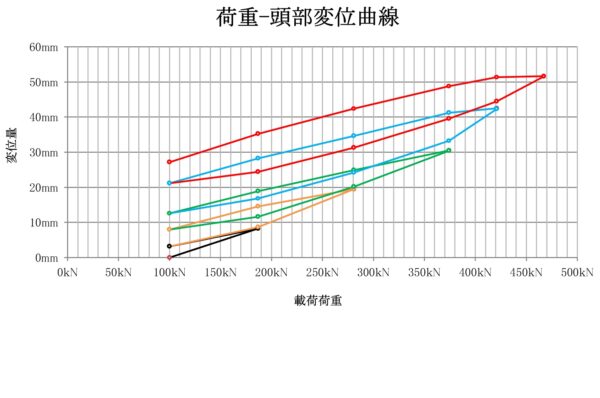
6. Don't worry if the head displacement curve looks a little off. (There's no "right" answer—if someone claims there is, I think they're lying. Or maybe it's just an ideal value.)
7. When applying tension, be sure to extend the jack’s stroke (cylinder) by about 1 cm first. (Otherwise, the wedge may become stuck.)
8. Be sure to know the Young's modulus of PC steel wire mill sheets.
9. If the bearing capacity of the natural ground is sufficient, measuring the length of the jack cylinder will yield more accurate data.
10. It is absolutely impossible to create a fixed point (one that absolutely does not move) for installing dial gauges and the like. (As long as it doesn't move on the scaffolding, it can be managed.)
11. We're measuring 1/100th-scale data in the field, but don't forget that the data can shift even when the wind blows (just a little bit is enough lol).
12. Handle the dial gauge with care (it's very expensive).
13. If you are a certified anchor installer, you can shorten the holding time (provided the anchor is stable) and apply tension (as described in the book).
14. It’s best to be thoroughly familiar with the books.
15. The difference between the maximum test load and the initial load is the maximum elastic displacement (immediately determine whether it falls within the range of the upper and lower limits).
16. If the data is poor, it is often because the testing method is flawed, so review the testing method.
As long as the anchor hasn't come loose, you'll be just fine, so you'll get the hang of it after taking the test a few times.
Some people apply the design load right from the start, check it, and then conduct the test.
Surprisingly, there are many things not covered in books, so people have their own theories based on personal experience.
People tend to have these rigid ideas about how things "should" be, so please be very careful when listening to them lol
Just be careful—sometimes you come across some strange characters even among consultants working on government contracts.
Well, in that case, let's check where in the textbook it's written—or if it's just a personal opinion ^^
I think ground anchor construction is a method that becomes much more accessible once you’ve tried it, so if you have the chance, give it a try.
See you later.