Hello, everyone.
This is Enta.
The other day, I was talking with the president of a company about how to handle customers who want to leave early.
Did you know that?
I just learned this myself, but apparently, standing a broom upright in the entryway is said to bring good fortune.
It is said that this refers to placing the object facing forward, with the intention of “inviting happiness” and “warding off evil spirits.”

Conversely, if a broom is placed upside down, it’s apparently called a “reversed broom,”When You Want an Uninvited Guest to Leave SoonApparently, it's a "spell"!
If only this existed... lol
But that's beside the point.

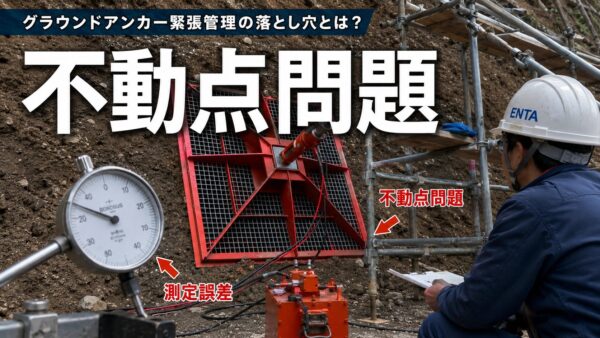
The other day, I went to check the tension on the temporary anchors.
We're temporarily containing the soil pressure at the excavation face using temporary anchors, but,
How have you been setting the design loads for temporary anchors lately?
Setting the Maximum Design Load
1.5 times or less the design anchor force (1.2 times or less for temporary structures); 1.0 times the seismic anchor force
0.9 times the yield strength of the steel
It's the smaller of the two, but IApproximately 0.8 times the design tensile stressI think that's fine.
This applies to all ground anchors, but the basic rule is that as long as they don't come loose, they're fine.
Is there really any need to apply unnecessary load?

As I’ve mentioned a few times on my blog, the purpose of anchor qualification tests and verification tests is to determine whether the installation has been performed properly.
Right?
After all, if you don't get eliminated, that means you're qualified.
That's just how it's designed.
That's why I think it makes more sense to use the maximum test value as the design load.
And we’ll keep the retention rate at around 80 percent.
If you're 100% on edge, you won't be able to respond effectively in the event of a disaster.
If you stop at 100% and an earthquake or heavy rain occurs, causing the load to exceed that limit and resulting in an overload, how would you handle the situation?
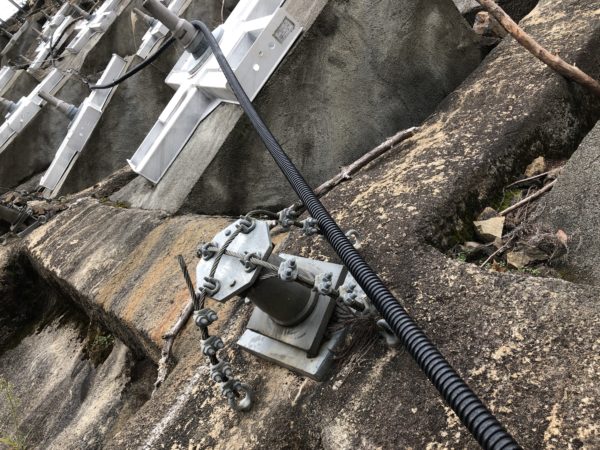
Do you want to prevent the PC steel strands from breaking and flying out?
Should we deal with this by installing additional anchors around the area?
That's how it goes, right?
If you realize during the design phase that the deterrent effect might not be strong enough, why not just add one more?
Just understanding the performance of prestressing steel strands isn't enough when it comes to natural ground conditions.
The data obtained from the qualification and verification tests is the elastic displacement (Young's modulus) of the prestressing steel strands.

First of all, you can check it on the mill sheet lol
It is inspected in accordance with strict JIS standards.
This is a test where you bring the item to the site to verify it.
When you really think about it, you just go, “Huh?”
This does not involve taking measurements on-site with 1/100 accuracy.
If it hadn't fallen out...
Well, I suppose that means there’s no other way to manage it, but what the inspector is likely thinking when they see this is,
It just means, “As long as it’s not missing, that’s fine.”
I have absolutely no idea what the surface friction is actually like on-site, lol.

Even though I call myself a ground anchor installer, there are times when I find myself wondering, “Is this really okay?”
I try to explain everything to people who aren't familiar with the basics, but (if you're interested) the truth is, it's really just a matter of having these complicated documents on hand, lol.
In that case, I think it’s fine to apply about 80–90% of the design tensile strength and say, “It worked out just fine!”
What do you ground anchor installers think?
See you later.
P.S. We'll be hosting a site tour for representatives from the Public Works Research Institute at a construction site where our company is working as a subcontractor.
Public Interest Incorporated Foundation, Public Works Research Institute
Since there’s a project underway at the Ministry of Land, Infrastructure, Transport and Tourism right now, I’m really looking forward to it.
I hope that by giving researchers and professional engineers a chance to see the actual site firsthand, this will serve as a helpful resource for their future papers and books.