Hello, everyone.
This is Enta.
The other day, an acquaintance introduced me to a term I’d never heard before. Have you heard of “gaslighting”?
It's like, "What the heck is that?!" lol
I found out about this for the first time, too.
But that's beside the point.
In this post, I’d like to explore the term “gaslighting” in the context of workplace relationships.
What exactly is gaslighting?
Upon looking into it, gaslighting is defined as a psychological manipulation technique in which a person repeatedly conveys information that contradicts the facts or consistently dismisses the other person’s memories and perceptions, leading the other person to believe that “maybe I’m the one who’s crazy.”
The term apparently originates from the 1940s foreign film *Gaslight*, and is said to be based on a scene in which the husband repeatedly dims the lights to make his wife doubt her own sanity.
Several sources on harassment training also describe it as a type of emotional harassment or a form of psychological domestic violence.
The tricky part is that it’s not obvious violence like punching or kicking, but rather the way it gradually erodes the other person’s confidence, and
It's hard for others to tell that you've been harmed!
Isn't this super scary!?
I myself was in a similar situation last year.
There was an incident at a construction site where someone who pointed out a safety issue was told, “I didn’t say that,” even though everyone present had heard it clearly. (Site Manager at a Major General Contractor)
Everyone was stunned at the time, but this kind of “denial of facts” is also one of the typical tactics used in gaslighting.
At the time, I just laughed it off and said something like, “Come on, it’s fine lol,” but looking back now, I realize that was actually a full-fledged denial of the facts. (I’m so clueless I didn’t even notice :;)
Some sources on harassment training explained that harassment tends to occur in relationships where there is a power imbalance, such as between a supervisor and a subordinate or between a senior and a junior colleague.
Since the workplace has clear hierarchies based on age, years of experience, and the relationship between prime contractors and subcontractors, I wonder if that might be the kind of environment where this kind of structure tends to develop...

Four Scams That Can Happen on the Job Site
Based on what I've found online, there are said to be several patterns of gaslighting.
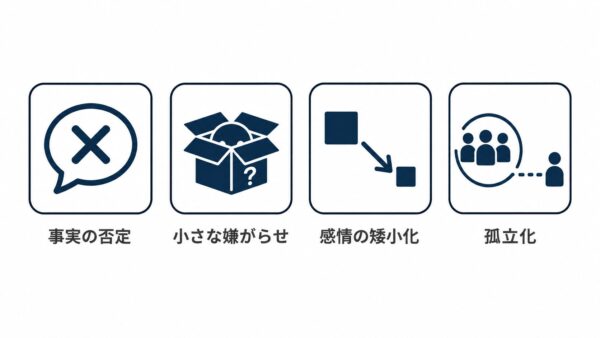
Here are four examples that make it easier to visualize how this applies in a real-world setting.
- Denial of the Facts: Pretending that something that happened or was said never happened. For example, saying, “I never gave such an instruction.”
- Petty Harassment: Repeatedly engaging in covert acts of harassment—such as hiding items or moving them without permission—to make the other person feel anxious.
- The Diminishment of Emotions: Dismiss the other person’s anger or anxiety by labeling them as “overly concerned” or “overly sensitive” and refusing to address it.
- Isolation: They isolate the other person with statements like, “Everyone else says you’re weird,” even though it’s unclear whether they’re true.
Since each one may seem like just a small remark or a minor action, the person on the receiving end tends to brush it off, thinking, “Maybe I’m just imagining things.”
However, when this happens over and over again, I gradually lose confidence in my own judgment.
Being on the job is all about making constant decisions, isn't it?
Personally, I think “petty harassment” is more likely to occur in smaller communities.
At our worksite, too, we’re having more opportunities to work alongside foreign technical interns and Specific Skilled Workers, but,
Sometimes I wonder if there’s a chance—albeit a small one—that something similar might be happening behind the scenes, out of sight of us Japanese.
However, since this isn't something I've actually been able to confirm myself, it's strictly just my personal feeling that "that might be a possibility."
There’s also a language barrier, and to be honest, I can’t say I fully understand it, so it’s hard to make a judgment call.
While researching this topic, I realized that I, too, might actually be using the phrase “overthinking it”—which is part of the concept of “diminishing emotions”—in my own work, and I felt a sense of regret.
Partly because I’m such an optimist, even when something is a big deal for the other person, I tend to downplay it based on my own perspective.
This is a challenging area where I need to be careful myself.
Another phrase to watch out for in "isolation" tactics is "Everyone else is saying the same thing."
This is just something I heard from an acquaintance, and it’s not information that has been officially verified, but,
Apparently, there are often only about two or three people who are actually saying this, and the key point is that the person hearing it is led to believe it represents the “consensus of the majority.”
Well, it’s like when adults say things that are just the kind of stuff kids are always saying—and then end up being controlled by it… (if this keeps up)
How to Respond When You See It on Site
We’ve looked at these tactics so far, but what should you do if you actually see someone doing this in real life? I think this is the most important thing to know.
Whether you're the victim or a bystander, the most reliable thing to do is to document what happened right away.
Even in sources that provide information on where to seek help regarding harassment, it seems that taking notes on the date and time, the content of the remarks, and who was present is repeatedly recommended.
I imagine many of you have the habit of jotting down the details of morning briefings and meetings in your field notebooks while on site, and those notes should serve as useful records as they are.
When a dispute turns into a he-said, she-said argument, the presence or absence of a record can completely change the weight of the argument.
It’s important not to keep things to yourself, but to talk to a trusted supervisor or a counseling service—whether within or outside the company.
Since workplaces often operate within tight-knit social circles, I think it’s really important whether the people around you can notice when something seems off.
It is also said that victims tend to think that they themselves are to blame.
That’s exactly why I think there are times when simply adding a quick comment like, “Doesn’t that seem a little off?” can be a source of support for those around us.
I think that just being aware of this will bring us a little closer to a workplace where everyone can feel comfortable doing their jobs.
Other than that,Even if the supervisor makes a few mistakes, the construction crew needs to figure out a way to make it work!
That's kind of how it is, lol
When I was young, many master craftsmen helped me out.
They covered for me a lot when I made mistakes.
So now it's my turn, right?
Please feel free to consult our craftsmen!
They'll definitely help you.
And things will definitely work out!
Leave it to me!

To be honest, I'm not an expert either, so I'm not in a position to arrogantly decide whether this is gaslighting or not.
What I’ve written here is just my own summary of information I’ve picked up here and there online.
Still, I think just knowing that terms like this exist might make it easier to notice when something feels off—whether in myself or in those around me.
Just as much as I want to keep an eye on the clock while working, I also want to pay close attention to the atmosphere on the job and my relationships with others. (Especially since Japanese people tend to be good at reading the room, lol.)
I hope this proves helpful, even in a small way, for your work and personal life.
And it's something I don't do myself.
Especially those in leadership positions!!
If I did do that, I'll go apologize!!
See you later.
Craftsmen who won't help unless it's their job!? Why is that?