Hello, everyone.
This is Enta.
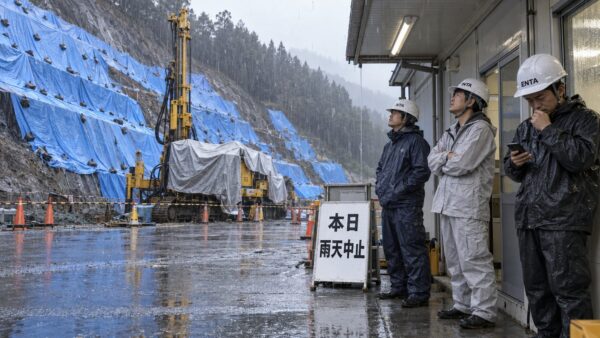
This is a continuation of the previous post.
But that's beside the point.
Part 1So, I wrote about how many craftsmen are paid on a daily wage basis, and if work stops due to rain, their income drops—and that this system might be holding back their ability to settle down.
In this second installment, I’ll share my personal thoughts on what companies should do.
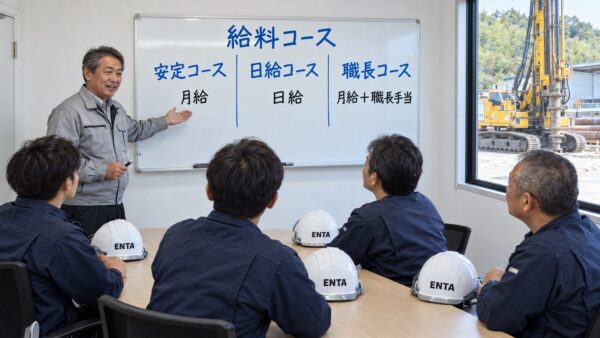
3 Pay Plans for Artisans to Choose From
I don't think it's necessary to standardize on either a daily wage system or a monthly salary system.
People who just want to earn a high daily wage.
People who want to receive the same amount every month for their family.
People who want to become foremen in the future.
People who want to start their own business someday.
It's impossible to satisfy everyone with the same system.
This is just a personal suggestion, but what if the company offered this kind of option?
Or rather, even though it’s a bit late to say this now, I don’t think we can really change the current pay structure that much after all.
Please understand that this is simply a way of clarifying the current situation.
Option 1: A Plan That Ensures a Stable Monthly Salary
We set a monthly salary, and even if work stops due to rain, we won't reduce your pay.
We'll give you a raise if you earn a certification or if you're assigned more responsibilities.
This is intended for young workers and skilled tradespeople who are paying off a mortgage or raising children.
Option 2: Earn Based on How Much You Work
We will keep the daily wage system in place and raise the daily wage.
We set unit rates based on specific skills and certifications, such as civil engineering construction management and national certifications in this industry.
Even under a daily wage system, as long as you are employed by the company, we will ensure you receive your days off, paid vacation, and social insurance benefits.
3. Course for Those Aspiring to Become Foremen
We will add the foreman's allowance to your first monthly salary.
The foreman trains the younger workers, plans the workflow, and oversees safety.
If the responsibilities increase but the pay stays the same, no one will want to be a foreman.
So that the person who takes on the role of foreman doesn't lose out.
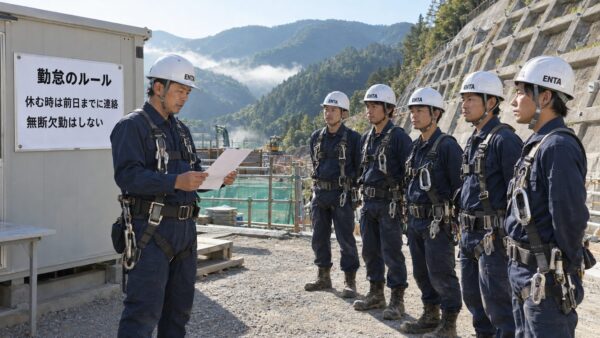
If you're on a monthly salary, unauthorized absences will not be tolerated.
If you skip this step, the monthly salary system won't work.
Paying wages even when work is canceled due to rain means the company bears that risk.
That is precisely why we do not tolerate unexcused absences.
We’ll establish communication rules from the start, such as: if you need to take a day off, notify us by the morning of the previous day; if you suddenly feel ill on the day of work, call your supervisor by a certain time in the morning.
We’ll clearly define the safety rules and code of conduct, put them in writing, and hand them out.
Don't just stop at making a decision; decide what to do if the decision isn't followed.
As I wrote in Part 1, there were some workers at construction sites back in the day who would stop showing up the day after payday.
If we switched to a monthly salary, I don't think people like that would disappear.
However, if the relationship is based on guaranteeing a salary in exchange for keeping promises, wouldn't that make it easier for the craftsmen to accept?
Valuing your craftsmen and tolerating unexcused absences are two different things, after all.
That said, if they tell me first thing in the morning that they're not feeling well...
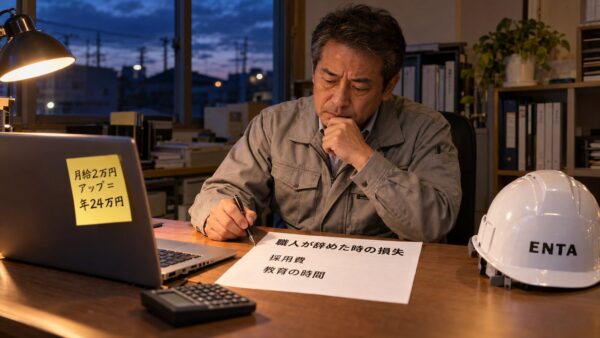
Calculate the loss from craftsmen leaving, rather than labor costs
Business owners view labor costs as fixed expenses.
It is true that there are risks associated with a system that pays wages even when there is no work.
But I’d like you to view the loss incurred when a craftsman leaves using the same standard.
If experienced employees quit, it will cost money to hire replacements.
Hiring new employees takes time and effort to train them.
If the foreman quits, we won't be able to form the team at all.
Sometimes we have to turn down construction projects we could have taken on because we don't have enough staff.
This is also leading to bankruptcies caused by labor shortages.
If we raise the monthly salary by 20,000 yen, it will result in an additional annual cost of 240,000 yen.
On the other hand, if an experienced foreman leaves and the team can no longer function properly, the resulting loss will be far greater than 240,000 yen.
According to the report from the Reiwa 5 Fiscal Year Study Group on Carpentry Skills and Related Professions, which I mentioned in Part 1, the turnover rate for fiscal year 2023 at businesses employing carpenters was 57% for those on a daily-wage, monthly-pay system and 39% for those on a monthly-salary system.
Since this survey was conducted among carpenters, I’m not sure if the findings apply directly to slope construction workers, but the data does show that the percentage of people who quit varies depending on the payment method.
What we should be calculating isn't how low labor costs (fixed costs) are, but rather the profit the company retains when a single craftsman stays with the company for a long time.
I've always felt that many artisans value their freedom.
When I get paid, I go out and have fun; when I get scolded, I take a day off—but I want to make a living on my own merits.
I've seen many artisans like that.
However, the reason workers don’t get paid on days when work is halted due to rain isn’t because they value their freedom.
This is because, under a daily wage system, fluctuations in the weather and workload directly affect the workers' pay.
I, too, am someone who used to do things in a way where I didn't even worry about that.
You can work with pride in your skills while earning a monthly salary.
Tradespeople who want to earn a daily wage can continue to be paid that way.
Workers choose their own payment method, and in return, the company ensures they comply with attendance requirements.
You get paid even on rainy days, and your pay goes up as your skills improve.
I think that, in order for the construction industry to become attractive to young people, it’s important to first establish clear boundaries.
But I know full well that this isn't exactly easy, either...
In the end, people will find something to complain about no matter what...
I believe balance is important when it comes to salary.
See you later.