Hello, everyone.
This is Enta.
Things are finally starting to get a little busy, aren't they?
Somehow, it seems like the busy season is getting shorter every year...
But that's beside the point.
This time, we’ll be talking about “the time it takes to make a decision.”
Does the outcome really differ between a decision made in 10 seconds and one made after an hour of careful consideration?
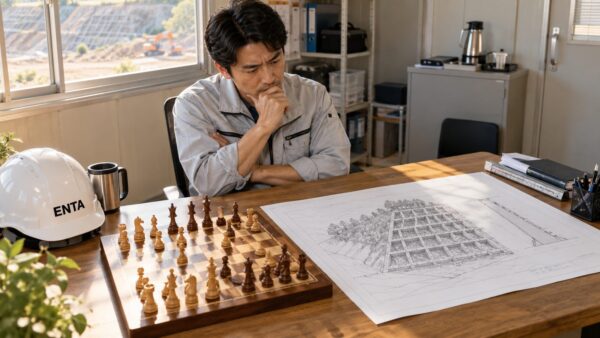
It all started when I recalled a concept called the “First Chess Theory,” and I tried applying it to a construction site.
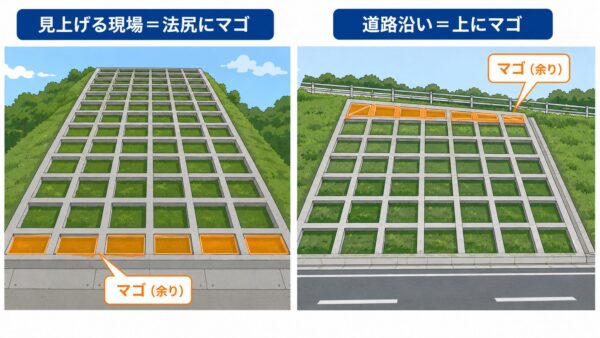
The topic of the tilt of the "Mago" in the legal framework and the reference line comes up partway through, but please just think of it as one example lol.
What Is First Chess Theory?
There is a saying that in a chess game, a move chosen intuitively in 5 seconds and a move chosen after 30 minutes of careful thought—86%—will lead to the same result.
This is known as the “First Chess Theory,” and it’s often featured in business books and online articles as a life hack that advises, “When in doubt, trust your first instinct.”
Simply put, whether you decide in 10 seconds or take an hour, the answer—86%—remains the same.
That leads to the reasoning that spending an hour agonizing over it is a waste of time, and you should just go with the answer that first pops into your head.
I’m sure many of you have come across statements like, “Don’t change the answer that first came to mind during an interview,” or “Projects chosen based on intuition tend to get approved in the end.”
Even Bruce Lee said, "Don't think, just feel!" lol
If you trace the origins of this theory, it seems to be based on research into chess, but as it’s been featured in business books and self-help articles, I get the impression it’s taken on a life of its own as a rather strong argument that “intuition is superior.”
I first came across this phrase in an online article, but at the time, I just thought, “Oh, so if I’m unsure, I should just go with my gut?”—it was a pretty casual reaction, lol.
When I first heard this story, I thought, “I see—this is actually pretty close to the kind of judgment made on the front lines.”
That's because there are quite a few situations where on-site supervisors seem to make snap decisions at a glance.
Applying This to a Construction Site | The Slope of the Frame’s Mago and the Reference Line
Let's apply this to a real-world scenario.
When constructing formwork, you have to decide each time which way to tilt the vertical formwork panels and where to position the single horizontal line that serves as the reference.
Especially on curves or at job sites with lots of turns.
In my experience, I usually set the first reference line at eye level—typically around 1.5 to 1.6 meters.
It’s almost an instant decision—rather than spending time agonizing over it, it’s more like a feeling that, the moment I step onto the scene, I just know, “This is the place.”
Then there's the length of the hair and the overall look.
On the other hand, if you ask a young, novice director to make the same decision, they’ll spend quite a bit of time hesitating.
It’s a common sight to see someone trying out different heights, stretching and releasing the string, stepping back to look at it, then going back to adjust it—repeating this process until they finally settle on the position for a single string.
It's one of those times when even craftsmen get frustrated, lol.
What's interesting is that, whether you take a long time or a short time, the end result doesn't actually differ that much.
Whether it's a spot I picked in 10 seconds or one the younger guys spent 30 minutes agonizing over, in the end, they often end up being pretty close to each other.
If that’s the case, I feel that the idea put forward by the First Chess Theory—that “even if you take your time, the outcome won’t be much different”—applies to some extent in the legal field as well.
I tried to figure out why the results are similar whether I spend a lot of time on it or not.
When a young director spends 30 minutes coming up with an answer, most of that time is actually spent checking to see if it’s correct or if it’s good enough.
On the other hand, I think the reason I can make a decision in 10 seconds is that I’m already starting from a place where I’ve gone through that verification process in my head.
In other words, it’s just that the nature of the time spent is different; what we’re actually doing hasn’t really changed that much.
I feel the same way in situations outside the legal framework as well.
For example, when the sky starts to look ominous in the middle of a spray application, the decision to continue or stop is often made in an instant on-site.
With an inexperienced foreman, it takes a while—they might just stare at the sky for a bit, wait to see how things go, and then consult with the boss before making a decision, or the boss might get so fed up that he says, “I’m calling it a day!” But a veteran foreman makes a snap decision right on the spot, saying, “Let’s call it a day.”
And yet, when you look back on it later, the outcome isn’t really that different from what someone who took their time to make a decision would have gotten.
I've heard that there's not much difference in the final figure between someone who can come up with a quote in an instant and someone who spends tens of minutes grumbling over a calculator. (That's me, lol.)
I think similar situations often arise even in contexts that involve business judgment.
A point raised that we shouldn't take 86% at face value
However, I came across an article that said it’s dangerous to take this “First Chess” theory at face value.
This is an article written by game writer Kazunari Yonemitsu.
According to this article, the source of the number "86%" itself is unclear.
Apparently, even though it’s often cited online, even Mr. Yonemitsu couldn’t track down the original research.
I feel the same way about this; I got the impression that the numbers were being taken out of context.
What struck me as an even more important point was that when a chess grandmaster makes a move in five seconds, it isn’t the result of a sudden flash of inspiration out of nowhere, but rather builds on a vast amount of game experience and research accumulated over time.
It's the same as what I said earlier about the legal framework—the reason I can determine the baseline in 10 seconds is because I have experience putting together hundreds of frameworks so far. (Actually, 10 seconds is impossible, lol.)
If a young, inexperienced director tried to decide in 10 seconds like that, he’d probably end up drawing the line in a completely ridiculous spot.
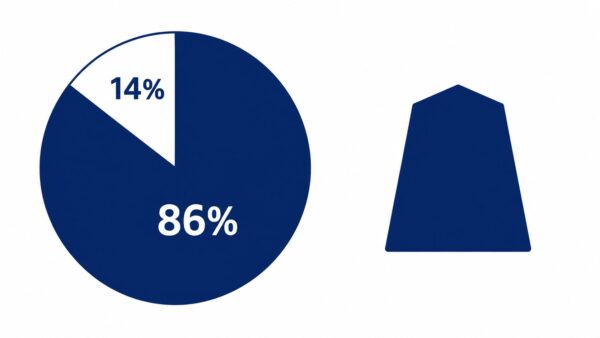
Yonemitsu also pointed out that since “86% is the same,” it follows that “14% is different,” and that the difference in ability is actually determined by that 14%.
This isn't a situation where you can just rely on intuition to push through; the real value lies in the thought process required to figure out the remaining 141 TP3T, and I agree with that point.
It’s also important to verify that the reference line for the legal framework looks right—after making a rough mark at eye level, check it with an auto-level to confirm.
The process is complete only when you back up the position you chose based on intuition with numerical data.
If it's just a legal framework, a quick glance should be more than enough, but since we're dealing with slopes—which are a matter of public safety—we really need to double-check everything.
So, intuition is a tool for narrowing down possibilities, but it doesn’t give you an excuse to skip checking your answers.
This article really made me realize this all over again.
If you take the argument that “spending more time won’t change the outcome” at face value, it could lead to unexpected accidents on the job.
That’s exactly why it’s important to deliberately give less experienced team members time to double-check things.
In this article, Mr. Yonemitsu also cites the book *Intuition* (PHP Institute) by shogi player Yoshiharu Habu.
Although Mr. Hanyu is a shogi player rather than a chess player, he writes the following about intuition.
"Intuition doesn't really spring from nothing. It must be built up based on the experience of thinking things through and exploring various possibilities."

The idea that it's the accumulation of experience—not the length of time—that matters
After thinking it through, here’s what I’ve come to conclude.
This means that the result will remain the same—whether it takes 10 seconds or an hour—only if the person has already accumulated sufficient experience.
When you're still new to something, there's real value in taking the time to think things through.
It’s not like I naturally knew how to easily set standards on the job right from the start.
It means that after completing hundreds of projects and going back and forth over "this isn't right, that isn't right" countless times, I've finally reached the point where I can make a decision in 10 seconds.
In a sense, I think the "10 seconds" we have now is the result of all the mistakes and corrections we've made on the job over the years.
Whether it’s an answer I arrived at after taking my time or one I came up with on the spot, the experiences that underlie them are the same.
When you think about it that way, I think it’s a bit of a waste to simply look at the results and categorize people as having “good taste” or “no taste.”
That’s exactly why I don’t really like the phrase, “That person has good taste.”
Behind all of that, there must be an absolutely enormous amount of trial and error and failure.
If we dismiss it with a simple phrase like “good taste” or “the talent to make decisions in an instant,” I feel like we end up overlooking all the hard work that person has put in.
Our technical trainees can’t do anything at first, but after three years, they’ve gained enough experience to know what needs to be done.
Even if you feel unsure about everything at first, as you gain more experience, you’ll gradually be able to make decisions without hesitation.
"It might look like I'm making decisions in 10 seconds now, but that's only because I've failed so many times in the past," he said.
Conversely, I don’t think it’s a good idea to rush young directors or artisans who are taking their time to think things through by telling them they’re “too slow.”
That’s because that time is a series of small steps that can only be taken right now—steps that will eventually be condensed into just 10 seconds.
Ultimately, I think what underpins both a 10-second decision and a one-hour decision is the amount of experience one has accumulated.
It’s not that taking your time makes you great, nor does making a quick decision mean you have good taste—it all comes down to how much experience you’ve gained up to that point.
I think the "First Chess" theory makes sense, as long as it's used by experienced players.
However, if you simply borrow that reasoning for your own convenience and try to rely solely on intuition to push through with everything while you’re still inexperienced, you’re bound to face the consequences at some point.
At our worksite, we have the younger workers start by handling a large volume of work so they can develop their own standards along the way.
It’s not exactly “haste makes waste,” but I do think that, in the end, that’s actually the quickest way.
See you later.
## Featured Image
—
## News reports and materials I referred to (not posted on WordPress)
– Kazunari Yonemitsu, “The Lies of the ‘First Chess Theory’ That Any Gamer Will Recognize. Watch Out for People Who Tell You to ‘Trust Your Instincts’” QJWeb (Quick Japan Web) https://qjweb.jp/journal/43347/ (URL provided by Enta. Content verified by Claude)
– Yoshiharu Habu, *Intuition*, PHP Institute (PHP Shinsho; later published as part of the PHP Bunko series). The quotation uses the wording provided by Enta-san, with only one obvious typo corrected (“okana neba” → “okane ba”). The text has not been cross-checked against the original source.
– To check for duplication with past articles, I searched norimen.net and confirmed the following: “90% of Reinforcement Frames Is About Appearance,” “90% of Reinforcement Frames Is About Appearance (Part 2: Horizontal Frames),” “Gaining Experience First Leads to More Gold Later,” and “The Reason for Design Methods in Empirical Techniques for Rebar Placement Is That the Arrangement Looks Neat.” Since the main topics of all these articles—how to hide joints, career development, and rebar layout—differ from the focus of this article, I determined there is no duplication.
## Handover Notes (Do not post on WordPress)
– [Structural Revision] The previous version was structured around the theme of “The Tilt of the Legal Framework and How to Determine the Baseline,” using First Chess Theory as supporting material; however, following Entas’s suggestion, I’ve reversed the primary and secondary focus. I have made the question “Do decisions made in 10 seconds yield different results than those made in an hour?” the main theme, and repositioned the discussion on the tilt of the legal framework and the baseline as one of the “analogies” used to apply this concept to a construction site. I have completely rewritten the title, the heading structure, and the introduction to the main text.
– Article Type: SEO article (4,000–6,000 characters), as specified by Mr. Enta.
– Regarding the quote from Yoshiharu Habu, we determined that the phrase “蓄積させておかなねばならない” in the original text provided by Enta was clearly a typographical error, so we corrected it to “蓄積させておかねばならない” before publishing. Since we have not yet verified this against the original source, we have included a disclaimer in the main text.
– Since the source of “86%” is noted as unclear even within the qjweb article, we avoided making any definitive statements in the main text and instead framed it in a tone suggesting that it is “often cited.”
– The sentence, “Whether it’s a spot I decided on in 10 seconds or one the younger guys spent 30 minutes agonizing over, the result ends up being pretty much the same,” is written in the affirmative as a statement based on Enta-san’s on-site experience. Please let me know if this doesn’t match your actual experience.