Hello, everyone.
This is Enta.
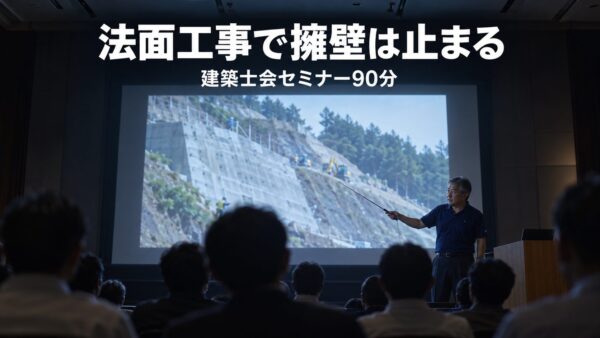
The other day, I had the opportunity to give a seminar at the Tokyo Association of Architects.
The theme was “Mountains, Ground, and Retaining Walls,” so I ended up talking for a full 90 minutes lol
To be honest, the construction industry is a world that we slope contractors usually have almost nothing to do with.
Even so, I’m truly grateful that you’ve taken the time to reach out to me like this.
But that's beside the point.
The 90-minute session covers everything from career backgrounds to the basic types of slope construction work
First, I’ll start by talking about my background, and"What exactly is a slope contractor, anyway?"That's what I explained.
Here is a general overview of the basic types of slope construction work.
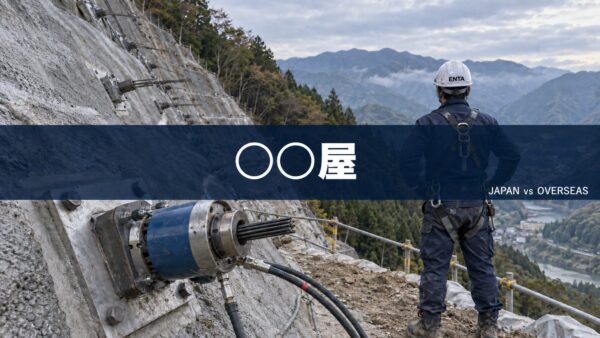
- Reinforcement Installer (Rock Bolt Installer)
- Ground Anchor Construction
- Mortar Spraying Worker
- Framework Engineer
- Drainage Boring Worker
These are the five types of work, right?
From an architect's perspective, I think this is a type of construction work you rarely have the chance to see in everyday life.
So I included plenty of photos and explained the process—"We set up this kind of machine on the slope, drive the piles in this order, and secure them this way"—in a way that would help listeners visualize the actual site as clearly as possible.

Why can retaining walls be used in slope stabilization projects?
"Why Can Retaining Walls Be Built Using Slope Stabilization Techniques!?"That's the story, isn't it?
To be honest, from our perspective, it's not really that complicated.
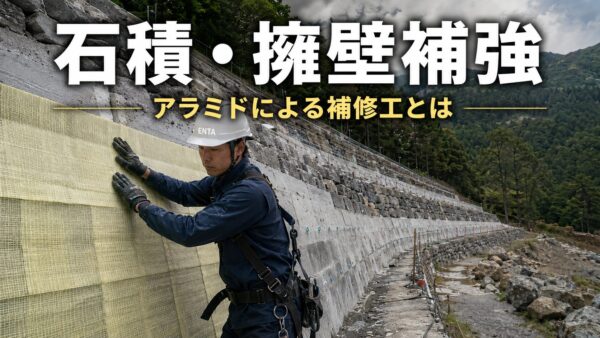
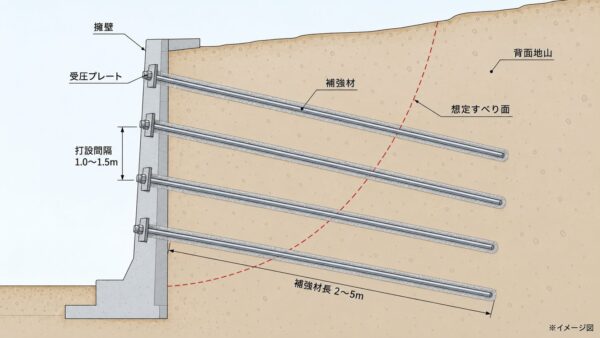
Instead of fighting the retaining wall itself, we should simply reinforce the natural ground behind it with support materials.
That's all there is to it.
There’s actually a clear source for this line of thinking.
The Design and Construction Manual for Soil Reinforcement Methods for Natural Ground covers conventional slope stabilization techniques such as retaining walls and various slope structures,"External measures that do not affect the interior of the ground"It is classified as such, whereas the soil reinforcement method, like anchors and drainage works,"Internal Measures That Act on the Ground"It says, "It is..."
Retaining walls support from the outside; our construction work reinforces from the inside.
The key point is that it reduces the load on the structure that bears the earth pressure.
Furthermore, the manual clearly outlines empirical guidelines for the placement of reinforcing materials.
The minimum spacing required to avoid cluster effects is 1.0 m; the maximum spacing under road standards is 1.5 m (up to 2.0 m provided that a rigid surface material is integrated into the structure on bedrock or similar surfaces where sufficient circumferential friction resistance can be expected).
The length of the reinforcing material is also specified in road standards, ranging from a minimum of about 2 meters to a maximum of 5 meters.
In other words,A construction method in which rule-of-thumb guidelines are laid out this clearlyThat's it.
(That said, it’s actually a tried-and-true method I’ve settled on—based on my own experience—thinking, “This is probably good enough!”—in his own words)
So, the feeling that “you can stop quite a few retaining walls using empirical methods” isn’t just a shot in the dark—it’s more like my past experience has actually become a fact, lol.
That said, in actual work, we naturally do a thorough job of designing things. After all, there’s a huge difference between “knowing from experience that it’ll work” and “doing it based on experience alone.”
It won't get approved by the local government, and it'll make the client anxious, too.
It came out during Q&A: 100% of people have never heard of "Hozamiya" lol
And during the Q&A session, I was asked all sorts of questions, but what shocked me the most was this.
Almost 100% of people had never heard of the job of "slope worker" lol
We're totally unknown to the world, lol.
"I thought the civil engineers were handling everything," they said.
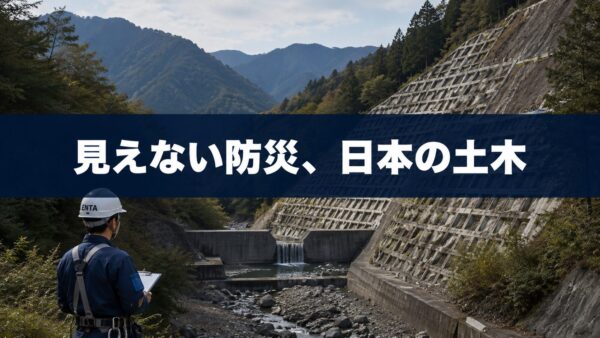
Actually, awareness of civil engineering projects in general was quite low.
It was kind of like, “I know a little bit about it, but not really what it’s all about…”
It really struck me that architecture and civil engineering are completely separate fields, and that people in each field really know absolutely nothing about the other.
To put it another way, it also means that simply by stepping forward and speaking up, you’re already adding value.
I plan to keep up these kinds of PR efforts for my slope-construction business in the future, lol.
But talking for 90 minutes really does take its toll.
I don't mind speaking in front of people, so I'm actually enjoying it, but,Making the slides leading up to that point was a total nightmare...w
This is especially true because the content is so niche.
I spend ages agonizing over just how much to simplify the explanation of drilling for rebar insertion for people in the construction industry.

But anyway, the capsule hotel in Shin-Okubo felt like something straight out of the future.
On a different note, the capsule hotel in Shin-Okubo, Tokyo, where I stayed that night.
This is so stylish!

It has a futuristic feel to it, doesn't it!?
The interior was beautiful and absolutely comfortable.
And above allFull of foreigners。
It really felt like I was abroad. Places like this are great—they’re so stimulating.

So, there was this foreign guy sitting in the seat in front of me this morning.
That shirt made me laugh lol

I'm definitely going to Kagoshima!!
All in all, it was a great day—including the seminar speaker.
On the way homeI came home with a sore back....lol
At the end of the day, whether we're on the job site or in front of an audience, our work can't get started unless people know about it.
Why does the retaining wall stop? Who is stopping it?
It's just that there aren't enough people in the industry who can explain it—but the demand is definitely there.
It was totally worth it to go talk to them, even if it meant hurting my back! LOL
See you later.
Retaining Wall Reinforcement Methods from a Slope Engineer’s Perspective (Part 1)