

Hello, everyone.
This is Enta.
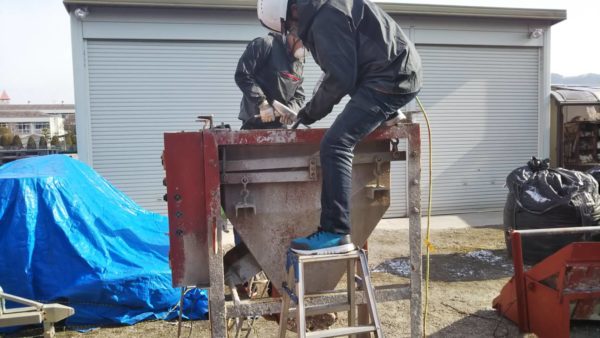
The other day, work at the site was suspended due to excavation of the natural ground.
So, let's talk about maintaining the equipment we use on a daily basis.
It’s these technical interns who are chiseling away with jet chisels!
We only had two jet chisels, so the three of us ended up fighting over them lol
I'll remove the rust and paint it.
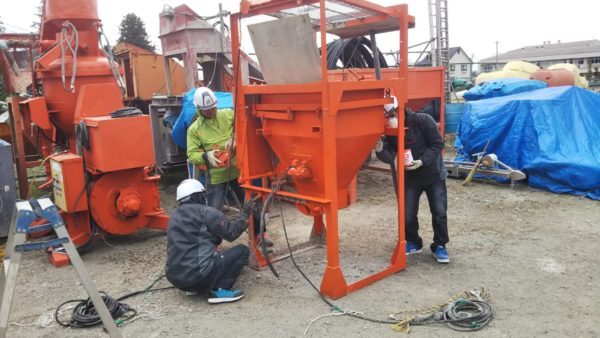
I'm not actually on a construction site, but for some reason I'm wearing a hard hat! I think it's impressive, but it's also kind of funny lol
(Although I was told I didn't have to wear it at work...)
I'll apply it with a brush.
This simple task really brings out a person's true character, doesn't it?
There are two types: the ones who meticulously chisel away at the rust bit by bit for a clean finish, and the ones who just rough it out and call it a day!
...and that's how you break up with that type of person.
Naturally, while the former is considered the better approach, it is slower, which means it actually ends up costing more.
If you take a slapdash approach to your work, you'll finish quickly. However, the work will be sloppy.
Which one would you consider acceptable?
If it's just a short-term profit, you'll generally make more money by finishing the job quickly.
But there won't be a next time with that job.
At its core, our work is also about providing services.
This is a service called slope stabilization.
When you provide a service, you want customers to come back to you next time, right?
The key is to secure the next project from the same general contractor.
They're what you'd call repeat customers.
From the general contractor’s perspective, there are times when they think, “This part of the project is too difficult, so I’d like to ask that company to handle it,” right?
You’d think, “That company is definitely a safe bet!” wouldn’t you?
That's what's important.
That's why I recommend going for a clean, nearly perfect result—even if it costs a little more.
That "almost" part is the key, though lol
There is something called the 1:5 rule.
It costs five times as much to sell to new customers as it does to sell to existing customers.The Law of...
This principle applies more to products and retail, but,
This certainly applies to our construction industry as well.
If you go out of your way to lower your construction price in order to win a contract from a new general contractor, your profits will drop significantly.
However, if we secure work from our existing general contractor at the standard rate, there is a high likelihood that our profits will remain stable or even increase.
Are there any benefits to securing a new prime contractor after putting in so much effort?
What's important?
The point is that it’s extremely important to do our very best to carry out our current work for our prime contractor to near-perfection.
And,It’s important to have new prime contractors that stem from that original prime contractor.That's how it turns out.
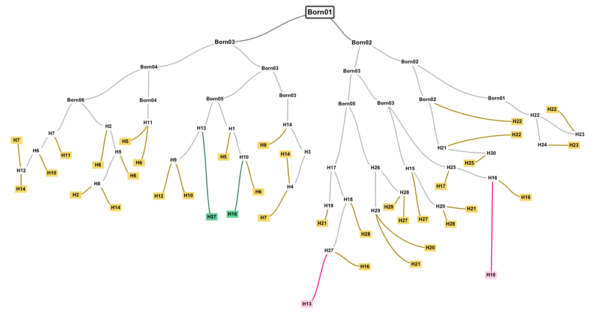
This new prime contractor, which has emerged from the existing one, is undoubtedly a new prime contractor created through your own efforts.
Since that general contractor is familiar with your company, I don't think they'll try to drive the price down too much.
Of course, there are times when the general contractor is a bit of a problem, but,
This means that if you’re a reputable general contractor, handling matters properly could lead to higher unit prices down the line.
Of course, figuring that out is key—it’s probably where the money is, but,
It’s true that there are times when I find myself thinking, “I’d love to do that if it were on that director’s set!”
You know how it is—even if it's cheap, you think, "But it's that person's work!"
It’s not just about money; I’d like to place importance on those human, emotional aspects as well.
Since I'm on the management side, my criteria inevitably tend to revolve around money.
Still, I’d definitely like to work with a good director!
See you later.