

Hello, everyone.
This is Enta.
I'm going on a business trip starting this week lol
Job opportunities in the Tokai region aren't great—are there any anchor positions available?
Please give me some work!!
We'll go anywhere! (Leave the design, construction, construction management, and design changes to us!)
In Part 1, I wrote about craftsmen’s salaries by comparing the minimum wage, daily wages, and the annual income at CCUS.
In this post, we'll discuss how much revenue a company needs to generate in order to pay those salaries.
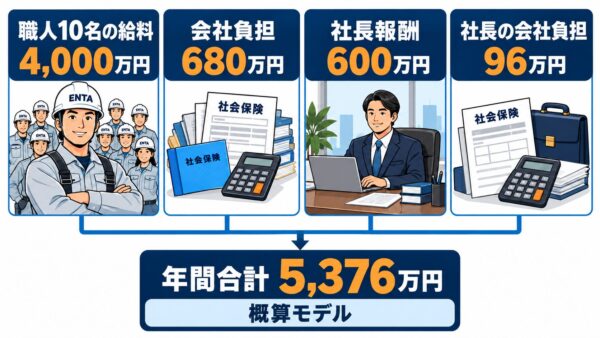
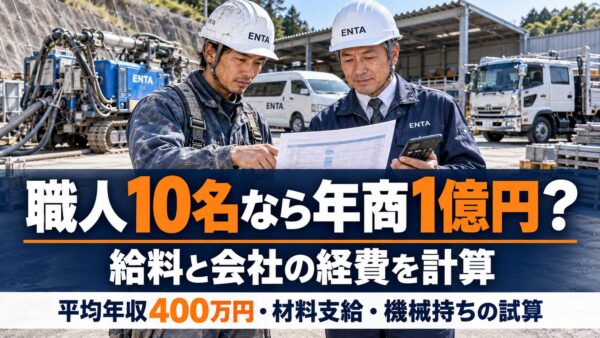
There are 10 craftsmen earning 4 million yen a year.
If we're just talking about salary, it's 40 million yen a year.
However, I need a car to get to the site.
You need a machine to spray it. You also need a hose and diesel fuel.
Just having the pay ready isn't enough to get the spray work started, lol.
So, for this example, let’s assume there’s a construction company that owns both its own spray equipment and vehicles, and list out the expenses.
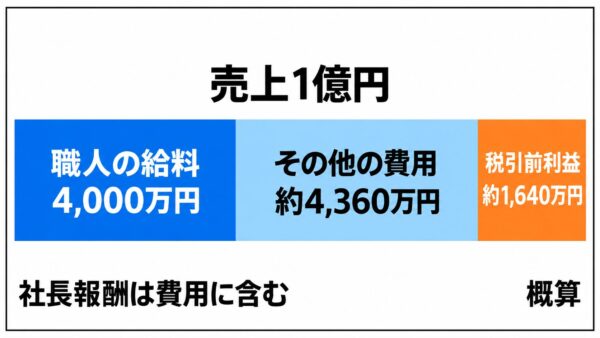
To start with the amount,Under the current terms, annual sales are approximately 100 million yen.
This is the minimum requirement.
With a salary of 40 million yen, why would he need that much?
Let's take a closer look at the money during that time.
10 craftsmen. First, let's look at salaries and company contributions.
Here's a brief overview of the company we'll be discussing this time.
| Item | Terms and Conditions for This Event |
|---|---|
| Artisan | 10 people, average annual income of 4 million yen |
| President | In addition to the craftsmen, one person receives an annual executive compensation of 6 million yen. |
| Construction Materials | Provided. Does not cover the cost of purchasing materials. |
| Complete Spray Application System | 8 million yen × 2 sets |
| HiAce | 5 million yen × 4 units |
| 4-metric-ton truck | 13 million yen × 1 unit |
| Administrative Work | Handled by the President and an Outside Contractor |
From here on,This is a rough estimate based on this company.
It's not the industry average, nor is it our financial results, lol.
When calculating an annual income of 4 million yen, we consider the total gross pay—including bonuses, various allowances, and overtime pay—before taxes and other deductions.
Equipment costs, sales, and expenses should be expressed in amounts excluding tax.
First, your salary. Then add the insurance premiums and other costs paid by the company.
| Personnel Costs | Annual |
|---|---|
| Salaries for 10 craftsmen | 40 million yen |
| Social Insurance, etc., for Craftsmen: Company Contributions | 6.8 million yen |
| President's Executive Compensation | 6 million yen |
| Social Insurance for the President: Company Contributions | 960,000 yen |
| Total | 53.76 million yen |
For now, we have tentatively set the company's share at 17% of the craftsmen's salaries and 16% of the president's compensation.
In reality, the rates vary depending on the insurer and age, among other factors, so they are not the uniform statutory rates.
Incidentally, according to data from the Ministry of Health, Labor, and Welfare, the employer’s contribution rate for employment insurance for construction projects in fiscal year 2026 is 1.05 percent.
This is included in the top 17 percent. [Ministry of Health, Labor and Welfare Documents]
In addition to the amount deducted for the employee on the pay stub,There is also a financial burden on the companySo that's how it is.
This means that for social insurance, the company contributes an amount equal to what is deducted from the employee's pay! (This is important.)
And I included the president's salary as well.
If the company could run on calculations that set this figure to zero, you’d have to wonder, “How would the CEO make a living?” lol
While the craftsman's salary is 40 million yen, personnel costs total 53.76 million yen. This figure does not yet include the cost of vehicles or machinery.
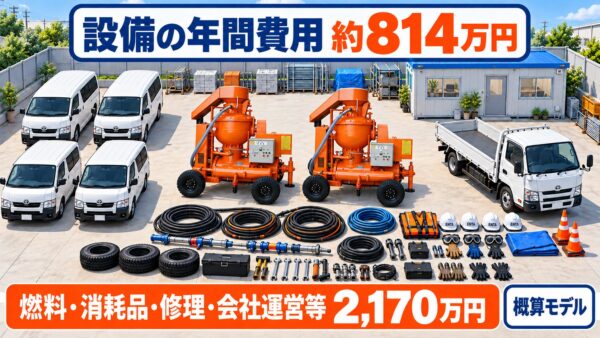
A spray gun, a HiAce, and a hose. It doesn't end with just having them.
Next up are machines and cars.
Two complete sets of spray equipment, four HiAce vans, and one 4-metric-ton truck.
When you add up the purchase amounts made this time, the total comes to 49 million yen.
However, I don't buy 49 million yen worth every year.
Since we’ll be using it for several years, we’ll divide the purchase price by that number of years to calculate the annual cost. This is the concept behind depreciation in this case.
| Facilities | Total Purchase Amount | Number of years used in the calculation | Annual Depreciation Expense |
|---|---|---|---|
| 2 complete sets of spray equipment | 16 million yen | 7 years | Approximately 2,286,000 yen |
| 4 HiAce vans | 20 million yen | 5 years | 4 million yen |
| 1 4-metric-ton truck | 13 million yen | 7 years | Approximately 1,857,000 yen |
| Total | 49 million yen | — | Approximately 8.143 million yen |
In this calculation, we divided the value evenly over the specified number of years and assumed the residual value at the end was zero. This table is not intended to explain the tax-deductible useful life.
That alone amounts to approximately 8.14 million yen per year.
Also, the machine I bought won't run unless I put diesel fuel in it.
Cars need to have their tires and oil changed. Hoses and gaskets need to be replaced.
You have to pay both the cost of purchasing the machine and the ongoing costs of using it.
From supplies to office furniture—let's take everything out at once
Since listing everything under “Miscellaneous Expenses” makes it hard to see the details, I’ll break it down in detail this time.
This is the annual budget we have set for our company, which primarily handles local construction projects but also includes some business travel. This figure is not based on actual fuel consumption or repair costs, but is a rough estimate provided for comparison purposes.
| Item | Contents and Placement | Annual Budget |
|---|---|---|
| Vehicle Fuel | A total of 150,000 yen per month for all five units | 1.8 million yen |
| Fuel for Machinery | A total of 200,000 yen per month for both sets | 2.4 million yen |
| Consumable Parts and Tools | Hoses, nozzles, fittings, gaskets, etc. | 1.8 million yen |
| Machine Repair and Inspection | Maintenance costs other than the consumable parts listed above | 1 million yen |
| Vehicle Maintenance | Vehicle Inspection and Maintenance, Tires, Oil, Repairs | 1.2 million yen |
| Vehicle Insurance and Taxes | Voluntary insurance, compulsory automobile liability insurance, automobile tax, etc. | 900,000 yen |
| Other Insurance | Machinery Insurance, Contractors' Liability Insurance, Workers' Compensation Supplement, etc. | 800,000 yen |
| High-Speed, Parking, and Transportation | Transportation and Delivery Costs (Excluding Fuel) | 1.2 million yen |
| Waste Management and Cleaning | Discarded hoses, oils, etc., at the company's expense | 400,000 yen |
| Work Clothes and Safety Equipment | Helmet, fall arrest equipment, shoes, gloves, etc. | 800,000 yen |
| Education, Certifications, and Health Screenings | Training, License Renewal, and Physical Exams | 600,000 yen |
| Retirement Mutual Aid Programs, etc. | Budget for Employer Contributions | 800,000 yen |
| Business Trips and Accommodations | The portion paid by the company that does not overlap with salary allowances | 1.2 million yen |
| Offices, Warehouses, and Storage Areas | A total of 200,000 yen per month | 2.4 million yen |
| Utilities | 50,000 yen per month | 600,000 yen |
| Telecommunications and IT | Telephones, the Internet, computers, and software | 600,000 yen |
| Tax Accountants, Certified Social Insurance and Labor Consultants, etc. | Consulting, Financial Statements, Labor Procedures | 800,000 yen |
| Administrative and Sales Expenses | Stationery, postage, membership dues, sales activities, etc. | 400,000 yen |
| Interest Expense and Financial Expenses | Placed here temporarily because the loan terms are unknown | 600,000 yen |
| Outsourcing of Administrative Tasks | 100,000 yen per month. This is in addition to fees paid to tax accountants and others. | 1.2 million yen |
| Other Taxes and Public Levies | Budget for Stamp Tax, Depreciable Asset Tax, etc. | 200,000 yen |
| Total | 21.7 million yen |
It turned out to be a long table, but the annual total is 21.7 million yen. (This is just an estimate.)
Even when we provide the materials, we don't include the hose for free. After all, we need to pay for company storage space and car insurance.
Of course, amounts such as retirement benefits provided by the general contractor will be excluded from our company's share of the costs.
For large-scale scaffolding, heavy lifting, security, subcontracted support, and long-term lodging, these will be arranged by the general contractor or quoted separately; we will add them to the estimate only for sites where our company bears the costs.
Consider this separately from the Ministry of Land, Infrastructure, Transport and Tourism’s “48% of necessary expenses”
Public documents from the Ministry of Land, Infrastructure, Transport and Tourism also include a reference figure indicating that necessary employment-related expenses account for 48 percent of wages.
This concerns statutory welfare expenses, labor management expenses, safety management expenses, housing expenses, and so on. [Ministry of Land, Infrastructure, Transport and Tourism: Explanatory Materials]
However, this 48% does not represent the company's overall expense ratio.
These are considered reference values that vary depending on the type of work and the scale of the project. [Materials for Reiwa 8]
Since we had our own machinery and vehicles this time, we loaded them separately.
I haven't calculated the total expenses by adding 48% to the amount so far.
According to the Ministry of Land, Infrastructure, Transport and Tourism, the cost of hiring and retaining a single craftsman amounts to 48 percent of the per-person unit price.
How can I pay for everything and still keep 10–20% as profit?
Add up everything up to this point.
| Annual Costs | Amount |
|---|---|
| Salaries for 10 craftsmen | 40 million yen |
| Social Insurance, etc., for Craftsmen: Company Contributions | 6.8 million yen |
| President's Compensation and Social Insurance | 6.96 million yen |
| Depreciation of Machinery and Vehicles | Approximately 8.143 million yen |
| Fuel, Supplies, Repairs, Company Operations, etc. | 21.7 million yen |
| Annual Total | Approximately 83.603 million yen |
I started out with a salary of 40 million yen and have made it to about 83.6 million yen. (And that's just the minimum!)
On a monthly average, that comes to about 6.97 million yen.
And the profit hasn't been recorded here yet.
For this calculation, I'll add a 10–20% profit margin.
This is the percentage of employees we want to retain—not based on government regulations or industry averages.
When you write “profit,” it might seem like all of that money is available for you to use as you please, but corporate income tax and other taxes come after that.
In this instance, we will compare the figures after deducting expenses—including interest expense—but before deducting corporate income tax and other taxes.
| Profit Retained from Sales | Required Annual Sales | Monthly Average Sales | Annual Pre-Tax Profit |
|---|---|---|---|
| 10% | Approximately 92.89 million yen | Approximately 7.74 million yen | Approximately 9.29 million yen |
| 15% | Approximately 98.36 million yen | Approximately 8.2 million yen | Approximately 14.75 million yen |
| 20% | Approximately 104.5 million yen | Approximately 8.71 million yen | Approximately 20.9 million yen |
This is where the figure of about 100 million yen comes into play.
The calculation is: Required Sales = Annual Expenses ÷ (1 – Profit Margin).
If the profit is 15 percent, that means all expenses are covered by the remaining 85 percent.
So, what if sales reached exactly 100 million yen?
| How to Use 100 Million Yen in Revenue | Amount |
|---|---|
| Salaries for 10 craftsmen | 40 million yen |
| Other expenses | Approximately 43.6 million yen |
| Income Before Taxes | Approximately 16.4 million yen |
After deducting the craftsmen's wages, there is 60 million yen remaining.
However, not all of that 60 million yen is profit.
Based on these calculations, approximately 16.4 million yen will remain with the company. The president’s compensation of 6 million yen has already been included in operating expenses.
Please keep the president's personal salary separate from the company's profits.
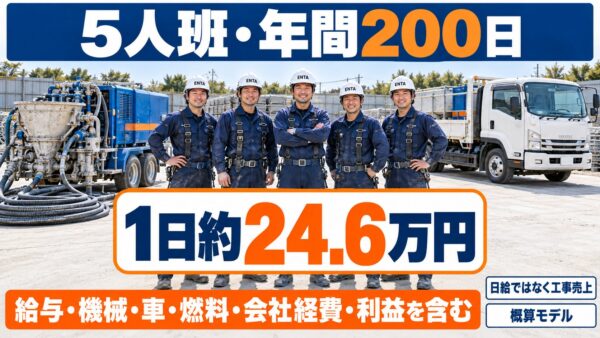
About 250,000 yen per day for a team of five. That’s not a craftsman’s daily wage.
This time, I'll try to come up with a figure that makes sense in the field.
Divide the 10 craftsmen into two groups of five each.
Suppose each team has a complete set of spray equipment and is responsible for half of the annual sales.
The table below shows the annual sales of approximately 98.36 million yen required to achieve a 15% profit margin, divided by the number of days required for construction.
| Number of Construction Days per Year for Each Crew | Average Daily Sales for the Entire Company | Average Daily Sales for a Team of 5 | Sales divided by the number of craftsmen |
|---|---|---|---|
| 180 days | Approximately 546,000 yen | Approximately 273,000 yen | Approximately 54,600 yen |
| 200 days | Approximately 492,000 yen | Approximately 246,000 yen | Approximately 49,200 yen |
| 220 days | Approximately 447,000 yen | Approximately 224,000 yen | Approximately 44,700 yen |
If it's 200 days a year, that comes out to about 246,000 yen per day for a team of five. Roughly 250,000 yen.
This figure includes the costs I listed earlier for machinery, vehicles, diesel fuel, and office expenses.
Just because it works out to about 49,200 yen per person doesn’t mean that’s the craftsman’s daily wage. Nor is it the hourly rate for temporary workers.
This is the amount of construction payment received by the spray team, divided by the number of workers.
Also, the number of construction days and the number of workdays are different.
Some days you’re servicing machinery, some days you’re attending certification training, and some days you’re preparing for the next job site, right?
I'm trying to figure out how much the construction will cost per year, including those expenses.
In this table, the annual expenses have been set to the same amount to make it easier to see the difference in the number of days.
In reality, fuel consumption and other factors vary depending on the number of operating days and the distance traveled, so this is where you’ll need to substitute the figures from each company.
Take a look at options that are close to your annual income
In Part 1, we looked at where our annual income falls on the scale.
If we adjust the average annual income at this company, the required sales will be as follows.
| Average Annual Income of 10 Artisans | Annual Sales Required to Achieve a 15% Profit Margin |
|---|---|
| 3.5 million yen | Approximately 91.47 million yen |
| 4 million yen | Approximately 98.36 million yen |
| 4.5 million yen | Approximately 105.24 million yen |
| 5 million yen | Approximately 112.12 million yen |
| 5.5 million yen | Approximately 119 million yen |
This comparison only changes the salary and the company's 17% contribution. Equipment and other expenses remain unchanged.
Since this is the average annual income, if a junior employee earns 3.5 million yen and a foreman earns 5.5 million yen, don’t base your calculations for the entire group on just those individual amounts.
Let's consider the total of all employees' salaries.
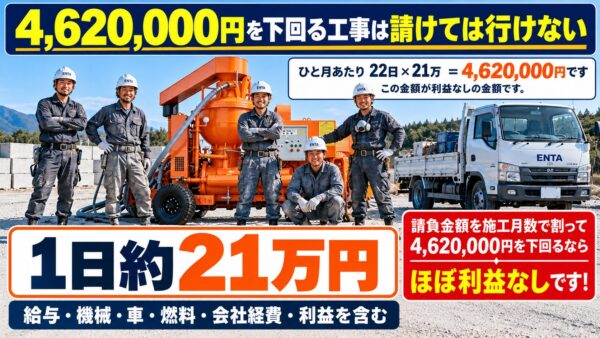
By the way,
If there is no profit: 22 days per month × 210,000 × =It is 4,620,000 yen.
This amount represents the amount before profit.
If you divide the contract amount by the number of months of construction and the result is less than this amount, thenVirtually no profitThat's it!
If the amount is less than this, I cannot accept the job!!
If we, as contractors, follow these guidelines, our profits will definitely increase, and the company will gradually improve.
For this calculation, we assume 10 craftsmen with an average annual income of 4 million yen, who are provided with materials and have their own machinery.
Under these conditions, the sales required to maintain a profit margin of 10–20% were approximately 92.9 million to 104.5 million.
However, if you travel frequently for business, your lodging costs will vary, and if you drive more, your fuel costs will change as well.
If you're working with a company that rents out equipment, the way you account for equipment costs will also change.
So, rather than just memorizing that “10 people equals 100 million yen,” try applying the information in the table to your own company.
Also, the amount of profit and the amount remaining in the bank are not the same.
This time, I did not include the repayment of the loan principal in my business expenses. I’ll skip the detailed calculations.
When planning your actual finances, you need to take into account loan repayments, tax payments, and any advance payments you’ll need to make until you receive payment for the construction work.
As for the target value,
Total sales ÷ Number of people = Sales per person,If you have between 12 million and 18 million ↑↑, that's excellent.That's right! (No ingredients needed; just a little effort and a machine)
I believe that craftsmen should be aware of these figures as well.
The HiAce I drive every day, the spray gun I use, and the replacement hose—I pay for all of them out of the construction fees.
If you're going to compare your salary to the company's revenue, make sure you fully understand everything that lies between the two.
Incidentally, if we define the “minimum sales” as the level that yields a 10% profit margin, the annual amount per craftsman is as follows:
| Annual Income of Skilled Workers (Gross Pay) | Minimum Annual Sales (10% Profit) | Annual Sales (15% Profit) | Annual Sales (20% Profit) |
|---|---|---|---|
| 4 million yen | Approximately 9.3 million yen | Approximately 9.8 million yen | Approximately 10.5 million yen |
| 5 million yen | Approximately 10.6 million yen | Approximately 11.2 million yen | Approximately 11.9 million yen |
| 6 million yen | Approximately 11.9 million yen | Approximately 12.6 million yen | Approximately 13.4 million yen |
| 7 million yen | Approximately 13.2 million yen | Approximately 14 million yen | Approximately 14.8 million yen |
We're estimating these expenses and profits on the conservative side.
So, in reality, you’ll need about two to just under three times your salary.
My gut feeling is that it's been trending at about 2.5 times the previous level.
This is just a rough estimate, but it's not too far off.
With prices rising rapidly these days, let’s make sure to firmly turn down work that isn’t in our employees’ best interests.
A good general contractor understands these details thoroughly.
That's some serious negotiating.
By the way, based on a rough estimate for this company, the company...For accounting purposesThis is the remaining amount.
But since this money actually goes toward monthly payments and other expenses, there’s hardly any cash left in my bank account... (It’s enough to make you cry.)
| Sales (excluding tax) | Profit Margin | Taxes (Estimated) | Amount after taxes |
|---|---|---|---|
| Approximately 92.89 million yen | 10% | Approximately 2.79 million yen | Approximately 6.5 million yen |
| Approximately 98.36 million yen | 15% | Approximately 4.43 million yen | Approximately 10.33 million yen |
| Approximately 104.5 million yen | 20% | Approximately 6.27 million yen | Approximately 14.63 million yen |
See you later.


![Will “Craftsman Subscription” Change Salaries in the Construction Industry? Examining Fixed Salaries, Skill-Based Pay, and Performance-Based Pay [Part 3]](https://norimen.net/wordpress/wp-content/uploads/2026/10/8a3ec972ee9f25ca49037b908efbc485.jpg)