

Hello, everyone.
This is Enta.

There is an app called "Correction App" on CAI.
An app that helps you prepare for written exams with support from seniors and your company!
Please give it a try.
CAI: Collection of Civil Engineering Apps
It's all free, so be sure to sign up!
But that's beside the point.
Is my salary high or low?
Daily wage: 10,000 yen. 15,000 yen. 20,000 yen.
Just looking at the numbers, it makes a big difference depending on how many days you work in a year and whether you receive a bonus, doesn't it?
In this post, I’ll compare craftsmen’s salaries by looking at the minimum wage, annual income calculated from daily wages, the government’s CCUS guidelines, and my own firsthand experience on the job.
Keep your pay stub handy and see where you stand right now lol
I’ll separate the published figures from my own experience and intuition.
The amounts listed are generally "gross pay" before taxes and social insurance premiums are deducted. This is different from the net pay deposited into your bank account. (Please be sure not to confuse the two.)
1. If you convert the minimum wage to a monthly or annual income, how much would it be?
First, search for the area where you work.
The table below shows the revised amounts for fiscal year 2026 from the Ministry of Health, Labor and Welfare,8 hours a day, 22 days a monthThis was calculated using that method.
The 22nd reflects the settings used for this comparison and does not represent the statistical average number of workdays.
As of October 11, 2026, there are still some prefectures where the revised amounts have not yet taken effect. The table shows only the “revised amounts for fiscal year 2026.” Ministry of Health, Labor and Welfare: National List
The calculation is simple.
- Monthly Income = Minimum Wage × 8 hours × 22 days
- Annual Income = Monthly Income × 12 Months
Bonuses, allowances, and overtime pay are not included.
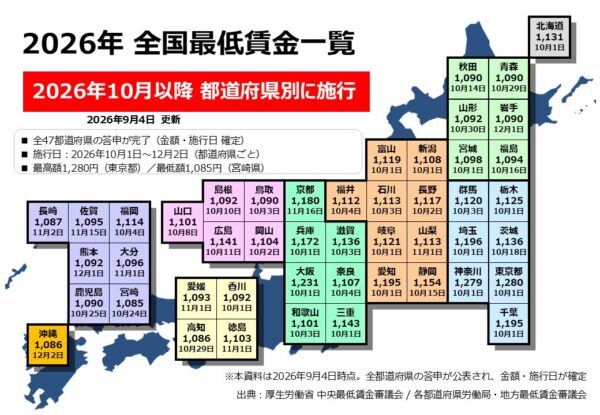
Check the minimum wage in your prefecture
Amounts are in yen. Working hours are per day, and the number of workdays is per month.
| Number · Prefecture | Minimum Wage | Working Hours | Number of Workdays | Converted to Monthly Income | Annualized Income |
|---|---|---|---|---|---|
| 01 Hokkaido | 1,131 | 8 | 22 | 199,056 | 2,388,672 |
| 02 Aomori Prefecture | 1,090 | 8 | 22 | 191,840 | 2,302,080 |
| 03 Iwate Prefecture | 1,090 | 8 | 22 | 191,840 | 2,302,080 |
| 04 Miyagi Prefecture | 1,098 | 8 | 22 | 193,248 | 2,318,976 |
| 05 Akita Prefecture | 1,090 | 8 | 22 | 191,840 | 2,302,080 |
| 06 Yamagata Prefecture | 1,092 | 8 | 22 | 192,192 | 2,306,304 |
| 07 Fukushima Prefecture | 1,094 | 8 | 22 | 192,544 | 2,310,528 |
| 08 Ibaraki Prefecture | 1,136 | 8 | 22 | 199,936 | 2,399,232 |
| 09 Tochigi Prefecture | 1,125 | 8 | 22 | 198,000 | 2,376,000 |
| 10 Gunma Prefecture | 1,120 | 8 | 22 | 197,120 | 2,365,440 |
| 11 Saitama Prefecture | 1,196 | 8 | 22 | 210,496 | 2,525,952 |
| 12 Chiba Prefecture | 1,195 | 8 | 22 | 210,320 | 2,523,840 |
| 13 Tokyo Metropolis | 1,280 | 8 | 22 | 225,280 | 2,703,360 |
| 14 Kanagawa Prefecture | 1,279 | 8 | 22 | 225,104 | 2,701,248 |
| 15 Niigata Prefecture | 1,108 | 8 | 22 | 195,008 | 2,340,096 |
| 16 Toyama Prefecture | 1,119 | 8 | 22 | 196,944 | 2,363,328 |
| 17 Ishikawa Prefecture | 1,113 | 8 | 22 | 195,888 | 2,350,656 |
| 18 Fukui Prefecture | 1,112 | 8 | 22 | 195,712 | 2,348,544 |
| 19 Yamanashi Prefecture | 1,113 | 8 | 22 | 195,888 | 2,350,656 |
| 20 Nagano Prefecture | 1,117 | 8 | 22 | 196,592 | 2,359,104 |
| 21 Gifu Prefecture | 1,121 | 8 | 22 | 197,296 | 2,367,552 |
| 22 Shizuoka Prefecture | 1,154 | 8 | 22 | 203,104 | 2,437,248 |
| 23 Aichi Prefecture | 1,195 | 8 | 22 | 210,320 | 2,523,840 |
| 24 Mie Prefecture | 1,143 | 8 | 22 | 201,168 | 2,414,016 |
| 25 Shiga Prefecture | 1,136 | 8 | 22 | 199,936 | 2,399,232 |
| 26 Kyoto Prefecture | 1,180 | 8 | 22 | 207,680 | 2,492,160 |
| 27 Osaka Prefecture | 1,231 | 8 | 22 | 216,656 | 2,599,872 |
| 28 Hyogo Prefecture | 1,172 | 8 | 22 | 206,272 | 2,475,264 |
| 29 Nara Prefecture | 1,107 | 8 | 22 | 194,832 | 2,337,984 |
| 30 Wakayama Prefecture | 1,101 | 8 | 22 | 193,776 | 2,325,312 |
| 31 Tottori Prefecture | 1,090 | 8 | 22 | 191,840 | 2,302,080 |
| 32 Shimane Prefecture | 1,092 | 8 | 22 | 192,192 | 2,306,304 |
| 33 Okayama Prefecture | 1,104 | 8 | 22 | 194,304 | 2,331,648 |
| 34 Hiroshima Prefecture | 1,141 | 8 | 22 | 200,816 | 2,409,792 |
| 35 Yamaguchi Prefecture | 1,101 | 8 | 22 | 193,776 | 2,325,312 |
| 36 Tokushima Prefecture | 1,103 | 8 | 22 | 194,128 | 2,329,536 |
| 37 Kagawa Prefecture | 1,092 | 8 | 22 | 192,192 | 2,306,304 |
| 38 Ehime Prefecture | 1,093 | 8 | 22 | 192,368 | 2,308,416 |
| 39 Kochi Prefecture | 1,086 | 8 | 22 | 191,136 | 2,293,632 |
| 40 Fukuoka Prefecture | 1,114 | 8 | 22 | 196,064 | 2,352,768 |
| 41 Saga Prefecture | 1,095 | 8 | 22 | 192,720 | 2,312,640 |
| 42 Nagasaki Prefecture | 1,087 | 8 | 22 | 191,312 | 2,295,744 |
| 43 Kumamoto Prefecture | 1,092 | 8 | 22 | 192,192 | 2,306,304 |
| 44 Oita Prefecture | 1,096 | 8 | 22 | 192,896 | 2,314,752 |
| 45 Miyazaki Prefecture | 1,085 | 8 | 22 | 190,960 | 2,291,520 |
| 46 Kagoshima Prefecture | 1,090 | 8 | 22 | 191,840 | 2,302,080 |
| 47 Okinawa Prefecture | 1,086 | 8 | 22 | 191,136 | 2,293,632 |
*This is not a table setting the legal minimum monthly or annual salary; rather, it is a calculation based on the specified hours and number of days.
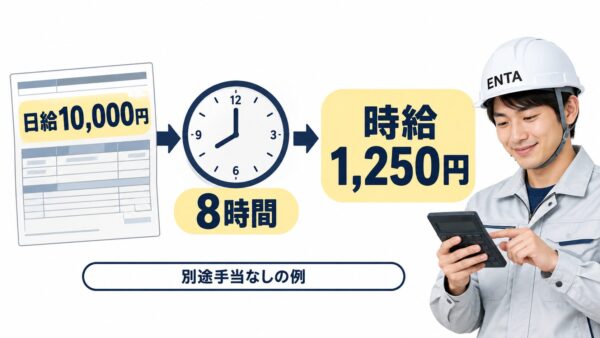
Converting a daily wage of 10,000 yen to an hourly wage
Daily wage of 10,000 yen ÷ 8 hours = hourly wage of 1,250 yen.
Doesn't it give you a slightly different impression when you hear it as a daily wage versus an hourly wage?
The revised hourly rate in Tokyo is 1,280 yen, so 8 hours’ worth comes to 10,240 yen. If we compare just the daily wages of 10,000 yen, it falls short by 240 yen.
According to the Ministry of Health, Labor and Welfare, the daily wage is calculated by dividing the total pay by the scheduled working hours.
If there are other allowances, you need to confirm whether they can be included. You cannot simply add anything—such as bonuses or commuting allowances—to the total.
Conversion Method・Eligible Wages
First, how much does your daily wage differ from the local minimum wage?
This is the first check.
At the job sites I've seen, craftsmen in the past used to start at a daily wage of around 8,000 yen.
Back in the day—when, as far as I can remember, labor management wasn't as strict as it is now—there were actually construction sites that paid a daily wage starting at 6,000 yen lol
This is based on my experience at that time.
That doesn't mean there were no legal issues with that amount. (People around 50 these days might be doing it, lol.)
Right now, what I consider to be the standard starting point for beginners is, at the very least,Approximately 10,000 to 12,000 yen per dayThat's it.
This isn't based on national averages, but on my own firsthand experience in the field. (Even our beginners start at around 12,000.)
I wouldn't recommend companies that pay less than that daily wage to anyone looking to become a craftsman.
However, please also confirm the working hours, bonuses, allowances, and the number of days’ pay you’ll receive each year.
Even if the daily wage is the same, the total amount you receive annually will vary.
How much is my daily wage in terms of annual income?
Please look in the table below to find the daily wage that is closest to yours.
Rows showing amounts of 14,000 yen or more are also provided as examples for calculation purposes. These amounts are not set as "the standard for mid-level employees" or "the average for veterans."
| Daily Wage | Monthly Income on the 22nd | Annual Income Based on 264 Working Days Per Year | Annual Income Based on 234 Working Days Per Year |
|---|---|---|---|
| 10,000 yen | 220,000 yen | 2.64 million yen | 2.34 million yen |
| 12,000 yen | 264,000 yen | 3,168,000 yen | 2.808 million yen |
| 14,000 yen | 308,000 yen | 3,696,000 yen | 3,276,000 yen |
| 16,000 yen | 352,000 yen | 4.224 million yen | 3.744 million yen |
| 18,000 yen | 396,000 yen | 4.752 million yen | 4.212 million yen |
| 20,000 yen | 440,000 yen | 5.28 million yen | 4.68 million yen |
*This estimate is based solely on daily wages multiplied by the number of days. Bonuses, allowances, overtime pay, and paid time off are not included.
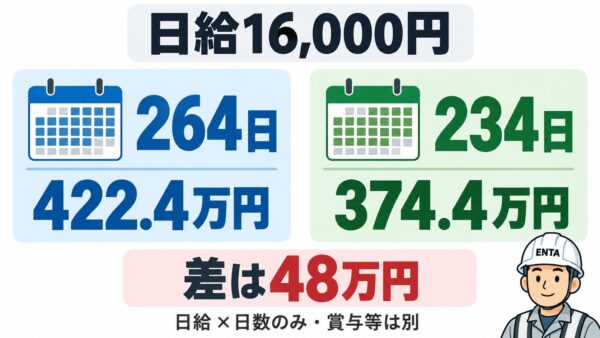
For example, a daily wage of 16,000 yen.
For 264 days, it comes to 4,224,000 yen, but for 234 days, it comes to 3,744,000 yen.
There's a difference of 480,000 yen for a 30-day supply.
Even if you hear that “that company pays a high daily wage,” you won’t know the annual salary unless you check how many days’ worth of pay is included in the annual total.
"234 days" refers to the number of working days per year used in the explanation of CCUS annual income, which will be discussed later. I've listed them here for comparison.Ministry of Land, Infrastructure, Transport and Tourism: Calculation Criteria
Beginner, Intermediate, or Expert. Where do you stand right now?
In my experience, it takes 3 to 5 years to progress from a beginner to an intermediate level.
We estimate it will take another 5 to 10 years or so to reach veteran status from that point.
| Stages of Growth | The time frame based on my experience | Questions to Reflect on Who I Am Today: “My Perspective” |
|---|---|---|
| From Beginner to Intermediate | 3 to 5 years | What tasks am I responsible for on my own? |
| From Mid-Career to Veteran | Another 5 to 10 years | To what extent are you responsible for planning, decision-making, and explaining things to junior colleagues? |
If you simply add up the years, it’s 8 to 15 years since joining the company, but the speed at which people learn and the work they’re assigned vary from person to person.
This is a guideline based on my experience; it is not a CCUS certification standard.
Don't use age alone to determine whether someone is a beginner or an experienced player,What kind of work are you currently responsible for?Please give it some thought, too.
By the way, I think coaches with 8 or more years of experience are considered mid-career, while those with 15 or more years are considered veterans.
There is a reason for this: as a supervisor, there is a limit to the number of times you can work as a prime contractor or subcontractor in a single year.
What’s more, because site conditions and types of work vary so widely, you might only get to work on a single type of job once a year—if that—so it just takes a long time.
3. The government has established a guideline for the annual income of CCUS workers.
CCUS stands for the Construction Career Advancement System.
Simply put, it is a system for recording on-the-job experience and certifications, among other things, to facilitate the assessment of skills.Official CCUS Explanatory Materials
The Ministry of Land, Infrastructure, Transport and Tourism’s annual income data includes “standard values” and “target values” for each skill level.
First, take a look at the figures for the entire country and all sectors.
| Level | A General Description of Skill Levels | Standard Value | Target Value |
|---|---|---|---|
| 1 | Beginner/Apprentice | 3.95 million yen | 5.35 million yen or more |
| 2 | Mid-level / Skilled Worker | 4.44 million yen | 5.99 million yen or more |
| 3 | Ready to work on-site as a foreman | 4.72 million yen | 6.64 million yen or more |
| 4 | A stage characterized by advanced management skills for coordinating on-site operations | 5.72 million yen | 7.54 million yen or more |
The descriptions of these skills are simplified versions of the official CCUS materials.Certification levels are not determined solely by years of experience or annual income.
Annual income isMinistry of Land, Infrastructure, Transport and Tourism—Materials Revised in April Reiwa 8This is the "Nationwide" section.
Do you mean “the salary the government wants”?
Looking at these numbers, some people might think that.
According to documents from the Ministry of Land, Infrastructure, Transport and Tourism, annual income was calculated based on the assumption that the labor unit rates used in the design of public works projects were paid as wages.
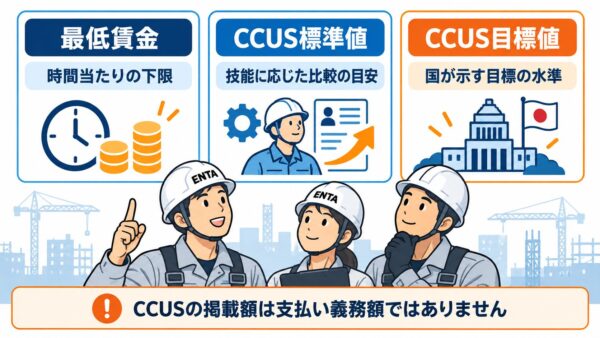
While it recommends paying more than the target amount, it is clearly stated that the listed amount is not legally binding.
In other words, just because you get the card doesn't mean you'll automatically have this annual income.
I'll also explain the meanings of the terms.
| Words | Meaning in this document |
|---|---|
| Standard Value | A value based on the annual income equivalent of the bottom approximately 15% of the survey sample |
| Target Value | A value based on a level above the average for the survey sample |
The standard values and target values are not the minimum and maximum amounts. Ministry of Land, Infrastructure, Transport and Tourism Data and Calculation Criteria
And these standards and metrics haven't been of any use so far, lol.
That said, these figures do come from people who’ve misunderstood this and are interpreting it to suit their own purposes, lol.
You don't have to take it at face value.
It is, after all, just a theoretical concept put forward by the government. (For now, at least.)
Compare it to a beginner's daily wage
CCUS annual income is calculated taking into account a two-day weekend and summer and year-end/New Year holidays.234 days a year, 8 hours a dayThat's the explanation.Ministry of Land, Infrastructure, Transport and Tourism: Frequently Asked Questions
If we calculate the daily wage based on 234 days, it comes out like this.
| Comparison Criteria | Annual Income |
|---|---|
| 10,000 yen per day × 234 days | 2.34 million yen |
| 12,000 yen per day × 234 days | 2.808 million yen |
| CCUS Level 1: National Standard Values | 3.95 million yen |
If you pay a daily wage of 12,000 yen for 234 days, the total comes to 2.808 million yen.
The difference from the national Level 1 standard of 3.95 million yen is 1.142 million yen.
However, the daily wage figures do not include bonuses or allowances. Since regions and job types vary, it is not possible to judge individual companies’ salaries based on this difference alone.
Even so,The amount calculated based on the minimum wage and the CCUS amount based on skill levels are based on different criteria.I understand that.
Take a look at the numbers for your area
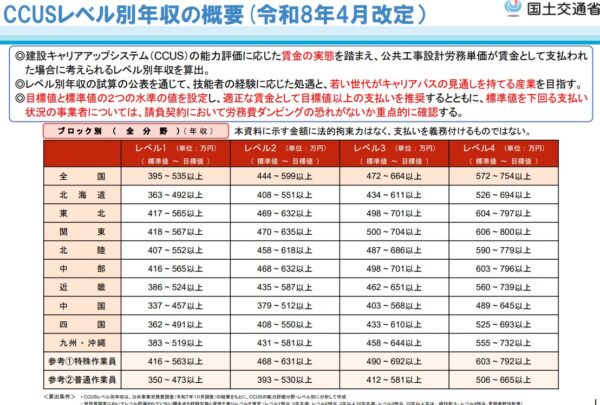
Source: Ministry of Land, Infrastructure, Transport and Tourism, “Overview of Annual Incomes by CCUS Level,” revised in April Reiwa 8.Official Documents
The table above shows nationwide figures; the image is for comparison by region.
Since these figures represent aggregated data across all sectors by region, please refer to the tables broken down by occupation in the official documents for more detailed information.
4. Based on my experience and intuition in the entertainment industry, what is the typical salary range for actual artisans?
From here on, I'm relying on my experience, practical knowledge, and intuition.
This isn't a statistical analysis based on pay stubs from all over the country, lol.
Based on my experience, if a site supervisor’s salary is 100, a craftsman’s salary is typically around 75 to 90.
For example, if we assume that the director's annual income is 6 million yen, the calculation would look like this.
| Comparison Criteria | Salary Percentage | Example of Annual Income Calculation |
|---|---|---|
| Site Supervisor (Hypothetical) | 100% | 6 million yen |
| Artisan: “My Personal Experience” | 75–90 percent | 4.5 million to 5.4 million yen |
This 6 million yen is just an illustrative figure.
Even among people of the same age, overtime, responsibilities, and the companies they work for vary. The ratio to a supervisor alone is not a sufficient basis for determining whether an individual craftsman’s salary is appropriate.
However, as I've mentioned before, the upper limit for craftsmen's salaries is currently around 6 to 7 million.
I don't know many people who make more than that.
Of course, there will be differences depending on the size of the company, the person’s position, and how demanding the work is.
Overlaying My Actual Experiences onto the CCUS Standard Values
Regarding the comparison with CCUS,
From the perspective that Level 1 is about 85%, Level 2 is about 90%, Level 3 is about 95%, and Level 4 is about 97%, right?
In this case, these are provisional figures obtained by multiplying that percentage by the national “standard value.”
| Level | National Standard Values | My Adjustment Rate | Estimated Annual Income Based on Experience | Difference from the standard value |
|---|---|---|---|---|
| 1 | 3.95 million yen | 85% | Approximately 3.36 million yen | Approximately 590,000 yen |
| 2 | 4.44 million yen | 90 percent | Approximately 4 million yen | Approximately 440,000 yen |
| 3 | 4.72 million yen | 95% | Approximately 4.48 million yen | Approximately 240,000 yen |
| 4 | 5.72 million yen | 97% | Approximately 5.55 million yen | Approximately 170,000 yen |
*The published figures areMinistry of Land, Infrastructure, Transport and Tourism National Standard Values。
The correction rate is based on my experience and intuition.
The figures in the table are rounded to the nearest 10,000 yen.
Based on my assessment, when calculated this way, the greater the lack of experience, the larger the deviation from the standard value becomes.
However, these results are based on percentages derived from my own experience and actual data.
These are not the actual national averages or medians.
A beginner’s daily wage of 10,000 to 12,000 yen is not the same as the approximately 3.36 million yen earned by a Level 1 worker.
Are they new hires, or have they been on the job for a while? Do they receive bonuses or allowances?
We cannot generalize the market as a whole without verifying that point.

Check your location in this order
| Order | Things to See | Things to Check |
|---|---|---|
| ① At Your Feet | Daily Wage and Scheduled Working Hours | Comparison with the local minimum wage. Excludes allowances not subject to the minimum wage. |
| ② 1 year | Monthly Salary and Bonuses | Tally based on pre-tax income, not take-home pay. Track overtime pay separately. |
| ③ Skills | CCUS Certification Levels and Responsibilities | Review the work I'm currently responsible for |
| ④ Points of Comparison | Average CCUS Annual Income by Region and Job Type | Check the difference between your annual income and the standard and target figures |
For example, for someone at Level 2 with an annual income of 4 million yen, the difference from the national average of 4.44 million yen is 440,000 yen.
However, you’ll also need to check the conditions regarding region, job type, number of working days, bonuses, and overtime pay.
Please don't interpret it the other way around—thinking, "Since my annual income is 4 million yen, I'm at Level 2."
Skill assessments and salary levels should be evaluated separately.
In this article, we’ve compared the salaries that skilled workers earn using a few figures.
If you take into account not only your daily wage but also your annual number of workdays and bonuses, I think you’ll start to get a clearer picture of where you stand right now.
So, how much revenue does the company that pays those salaries need to generate?
Next time, I plan to present the company's figures.
See you later.



![Will “Craftsman Subscription” Change Salaries in the Construction Industry? Examining Fixed Salaries, Skill-Based Pay, and Performance-Based Pay [Part 3]](https://norimen.net/wordpress/wp-content/uploads/2026/10/8a3ec972ee9f25ca49037b908efbc485.jpg)