



Hello, everyone.
This is Enta.

The whole world is all about the Olympics right now.
Yuzuru Hanyu (Hanyu) is just amazing!
He's already a legend at that age!!

And behind the scenes, the legendary genius Yoshiharu Habu (Habu) lost to the junior high school student and professional player Sota Fujii—
There was a moment that changed history!

I just can't take my eyes off Mr. Hanyu and Mr. Habu this year, lol.
But that's beside the point.
Surveillance Starting from Sample Collection
The other day, I found some test specimens from a company’s compressive strength test that had been thrown away, and they were actually really good!
Normally, we extract cores from the test specimens to conduct compressive strength tests (for formwork construction, sprayed mortar, and sprayed concrete).
A common comment during inspections is, “We can’t really be sure if this test specimen was actually collected from the site, can we?”
I don't think many companies would do something so trivial these days, but it's true that the process is hard to follow.
I thought it would make things a little easier to understand if we labeled them starting from the time the test specimens were collected.
This is it.
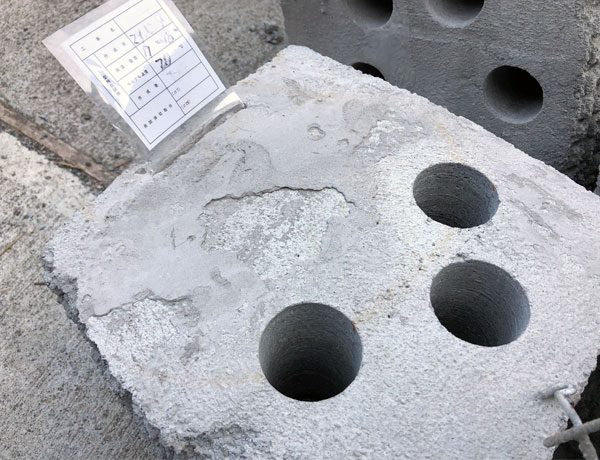
When taking samples, you insert a plate with a laminated label like the one shown above into the test specimen.
For example, write “Test specimen collected on [Month] [Day]” on the blackboard. Then, write it on the plate as well. Take a photo of the plate along with the specimen.
Also, when extracting the core, take a photo of the plate along with the "Core Extraction Complete" and "Core Sample" photos.
Filmed the compressive strength test along with the plate during the 7-day and 28-day strength tests.
That completes the flow.
It's flowing really nicely, isn't it!?
I think having a procedure for compression strength testing gives us a sense of security in terms of quality control.
If it boosts your rating even a little, it's worth doing, right?
In a sense, on-site management in construction management can be a bit self-indulgent.
Personally, I hope they stick to doing whatever makes them happy—as long as they don't bother anyone! lol
After a lot of trial and error, being able to explain construction management in a way that even a complete novice can understand is part of a foreman’s skill, after all.
If you make complicated things sound complicated, you can’t really call yourself a true professional yet.
A true professional is someone who can explain complex things in a simple way, isn't that right?
See you later.

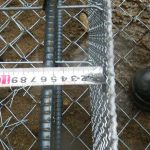
I see. So that's another way to do it.
I used an anchor pin to mark the test specimen directly.
Even if you write on the plate for the vegetation thickness you entered incorrectly and insert it,
Is that okay?
It's been a while!
Please bear with us a little longer while we make the necessary revisions to those documents and take care of other matters.
I'm really worried, and I'm so sorry!!
That's one way to do it, isn't it? They really put some thought into it!
I think you can write on anything.
Thank you for your concern.
Don't worry about it—just take your time and think it over.
I have a question that’s been on my mind—is it not allowed to take test specimens of sprayed mortar using a mold?
Thank you as always.
Basically, it's a core, not a mold. This is also stated in the specifications.
If you consult with the local government and they give their approval, it may be possible to use a mold in some cases.
However, I can't say for sure whether they'll approve it.
We used to make them using a mold, but because of the difference in strength, we switched to a core. (Since molds can be made by packing material into them.)
Only NEXCO uses the NetMold specification, so please use NetMold.
I learned a lot.
Thank you.
We look forward to your continued support.
I asked a question here before!
Thank you very much.
I have another question: What temperature should be maintained when applying sprayed insulation under the legal framework for winter construction?
Also, which references should I consult regarding temperature control?
Thank you in advance.
Thank you as always.
I'm sorry—I didn't realize I had received your email.
Sorry for the delay.
To get right to the point,
When it comes to temperature control, the key is to focus on the final kneading temperature.
It appears that the ideal temperature for placing the freshly mixed concrete is between 10 and 20 degrees.
That's why we use hot water.
To achieve a final temperature of about 10 degrees, the temperature of the water from the boiler needs to be raised to around 50 degrees.
I also think it’s a good idea to use fast-setting cement, as this accelerates the hydration reaction.
Guidelines for Concrete Construction in Cold Weather and Explanatory Notes
There is one problem, though: if you use water that's about 50 degrees, the submersible pump usually breaks down.
Please use a submersible pump that is suitable for use in hot water.
From a construction management perspective, we should conduct a test mix. For example, if the outside temperature is 0 degrees and the water temperature is 50 degrees, what will the mixing temperature be?
I think it should be fine as long as you use a thermometer to monitor the temperature during installation.
Also, since surface hardening begins within just five hours during the winter, I think it will be less likely to freeze after that.
However, one thing you absolutely must not do is use antifreeze lol. You probably won't believe this, but it's true!
Please feel free to use this as a reference.
We look forward to your continued support.
Thank you so much for everything you do for us!
Thank you.
I just thought antifreeze was fine.
I usually handle things like coke briquette curing, but the general contractor asked me a few times, “Is this the standard?” so I asked them a few more questions myself, haha.
It really does seem like using a boiler to heat water is the way to go.
Thank you very much!
In fact, tests conducted by government agencies have shown that antifreeze reduces the heat generated during the hydration reaction as the concrete hardens.
If the temperature drops and the curing process slows down, it will freeze.
I’d actually like to publish that data, but I haven’t done so because I don’t want to get into trouble if the manufacturer accuses me of interfering with their business.
Hot water is the best. If you increase the heat of hydration to speed up hardening, you won't have to worry about freeze damage.
If it still freezes, you just have to accept it lol
Since we can't really do that, I think we should just shorten the construction time.
It's better to prevent freezing than to let construction efficiency drop.
I think it's generally fine as long as the temperature doesn't drop below zero for more than five hours.
We look forward to your continued support.
Thank you as always for your very clear explanations.
By the way, do you manufacture the boilers used to heat water in-house?
Thank you.
You made that yourself, didn't you?
I'm thinking of writing about this in more detail next time.
About Boilers lol
It really is best to make it yourself, isn't it!
There isn't any!
If possible, I'd really appreciate it if you could tell me.