



Hello, everyone.
This is Enta.
My eyes are starting to get really bad.

If I buy this, I can go anywhere, but driving a car is a little scary.
That said, this situation is pretty scary even at the office. In my case, I have a 12-tatami-mat air purifier running at full blast right next to my desk!
And maybe it's partly because of the medicine, but I feel a little dazed, lol.
Please be careful, everyone.
But that's beside the point.
What Is Reverse-Winding Construction? (Part 1)
About Reverse-Winding Construction (Part 2)
Continuing from last time,
For mountains that might collapse if cut in the usual way, the reverse-cut method is used.
I guess I just need to cut it carefully so it doesn't fall apart.
That said, if, for example, the slope is cut to 45 degrees—which is the standard safe slope in civil engineering—the usable land area will decrease.
The earthwork plan is the core of the project, so it’s highly unlikely to change.
Our slope work crew—commonly known as the "ancillary work" crew—is really giving it their all! lol
So, we'll proceed with the installation to make sure it doesn't collapse.
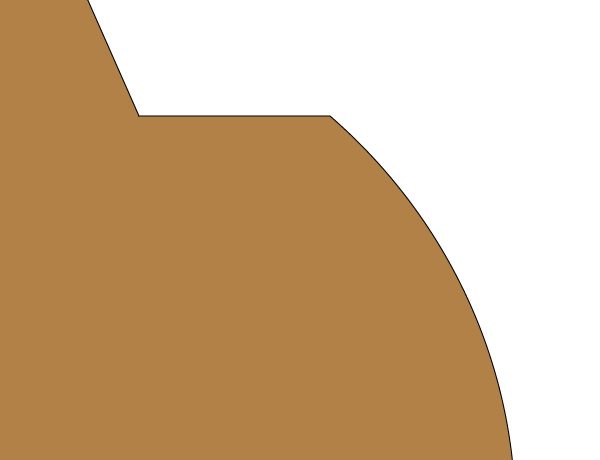
The color is different from last time, but don't worry about it!
For now, I'll cut the first layer like this.
Depending on the design specifications, this step is generally about 1 m to 2.0 m.
If the soil conditions at the design site were better, we could cut a little deeper, but that would still involve some risk.
At this stage, should we start by applying sprayed mortar or installing formwork?
Or perhaps rebar installation or ground anchor installation?
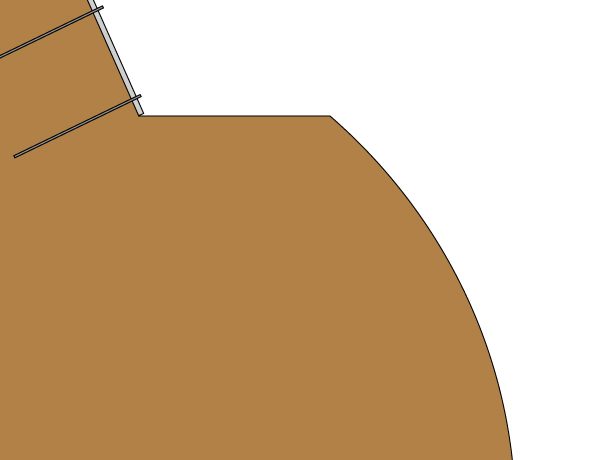
This illustration shows the process of spray-applied mortar and rebar insertion.
If you adjust the formwork properly (in consultation with the earthwork crew) while cutting it out, you may be able to pour two layers at a time.
Even the main contractor and the slope stabilization company want to minimize the number of visits as much as possible!
This is because loading, unloading, and transportation all incur costs. Furthermore, if the quantity per shipment is small, there is more waste, which drives up material costs.
What's more, it will be difficult to coordinate work schedules, which means the project will take longer to complete.
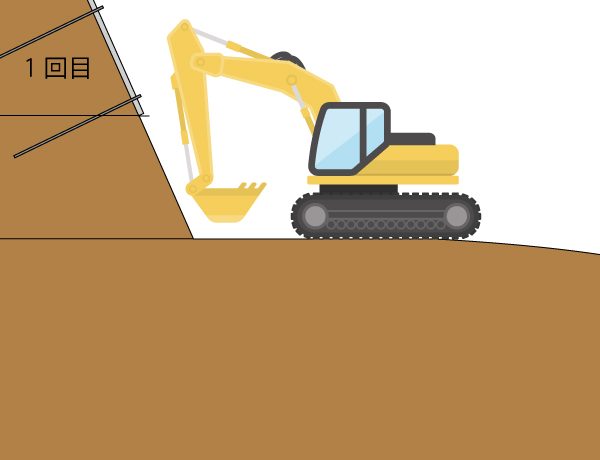
I've finished the second cut. The first tier has been reinforced, so it won't fall down. (Though that's not a guarantee.)
If you cut too much at this point, there is a risk that the upper section will slide down and collapse, so it is necessary to constantly monitor the slope for any changes.
However, caution is needed during periods of heavy rainfall, such as the rainy season.
Even if the first tier is fine because it has been reinforced, the second tier—which has not yet been constructed—is more susceptible to soil pressure and is highly likely to become saturated quickly.
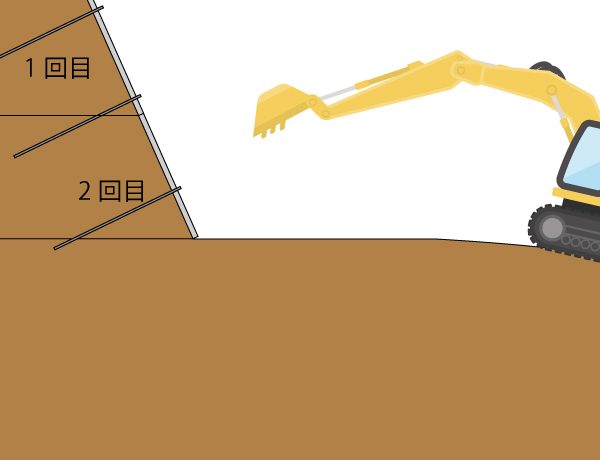
This is what it looks like once the second application is complete.
Since rebar installation work may involve pouring in two layers or only one layer, this point also needs to be discussed.
In our case, after cutting, we apply sprayed mortar (for small slopes, the anchor crew handles the spraying),
We use a crawler to drill single holes. Crawler drilling offers a different level of power compared to standard air-powered drilling machines.
Types of Drilling Machines Used in Slope Stabilization Projects
Even with something as small as an air drill, it can get really tough if it gets stuck, but with a crawler, it’s a breeze lol
In the worst-case scenario, I'll have to use a double pipe, lol.
However, when inserting rebar into long boreholes, connecting the casings can be time-consuming. (It’s especially difficult when the borehole is deep.)
That said, since the site must be able to accommodate a crawler-type rotary percussion drill (12 metric tons), it really depends on the situation.
Although there are various installation methods, this reverse-wrap installation is already standard practice.
I wish the government would give a little more thought to the financial aspects when designing government buildings.
With the "inversed spiral" method, the general contractor doesn't make a profit. In some cases, even after factoring in labor costs and overhead, the project ends up running a deficit.
I really hope they'll reconsider the standard unit price.
The government won't accept quotes based on market prices from the start, right? lol Even the association's quotes are like that, lol.
See you later.



Thanks for all your hard work as always. I’m getting hit harder by pollen than ever before. My eyes hurt so much. It’s really something, isn’t it? I actually hate reverse-wrap installations, but the sense of accomplishment after finishing one is (lol) incredible. Plus, it was a chance for the contractor to show off their skills (lol). Even though I really don’t want to do reverse-wrap installations… (lol) The more brutal the job site, the more satisfying it is once it’s done—I just can’t get enough of that feeling. It really builds your courage, too. The pollen (and strong winds) are terrible again today… but please stay safe!
Thank you for your hard work.
It's really windy, huh? lol
Today is really tough!
I highly recommend swimming goggles!
When there's a backdraft on site, you have to be extremely strict about the process, don't you?
Only when you are able to manage both the construction process and costs can you truly be called a supervisor.
The "Reverse Swirl" shoot is like a compilation of all that, lol. It's really going to put the director's skills to the test.
Stay safe today!