Hello, everyone.
This is Enta.
This time, we’ll look at the question, “Is it a good idea to email invoices as PDFs?”
So, I’d like to write about the question, “What’s the difference between a paper book and a PDF?”
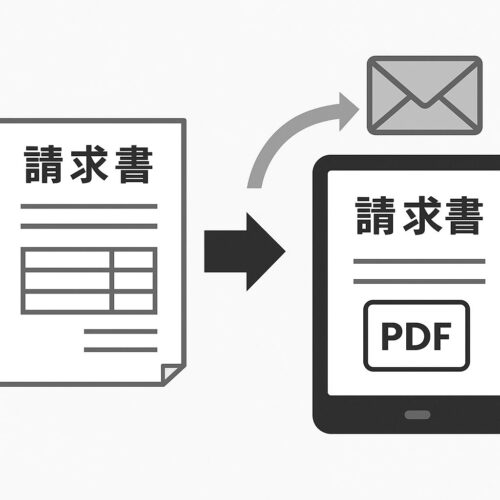
Sending it as a PDF is legally acceptable.
I think it’s still common in the construction industry to send “paper invoices” by mail.
However, in reality, there is no law that requires it to be on paper.
That's because we generally send files in digital format (PDF).
To be honest, when you consider the hassle and cost of mailing it, it's mostly a waste.
Even if you send an invoice in electronic format, such as PDF or Excel, it is valid as long as the recipient acknowledges receipt.
Furthermore, as stipulated by the National Tax Agency,"Electronic Record-Keeping Act"According to this,
You can also save it as a PDF and use it for accounting purposes.
*The Electronic Bookkeeping Act is listed at the bottom of this page.
The Difference Between PDFs and Paper
-
Legal Effect: Both are the same (valid if the other party agrees)
-
Shipping Costs: The PDF is free; for the paper copy, printing and shipping fees apply.
-
Speed: PDFs are sent the same day; paper copies are mailed and take 1–2 days.
-
Save: PDFs are stored electronically and are easy to search, while paper documents must be stored in an archive.
-
Evidentiary Value: PDFs can be secured with digital signatures and timestamps; paper documents are authenticated with seals.
- Seal: Since it's an electronic seal, it's the same whether printed or sent by email
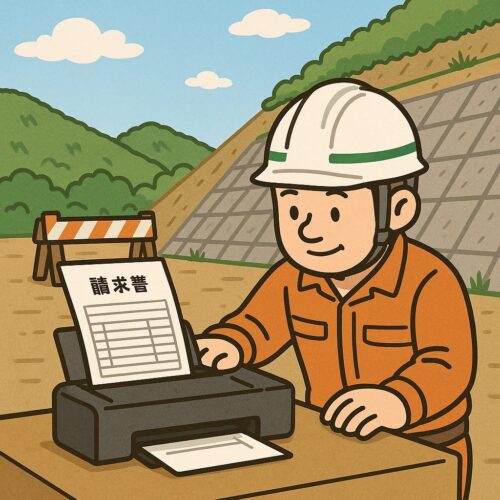
Points to Note Specific to the Construction Industry
Although there are still many companies in the construction industry that “only accept paper documents,” this stance has softened considerably.
Also, the practice of using physical seals is still deeply ingrained, so the only question is whether the other party will approve a PDF even if you include an image of the company seal.
That said, the seal used on invoices is generally just a personal seal (mitome-in). It’s not a particularly important seal (you wouldn’t use the company’s official seal for this).
Furthermore, due to the impact of the invoice system that took effect in October 2023, there is a growing trend toward requiring support for “electronic invoices”—a step beyond “PDFs”—going forward.
Major companies in particular are rapidly shifting from print to digital.
Recently, I received an email from a major company saying they were discontinuing email invoices and asking me to send a paper copy instead.
This is seriously crazy lol
In conclusion,The printed version and the PDF are essentially equivalent in terms of legal validity.That's it.
However, in the construction industry, “business practices of clients” have a strong influence, so
In practice, it might be more realistic to adapt to the other person.
Since the shift toward digitalization is set to accelerate, getting used to PDF invoices will definitely be an advantage.
Also, make sure to have an electronic seal ready if possible.
Since we generally issue all our invoices electronically,
Even if that major company mentioned above told us to send them the invoice forms, we’d just print them out on a printer.
It doesn't make any difference whether I print it at home or the recipient prints it after receiving it via email.
It's just a waste of time and money...
To be honest, I think this is a field that most office workers wouldn't understand.
If the company tells me that, it’s just a matter of saying, “Oh, really?” and that’s the end of it.
However, I’d like to point out that it’s actually very wasteful.
And also that it's legal.
See you later.
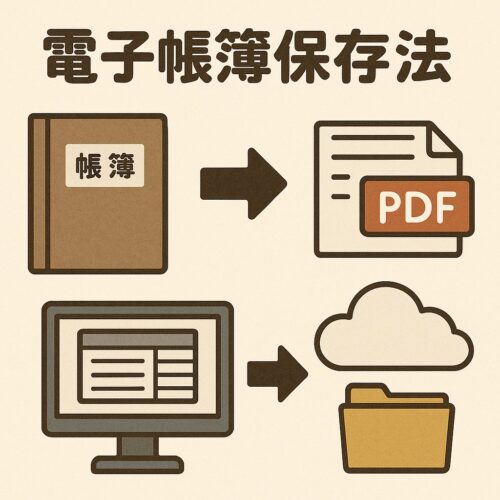
What Is the Electronic Bookkeeping Act?
**The Electronic Bookkeeping Preservation Act** is a law enacted in 1998 (Heisei 10), and
This allows companies to “store their ledgers and documents as electronic data rather than on paper.”
It establishes rules for the electronic storage of national tax-related records, invoices, receipts, and other documents.
1. Eligible Documents
-
National Tax-Related Records(Journal, General Ledger, etc.)
-
National Tax Documents(Invoices, receipts, quotes, contracts, etc.)
2. Three Categories of Storage Methods
The Electronic Bookkeeping Act stipulates the following three main methods:
-
Electronic Record Keeping, etc.
→ Save the ledgers created using accounting software or similar programs directly as electronic data. -
Scanned and Saved
→ Scan paper invoices and receipts and save them as digital files. -
Electronic Transaction Data Retention
→ Save invoices, receipts, and other documents received as PDF files or email attachments—that is, documents exchanged electronically from the outset—as electronic data.
3. Retention Requirements
In exchange for allowing electronic storage, there are requirements in place to prevent tampering and ensure searchability.
-
Ensuring Accuracy(Mechanisms that prevent tampering, such as timestamps and log management)
-
Ensuring Visibility(Can be displayed on screen or printed)
-
Search Function(Ability to search by date, amount, business partner, etc.)
4. The Process of the Amendment
-
Enacted in 1998: Permitting Electronic Record Keeping
-
2005 Amendment: Scanned documents can now be saved
-
2020 Amendment: Simplification of procedures (such as the abolition of the prior approval system)
-
Effective January 2022: Mandatory Retention of Electronic Transaction Data
-
Fully Implemented in January 2024: Saving in paper format is not permitted; electronic data must be stored electronically.
Summary
The Electronic Bookkeeping Act is,
**"A law that establishes rules allowing ledgers, invoices, and receipts to be stored as electronic data rather than on paper."**
Starting in 2024, the storage of electronic transactions in electronic data format will be fully mandatory, and all industries—including the construction industry—must comply.