

Hello, everyone.
This is Enta.
This is a continuation of my previous post.
To be honest, I haven’t actually taken all of these exams myself, but I’ll write about them based on what I learned in school and my experiences in the exam room.
So please don't assume I know everything, lol (just making excuses)
With my limited knowledge, I’d like to look into this again and explain it to you all as clearly as possible ^^
That said, it’s the kind of thing where “it’s fine if you just know it,” so feel free to skip it... lol
Types and Methods of Shear Strength Tests
Shear Test on a Single Plate
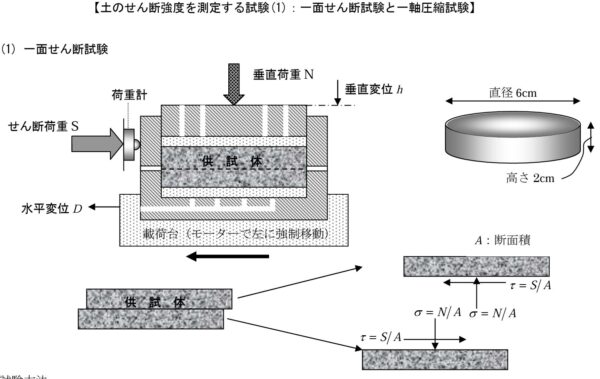
The soil, sand, and other test specimens are placed in a container measuring 6 centimeters in diameter and 2 centimeters in height, and a vertical load is applied from above while the top of the container is moved at a constant speed.
Record the relationship between horizontal displacement and shear stress, and the relationship between horizontal displacement and vertical displacement
Uniaxial Compression Test · Triaxial Compression Test
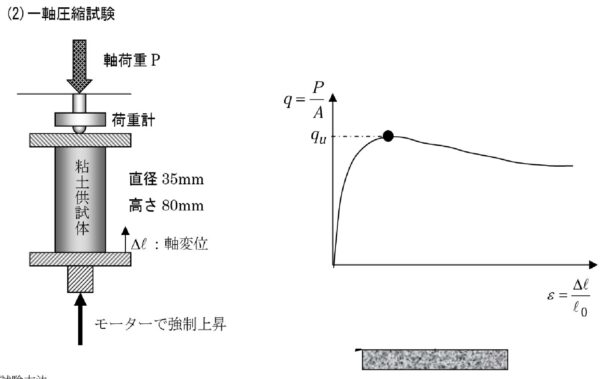
Raise the lower platform at a constant rate and measure the shaft displacement as you go.
Calculate shaft strain from shaft displacement; calculate shaft stress from shaft load
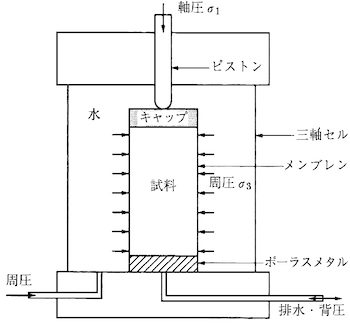
The triaxial test is a test in which the compression directions are increased to three.
The procedure is the same, but the types of samples are different.
For uniaxial testing, the material is clay or a material with greater cohesion than clay, allowing the specimen to stand on its own; for triaxial testing, the material is sand.
Unconsolidated soil samples are tested using uniaxial compression tests.
Behn Test
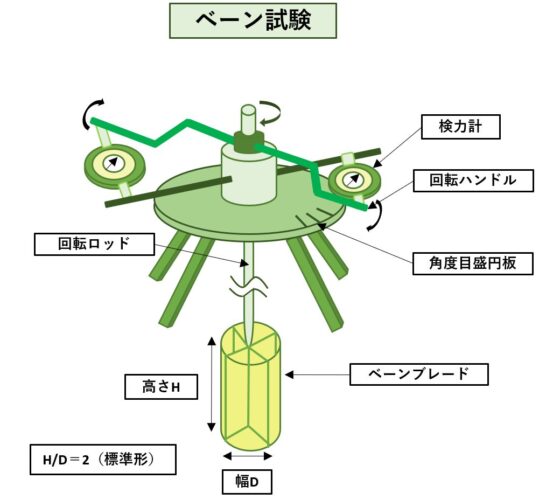
I spin the Beyblade vigorously as I insert it into the ground.
At that time, call for the goniometer and dynamometer at the top to take readings and record them.
In-Situ Vane Shear Test Method JGS1411
For more details, click ↑↑↑↑↑↑↑↑↑
We measure the strength of the soil using the test method described above.
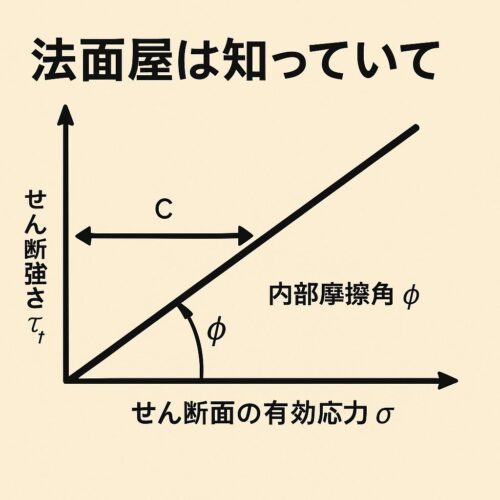
The values obtained here are C (C) and φ (phi).
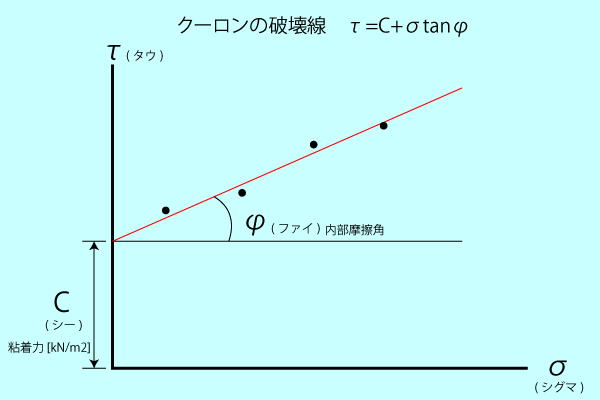
If we express this figure as an equation,τ = C + σ tan φ This equation is called the Coulomb breakdown line.
Cohesion is the force that causes soil particles to stick together due to the water surrounding them; it increases as the proportion of fine particles in the soil increases.
φ (phi) represents the property that prevents particles from sliding against one another (friction), which is called the angle of internal friction.
Summarizing this "adhesive force" and "angle of internal friction"Soil Strength ConstantsIt is called (doshitsujōsū).
This means that as the load increases, the surface becomes less prone to slippage; therefore, the deeper you go into the natural ground, the less likely slippage is to occur.
There are actually a lot of other complicated issues involved, but if you're curious, please look into them yourself lol.
For now, I think it’s good to know at least the basics.
That's it for now, lol.
See you later.