Hello, everyone.
This is Enta.
As I mentioned the other day, my cell phone's contact list got wiped, so I don't know most people's phone numbers lol
It's a bit of a hassle, but please send me a text message or give me a call directly.
Thank you in advance.

But that's beside the point.
We slope engineers often use the coefficient of adhesion c and the angle of internal friction φ, don't we?
It often appears in design calculations, and it’s a term that comes up frequently when talking with designers.
I guess that's a bit hard to understand, huh? lol (I think the older guy gets it, at least a little.)
But knowing that makes me feel just a little bit smug, lol.
In this post, I'd like to give a brief explanation of that.
However, before we get to that, you need to understand a bit about soil, so I’ll start with a brief explanation.
I’d be at a loss if you asked me for “more details,” so please just keep it brief lol
The strength of the soil is
The “soil” we work with on-site is made up of countless . (I think I’ve written about this before.)
To give you an idea, it’s like a state where air and water have seeped into the gaps between the soil particles.
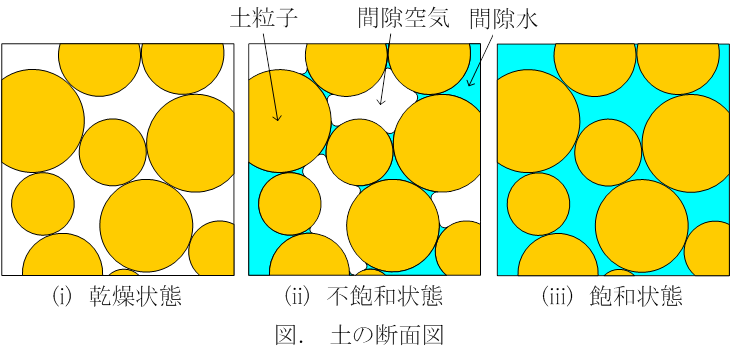
http://zhang.web.nitech.ac.jp/research.html
However, the soil particles are not strongly bound to one another; they merely interlock and support each other, resulting in a lack of stability.
If you pull on the soil, it crumbles easily.
The tensile strength of soil is practically zero.
On the other hand, it can support a certain amount of weight if you place objects on it.
This means it can withstand compression. This relates to the bearing capacity discussed earlier.
When the Soil Breaks Apart
When soil is compacted using a load plate, rather than the particles themselves breaking apart,
The soil shifts and collapses as if sliding diagonally.
This is the so-called "shear failure."
When considering slope stability at a construction site, it is extremely important to understand this concept of “shear failure.”
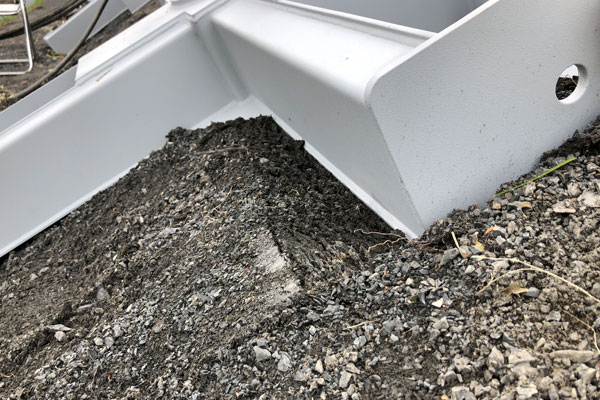
The bottom of the pressure plate has bulged due to shear failure.
Soil Strength Test
Uniaxial and triaxial compression tests are typical methods used to investigate shear failure conditions. They are commonly used in the field for tests related to column-based ground improvement and similar applications.
We use “standard compressive strength” a lot in our on-site testing, don’t we? That’s basically because there are so many concrete structures.
However, in the case of soil, what we want is the strength at which shear failure occurs—that is, the shear strength.
That means,Shear strength is the true strength of soilThat’s how it works.

Let's say there was a mountain like this.
When this mountain slides, it looks like the image below. (It’s a familiar sight, isn’t it?)
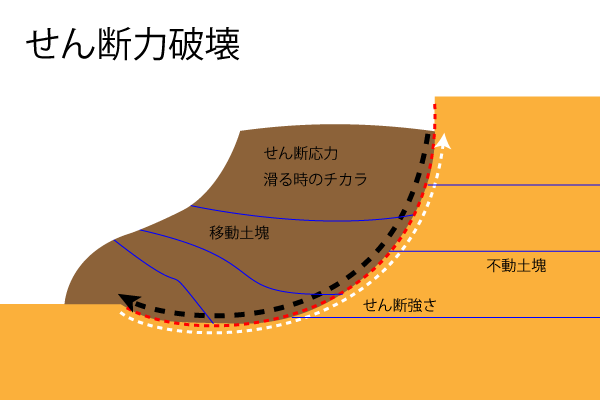
Commonly referred to as "mobile soil masses" and "stationary soil masses"
So, if the shear strength is high, it won't slip. That's the idea, lol.
White line: Shear strength
Red line: Sliding line
Black line: shear stress
To measure this force, there are tests such as the ones listed below.
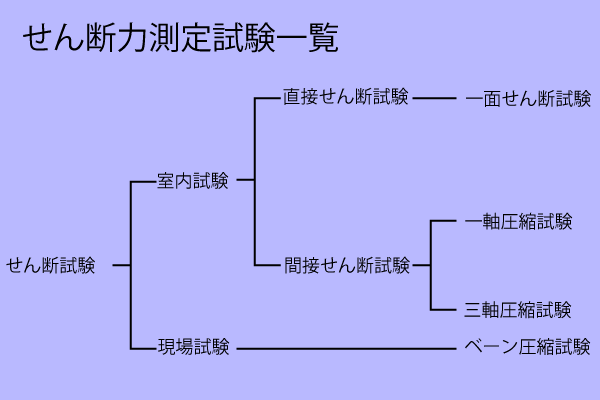
That's all for now.
Next time, we'll take a closer look at the exam.
See you later.