About 90% of civil engineers wouldn't want to recommend the construction industry to their families
When a certain organization conducted a survey of civil engineers (those certified as Civil Engineering Construction Managers) working in the local construction industry, the results were shocking.
89.31% of civil engineers say they would not recommend that their family members seek employment in the construction industry.
Given this situation, it would be more accurate to describe the civil engineering industry not as an “unpopular industry,” but as one with “a bleak future.”
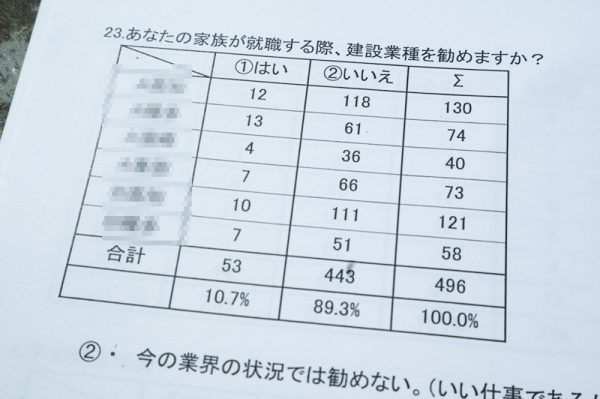
The local construction industry is being increasingly written off, even by active, seasoned civil engineers.
Weren’t long working hours supposed to be addressed and the number of days off increased as a result of the government’s “Work Style Reform” initiative?
What’s happening right now on construction sites across the country? We spoke with Industry Insider A (pseudonym), who is well-versed in the inner workings of the local construction industry.
"Stricter regulations" are being implemented at construction sites.
——I hear that the health and safety rules at construction sites are constantly changing.
A The main law governing occupational safety in Japan is the “Occupational Safety and Health Act.” Amendments to this law require the approval of the Diet, so it is difficult to change. The “Enforcement Order,” which is a cabinet order, is determined by the government, so new provisions are occasionally added. The “Occupational Safety and Health Regulations,” which are ordinances issued by the Ministry of Health, Labor and Welfare, set forth specific regulations for the workplace and have been revised frequently in recent years.
These conditions will change significantly in 2019 as well. In recent years, every time a ministerial ordinance has been amended, regulations on construction sites have become stricter, and work efficiency has declined significantly. From the perspective of “revitalizing the construction industry,” deregulation is necessary, and frankly, I can’t shake the impression that this is a step backward.
Naturally, the intent behind the amendments is to reduce the number of disasters by tightening regulations and penalties, and there is no doubt that reducing workplace accidents will lead to the revitalization of the industry. However, I can’t help but feel a sense of unease, wondering, “Why now?” In light of these amendments,The local construction industry has voiced dissatisfaction, with comments such as, “They don’t understand the realities faced by small and micro construction companies in rural areas. This is nothing short of cutting them off.”。
Small and Micro Construction Companies Struggling with “Paperwork-Only Safety Measures”
——What exactly are people complaining about?
A For example, in 2017, regulations governing rope access work replaced the traditional “safety rope” with a “main rope” and mandated the installation of a “lifeline” to which a safety harness is attached; however, having to manage two ropes significantly reduced work efficiency.
Furthermore, some of the clients who are “self-proclaimed experts” even demand the use of two ropes for tasks for which there are no regulations. This is a demand that goes far beyond the concept of “safety first.” The site supervisor faced with this request wondered, “Why go this far…?”I feel some frustration, but I'm close to a state of resignation." he said. Small and micro construction companies are struggling, caught between the client and "paper safety measures."
Effective February 1, 2019, the standard for “safety harnesses” will change to “fall arrest devices.” This change aligns with international standards and adopts ISO specifications. Not only in the construction industry but across Japanese industries that have used safety harnesses as fall prevention equipment, companies will be legally required to replace them. Looking back at past accident records, there do not appear to be that many incidents caused by safety harnesses. This naturally raises the question: “Why now?” I cannot help but feel that the standard change and the resulting replacement of equipment are taking precedence over the actual effectiveness of these measures in reducing fall-related accidents.
Still, if the government decides something, we have no choice but to comply. I’m well aware that public comment periods are merely a way to “let off steam” and don’t actually lead to any changes, but I still can’t help feeling unsettled. I find myself wanting to ask, “Isn’t the purpose of the Occupational Safety and Health Act to prevent accidents and disasters by creating a comfortable workplace environment?” Perhaps we’re focusing on the wrong things—the wording, the after-the-fact justifications, the standardized products, and the effective dates.Shouldn't we implement measures that better take into account the needs of those working on the front lines?。
In the past, deregulation was promoted. There was even a term called “private-sector participation.” However, hasn’t the tightening of regulations in recent years amounted to a “crackdown on private-sector participation”? The work environment for those known as craftsmen is becoming increasingly difficult, and new entrants are unable to gain a foothold, leaving the industry in disillusionment.
——As if the shortage of skilled workers weren't enough of a problem already, this is just adding insult to injury.
A That's right. The equipment required for craftsmen's work has become increasingly elaborate. Naturally, protective gear is the last line of defense for the body, and regardless of whether there are laws requiring it, it exists to put safety first.
However, in recent years, safety gear has become much more elaborate, and the physical strain it places on the body has increased significantly. Newly released products are becoming more expensive, placing a greater financial burden on users. While current waist belt-style safety harnesses can be purchased for around 10,000 yen, full-body harnesses easily exceed 50,000 yen.
Since the new standard is a government-backed initiative, I hope the unit price will be affordable, but we’ll have to wait and see. In any case, major manufacturers and retailers are sure to profit handsomely.
The introduction of a two-day weekend in name only has led to cutbacks in wages and project schedules
——The government is promoting the “introduction of a two-day weekend” as a national policy, but...
A I don’t understand the essence of the “Work Style Reform” being promoted by the government. While a two-day weekend is a thing of the past for the general public, for construction sites, it’s still a future prospect. The same is likely true for industries where many skilled workers are paid on a daily or monthly basis. However, in the construction industry—which relies almost exclusively on public works projects—the “wishes” of the contracting authority have a major influence. The clients commissioning public works projects themselves enjoy a two-day weekend and a comprehensive annual leave system. Consequently, they assume that others should operate the same way.
When I spoke with the client, they said that the design “includes pay for two days off per week,” but the amount included doesn’t seem realistic. For skilled workers, taking time off means a drop in income. This might be a concept that’s hard for people whose income is guaranteed even when they take time off to understand. Even when they have days off, they don’t have any money to spend. Isn’t that tough?I don't understand the point of using tax money for expensive toilets and image-boosting signs.. I simply cannot believe that expensive billboards will lead to an improvement in the public’s standard of living. If we face reality, shouldn’t we first raise the wages of working people—who are both citizens and taxpayers?
A sign that reads, “This worksite has two days off per week”
Furthermore, while they talk about a “reasonable construction schedule,” the current schedule is simply unrealistic. The client claims to have “set a schedule with two days off per week in mind,” but the engineers actually managing the site with that schedule are barely keeping up. The workload on-site is taking a heavier toll than ever before, both physically and mentally. The reality is that even when workers take time off from the job site, they are still at the office preparing paperwork. According to the results of a survey conducted at a training session for civil engineering technicians, the majority of respondents answered that “switching to a two-day weekend would make meeting the construction schedule difficult.” This is a pressing issue.
——The client side is pursuing a “two-day weekend” that’s merely for show, without any substance to back it up.
A Lately, I’ve been seeing signs at public construction sites that say, “This site has two days off per week.”Is the industry trying to convey to the public that “the construction industry doesn’t have a two-day weekend,” and if so, what is the purpose of this message?Whether the notice is posted based on the consensus of those working on-site, in accordance with the Construction Industry Act, or at someone’s instruction, if it is the result of an instruction, the person who gave the instruction should clearly provide a solid basis for it.
I certainly don’t think this is an act intended to curry favor with those in charge of assigning points under the public works scoring system, but I certainly hope that’s not the case. Even if you fabricate a “nominal two-day weekend” or a “haphazard sense of fulfillment” to project a sense of accomplishment, if there’s no substance to back it up, there’s no way young people will be drawn to the industry. If you were to have your own family or close relatives work in the construction industry or on the front lines of a construction site, would you really be okay with this? Recommending something substandard to others is an act that goes against basic ethics.
It's impossible, but you took the order, right?
——There’s simply no other way to describe it than as “bureaucratic red tape.”
A. Clients often use the term “minimum design,” but this is not the same as “safety first.” Doesn’t this effectively make “safety second or third”? Sites where accidents or disasters occur face work stoppages, low evaluation scores, and administrative penalties—such as suspension of contract eligibility—that aren’t even stipulated by law. While money is prioritized during the design and procurement phases, once work begins, they demand “prioritize safety” regardless of cost. Don’t you think this is unreasonable? Is this what they call “shifting the burden” to the contractor? What does “equal partnership between the client and contractor” even mean? If they don’t truly believe it, then it’s nothing more than a “false and deceptive document.”
"This is how it's designed, but it's not feasible right now, is it?" (Site Supervisor)
"Sure, it's impossible, but you knew that when you took the order, right?" (All the clients)
We’re no longer in an era where this kind of back-and-forth is acceptable. Sometimes, clients will simply tell contractors to “just do it”—even for work not specified in the contract or tasks that pose safety risks. From the contractor’s perspective, they brace themselves, knowing they have “no choice but to do it,” anticipating retaliation down the line. They’ll do it even if it means operating at a loss. This is the reality of the “contracting” business. It’s a far cry from pride in one’s work—it’s nothing more than a “desperate attempt to talk oneself into it.”
——Isn't that just "workplace harassment"?
A For example, in steep slope collapse prevention projects, contracts for work requiring the stable gradients specified in the Ministry of Health, Labor and Welfare Ordinance are rarely awarded. Contractors who win these contracts cut the slopes at “5-minute” or “3-minute” gradients as specified in the design. Violations of the law frequently occur during formwork operations.
High-risk site surveys, preparatory work, and temporary walkways are often not included in the original design. The same applies to the prior removal of obstructing trees and other vegetation.There is a significant disconnect between “minimum design” and the “safety first” principle in public works projects.。
Information about challenging job sites is shared across the industry. Even when similar small-scale construction projects are put out to bid, they continue to fail to attract bids. It is rare for a project to be re-tendered after the client reviews it and makes design changes. We often hear the phrase, “We’ll make sure to cover the costs for any parts that differ from the design later on.”
Sweet talk is usually baseless and often amounts to nothing more than sophistry meant to get by in the moment. When it comes to claims for expenses incurred, there are also occasional threats involving “raising or lowering scores.” Although the causal relationship is unclear, it appears there have actually been cases where sites were given low ratings. This tactic of preying on people’s vulnerabilities is tantamount to antisocial behavior.
——While “self-interest and self-preservation” are par for the course among government officials, this is really bad.
A. Attitudes toward “expenses incurred” vary greatly depending on an individual’s character. Even among civil servants, those who sincerely engage with the sites and communities under their purview will explain matters to their superiors with enthusiasm and strive to secure reimbursement from contractors. On the other hand, there are also reports of civil servants who adopt a “don’t rock the boat” attitude, fixated solely on their evaluation within the organization.
The personnel transfer system accelerates the process of becoming estranged from one’s hometown. Dealing with local communities has become a crucial task for regional contractors. If that’s the case, I’d like them to come up with ways to further revitalize local companies. It’s a nuisance for construction companies to be valued only when I’m around.
A sense of fulfillment and accomplishment? “I’m sick of this already.”
——No wonder “communication skills” are so highly valued in on-site supervisors.
A survey of civil engineers included the question, “If a family member were looking for a job, would you recommend the construction industry?” 89.3% of respondents answered “No.” The top reasons cited were “low pay,” “dangerous work,” and “no days off.” Some engineers even responded that it was “a low-status profession.” This is likely their honest opinion, spoken without holding back. I imagine people working in industries that are safe, injury-free, offer two days off per week, and provide stable income and career prospects would find these responses hard to believe.
I heard that this year, the major general contractors offered record-high bonuses and pay raises. Even though we’re all working in the same industry here in Japan, what exactly accounts for this disparity? Is this what they call “polarization”? Who, exactly, is driving this polarization? Are they saying that companies in regional areas aren’t making an effort?
——It seems that engineers’ “true feelings” rarely come to the surface.
A This is a story I heard from an engineer. “When a farmer’s tractor spills dirt on a public road, no one complains. But what if a construction company’s truck spills dirt? Someone will report it to the authorities, and the company will be required to clean it up and apologize—and the client will also reprimand them.”
“But the locals are always saying, ‘Do this, do that.’ They treat us like a handyman service. No matter what we do, they expect us to do it for free. We always have to be humble. We don’t shy away from dirty work. We don’t take a day off even when it’s raining. We push through even with a slight fever. After all, the deadlines, the budget, and the staff are all set in stone, so we have no choice.”A sense of fulfillment, a sense of accomplishment? I’ve had enough of that. There’s no job I hate more than this. I’m going to make sure my son gets a job outside the prefecture.」。
Unless the various structural issues facing the local construction industry change, I don’t think the local tradespeople’s complaints will stop anytime soon.