Hello, everyone.
This is Enta.
It's March now.
It's the last month of the fiscal year!
That said, these days, March is already pretty slow, isn't it!?
Come to think of it, work starts to slow down in January, doesn't it...
I wonder if I could get my work to turn out a little better...
But that's beside the point.
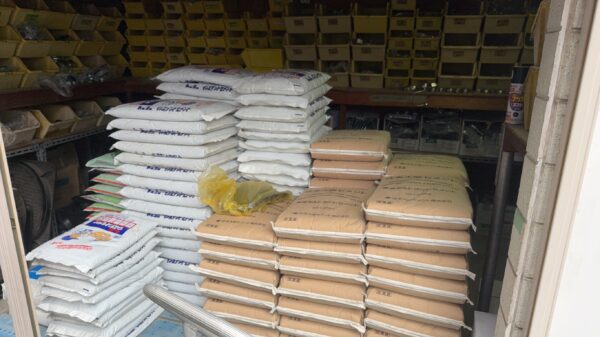
I recently bought some cement at a building materials store in Nagoya, and I was shocked by the price!
When I saw this, I couldn't help but go, "Huh!?" lol
Regular cement (25 kg per bag) costs 1,000 yen.
"Wait a minute," he said.
Don't you just think, "It's actually that much!?"
The things we use on site aren't just gradually...It's skyrocketingThat's the reality.
How much did regular cement cost to begin with?
Back when I first started using it on job sites (30 years ago), regular cement (25 kg per bag) was available at building supply storesIn the 350-yen range to around 400 yenThat's how it was. (Or so I seem to remember.)
I seem to recall that until a little while ago (around 2020), it was around 600 yen.
This is now 1,000 yen. (This is the retail price; ↑ is for bulk purchases.)
Based on the year 2020,According to the Bank of Japan’s Domestic Corporate Price Index, the price of cement rose by 56.61 TP3T as of May 2025 compared to 2020.is being recorded.
(Source: Bank of Japan, Corporate Goods Price Index, May 2025)
If you look at the numbers, it’s not a gradual increase at all.
It's all coming at once.
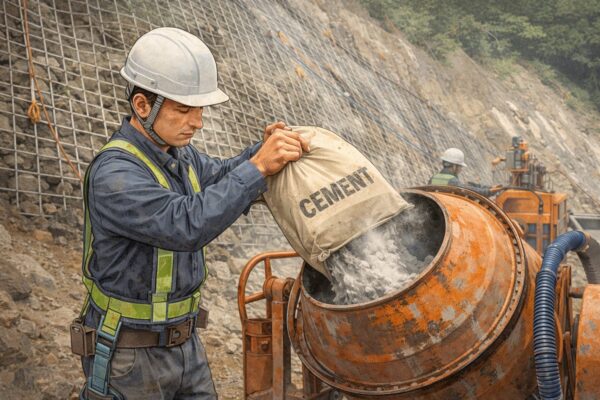
Why did it go up so much? The reason is clear.
If you just say, “Man, that got expensive,” and leave it at that, you’re a failure as a slope contractor, lol.
There's a good reason for that.
I looked it up lol (Google search & AI summary)
(1) Soaring coal prices
The production of ordinary cement requires a process in which limestone is calcined.
It takes about 130 kg of coal to produce 1 metric ton of cement.
It is said that, following Russia’s invasion of Ukraine in 2022, there was a period when coal prices surged to about five times their levels from the summer of 2021.
(Source: Construction Price Survey Association, a general incorporated foundation)
(2) The Yen's Continued Weakening
Coal is almost entirely imported.
Naturally, the weaker the yen becomes, the higher the cost of imported coal will rise.
③ Increase in Transportation Costs
In terms of the price structure for cement, it is said that transportation costs account for more than 30 percent of the total.
(Cement Association, “Current Status of Cement Supply”)
Due to a driver shortage and soaring fuel costs, transportation costs are skyrocketing.
A major cement company isA price increase of 2,000 to 2,200 yen per metric ton, effective April 2025Conducted.
(Construction Market Insights: Based on materials released by various cement companies)
Based on one bag (25 kg), a price increase of 2,000 yen per metric ton equals a price increase of 50 yen per bag.
All of that adds up to the current 1,000 yen.
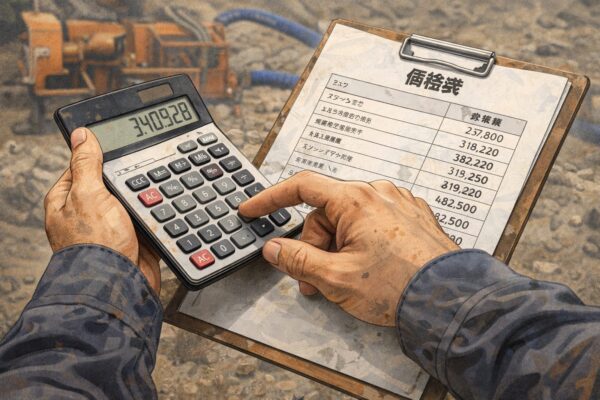
Let's calculate the actual impact on on-site costs
This is the part that civil engineers and slope engineers are most concerned about, isn't it?
Let's actually calculate this using sprayed mortar (t = 10 cm, mix ratio 1:4, 1,000 m²).
[Calculation Conditions]
・Mix ratio: 1 part cement to 4 parts sand (by weight)
・Installation thickness: t=10 cm
・Construction area: 1,000 m²
・Loss Rate: 20% (rebound and scrap losses)
・Market price (Aichi Prefecture): 8,770 yen/m²
① Cement consumption per 1 m³ (1:4 mix ratio)
The amount of cement per 1 m³ in a 1:4 mix isApproximately 420 kg/m³。
② Net design quantity (no loss)
1,000 m² × 0.10 m × 420 kg/m³ = 42,000 kg
③ Actual usage, including 201 TP and 3T losses
42,000 kg × 1.20 = 50,400 kg
④ Number of cement bags (25 kg per bag)
50,400 kg ÷ 25 kg = 2,016 bags
⑤ Comparison of Cement Costs
The era when one bag cost 500 yen (former price): 2,016 bags × 500 yen = 1,008,000 yen
1,000 yen per bag (current price at a Nagoya materials supplier): 2,016 bags × 1,000 yen = 2,016,000 yen
Difference: +1,008,000 yen (approximately 1 million yen)
What do you think of this?
It's just cement.
Sand prices are rising. Diesel prices remain high. Labor costs are also rising.
The market price of 8,770 yen per square meter is rising only gradually...
Despite this, the proportion of material costs is steadily rising.
This is about the figures that are "proof that prices are rising."
And this is proof that construction companies' profits are steadily declining.
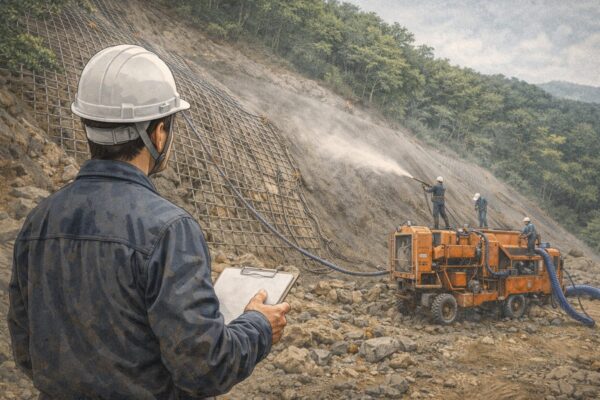
This isn't just "about cement"
I mentioned that the price of regular cement has risen to 1,000 yen, but this isn't just an isolated issue.
According to data from the Japan Federation of Construction Industries,The Construction Materials Price Index (Civil Engineering Sector) rose by more than 411 TP3T compared to January 2021....continues (as of December 2025).
Groceries, electricity bills, gas bills—everything is going up.
Energy costs, coal, transportation, labor costs… everything is going up at the same time.
This is "proof that prices are constantly rising."
So, if we contractors just shrug it off with a “Yeah, that’s right… that’s a problem,” then it’ll end up being a situation where only the companies with the most resources will survive.
Keeping track of these material movements with specific figures is crucial for everything from preparing estimates to negotiating unit prices with the general contractor.
Instead of just thinking, “I feel like prices have gone up a bit,”"Cement prices have risen by more than 561 TP3T compared to 2020. Therefore, we ask that you review the unit price."Whether we can have that conversation.
I think this is the turning point that will determine whether companies can survive in the construction industry today.
And it's still going up...
If we don't raise our market rates even a little more, there's a pretty good chance we won't be able to keep doing this work.
It’s predicted that an enormous number of companies will go out of business this year!
It doesn't make you "cheap" to be mindful of the cost of ingredients.
Accurately tracking on-site costs is directly linked to protecting the company.
In this era when cement costs 1,000 yen, before we just accept it as a matter of course,
Please take the time to thoroughly review your company's cost estimates and quotations.
See you later.